
“The only urban policy in North Lawndale over the last 30 or 40 years has been demolition,” argues Vincent Michael, SAIC director of the Historic Preservation program, in a conversation with F Newsmagazine. “Every problem gets solved with demolition.”
“The bulldozer [became] a tool of urban planning, public safety and law enforcement,” declared the Chicago Tribune in the 2003 article “A Squandered Heritage,” which criticized the demolition machine set in motion by then mayor Richard M. Daley. Preoccupied with the development of downtown and gentrifying neighborhoods, the city administration promoted rampant destruction in West and South Side neighborhoods.
“When you add another vacant lot to a neighborhood that already has too many vacant lots, it is reverse urban planning,” argues Fine.
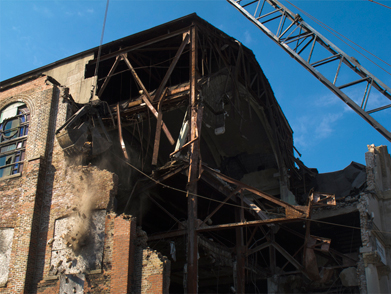
Photo by Jan Tichy
“I’ve lived here all my life,” community organizer and development consultant Valerie Leonard told F Newsmagazine. “When you live in a community that has been torn up from within by poverty, a community that has suffered long-term neglect both by people who live here and policy makers, a community that has fallen victim to the subprime mortgage crisis, just the thought of losing yet another building and having yet another vacant lot is tragic.
“When you lose this particular building, you will not just end up with a vacant lot on Douglas and Homan – you are actually going to end up with a hole an entire block long because half of 15th street is vacant lots. When this building is demolished, it is going to look like a bomb hit the boulevard. That is going to be very difficult for the neighborhood to recover from psychologically. Enough is enough.”
The activists began to develop a new plan for Shepherd’s Temple to celebrate the historical legacy of North Lawndale. They proposed to create a Martin Luther King Jr. museum. Leonard hoped the building would become a cultural center, a West Side hub. “We don’t have cultural centers on the West Side. I really think this has a negative impact on our kids and a negative impact on the adults. As cultural activities go, so goes the society.”
“The challenge with these inner-city buildings is that they’ve been falling apart for 20 years,” explains Michael, “so a problem you might have been able to solve for $100,000 20 years ago now costs $3 million because it has been getting worse over time. This is what happened to the Uptown Theater. You might ask, ‘How can you spend $60 million on a building?’ Well, you let the pipes freeze, you open up the roof and let it snow in there for 10 or 15 years, and the problem will get that big.”
Leonard admits that it will take a financial miracle to save 3411 W Douglas Boulevard: “Unless there is some angel that comes forth with $100,000 that we need to stabilize the building, Shepherd’s Temple is a goner.”
“It cannot always be about the cheapest way of doing something,” Fine explains to F Newsmagazine. “If you live in an enlightened, progressive society that values its historic architecture and cultivates the fabric of its neighborhoods, then sometimes you might end up spending more money, and in some cases more taxpayer money, to rehabilitate historic structures.”
The current owners of the building have had since 2007 to address building code violations. Their time ran out March 14. Five days later the red cranes and excavators of Heneghan Wrecking Company invaded the property. The grand façade of Anshe Kenesseth Israel now lies as a mountain of rubble.
Fine reflects on the effort to stave off demolition: “Unfortunately, it was a perfect storm. The problem was you had an owner who was not maintaining the building, you had a community whose history had been ignored for over 50 years, and you had a very difficult building type that did not lend itself easily to adaptive reuse.”
“We can’t rewrite history,” Fine laments, “but we can start planning for the future.” Preservation Chicago hopes to collaborate with the Commission on Chicago Landmarks and the Department of Housing and Economic Development to create a framework for the revitalization and reuse of vacant landmarks. Instead of building new facilities for libraries, schools and cultural centers, the city could invest in renovating existing historic structures.
Writer Gore Vidal warns of a United States of Amnesia, where we learn nothing because we remember nothing. Preservation is not about saving every old building, but preserving history.


















Thanks for the coverage, Annette. You did a great job of exploring the various perspectives. At the end of the day, I agree wholeheartedly with Gore Vidal’s sentiments. Another saying I like is “those who forget the past are condemned to repeat it.”
And politics reign in Lawndale. We are trying desperately to keep 3622 in tiptop shape. It is difficult. The building is so big and the beautiful high ceilings, original lighting, and domed roof are expensive to maintain. Hope someone can convince the city of the wonderful history that still remains in North Lawndale.
Anshe Kenesseth Israel Synagogue loomed over the elegant greystone houses along Douglas Boulevard. It was the largest of the 60 synagogues built on Chicago’s West Side.
This was not the largest synagogue.
Although the 3411 building has run into what you call the demolition machine. I think it rather unfair to blame city policy. Until recently, there was very little effort to keep or bring the building to a standard that would allow it to not make the demolition list. The effort to save the building was to little, to late.
As the Pastor of Stone Temple Church, with connections to both churches whom occupied 3411, we regret that the demolition ball has come. However, we cannot and should not blame it on city policy.
If there is no one who has the love and compassion to perserve and keep the building, the building will become run down and ultimately die. If these building are to be preserved those that “believe history is lost” should partner with those places to help secure funding that will help maintain the buildings, thereby keeping them away from the demoliton machine.
The First Roumanian Congregation moved to 3622 W. Douglas Blvd. in 1925 from the Maxwell Street area. The Stone Temple Missionary Baptist Church moved here in 1954.
We are still here and plan on being here for years to come. But, staying comes with a price that I’ve yet to see many outside of our building are willing to pay.