

I don’t know if words can express the feeling of watching Jane Schoenbrun’s films. I have a deep love for Schoenbrun’s work, despite finding it confusing — because being confused is the point. Or at least for me it is.
Schoebrun is a filmmaker from New York whose films often center horror, online spaces, and the queer experience. Schoenbrun has four feature-length films, including “I Saw The TV Glow”; a series in pre-production with Netflix; and a horror fiction novel to be released on Oct. 27.
Schoenbrun will be making an appearance at the Gene Siskel Film Center on Oct. 28 for a screening of their film “We’re all Going to the World’s Fair.” Attendees will all receive a signed copy of their new book “Public Access Afterworld.”
In 2018, before Schoenbrun was a well-known avantgarde filmmaker, they debuted “A Self-Induced Hallucination,” a feature film about the internet horror creepypasta Slenderman. It’s composed entirely of YouTube found footage about Slenderman.
“A Self-Induced Hallucination” is confusing, and potentially narrativeless. In its own way, it acts as an essay about the online obsession with creepypastas and analog horror. Because of the lack of a solid throughline or any created footage, the film is rambling. Maybe it’s about how the worship of horror characters is unhealthy for the youth on the internet to consume regularly. Who’s to say.
Schoenbrun’s film “We’re All Going to the World’s Fair” (2021) is commonly cited as their first film, and it was the first I watched. I viewed it on a laptop in my dorm room shortly after its release. I hated it. I found it meandering and pointlessly long.
But the premise stuck with me: a teenage girl tries to participate in a viral challenge that devolves into psychological trauma. I enjoyed the idea that the audience never gets to know how much the characters believe in “The World’s Fair,” but on some level, this film gives you almost nothing to hold on to, which makes it hard to really love.
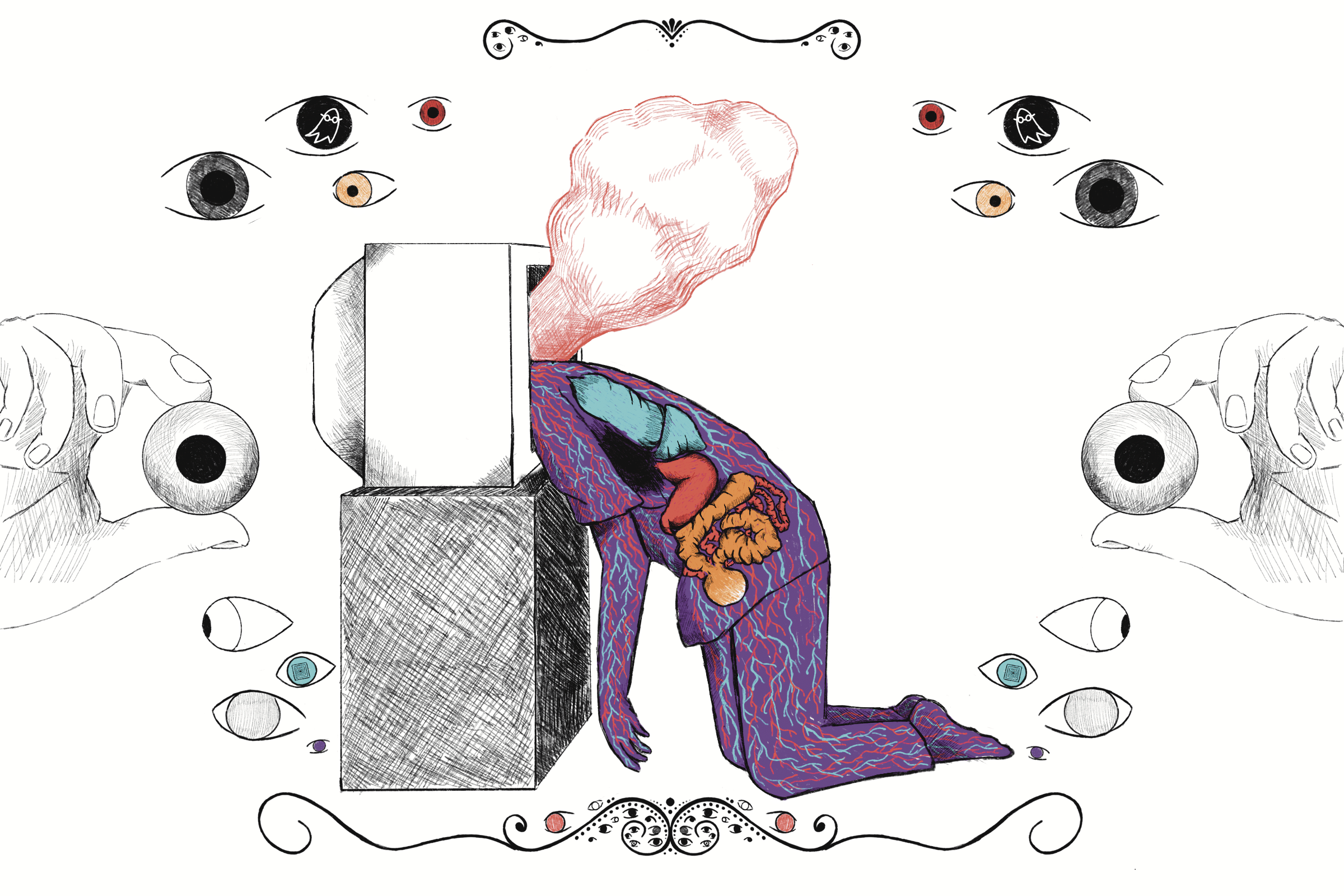
“I Saw the TV Glow” (2024) is the work Schoenbrun is best known for. Chances are (if you’re trans and insufferable), you’ve already watched it, seen clips of it online, or heard songs from the soundtrack.
The film follows Owen (Justice Smith) and Maddy (Jack Haven), two teenagers in the mid-90s who bond over their love of a tween show called “The Pink Opaque.” One night, Maddy disappears, and the show is canceled. Years later, Maddy returns, warning Owen that they are actually the main characters of “The Pink Opaque,” and he needs to bury himself alive to come back to life in their actual reality.
In the summer of 2024, I somehow convinced my mom to go see “I Saw the TV Glow” with me in an art house theater in LA. I adored what the film was trying to say, but in the moment, I didn’t really get it. My mom wouldn’t stop talking about how much she didn’t like it. She said that it was too slow, and not really a horror movie or a thriller, but an existential movie, and that made it worse somehow.
So a couple of years later, I decided to rewatch “I Saw the TV Glow,” alone in the dark, and not talk to my mom about it. This time, I loved it. Really, really loved it. Whatever wasn’t clicking before — the suggestive or ambiguous parts of the narrative — completely made sense to me. Yes, I still didn’t think it was perfect by any means, but it felt like it was saying what I needed it to say: “There is still time.”
“I Saw the TV Glow” is cerebral and existential, but that isn’t a bad thing, it’s actually what makes the film so moving. (And not for nothing, I listen to its terrific soundtrack almost every day now.)
Schoenbrun’s newest film, “Teenage Sex and Death at Camp Miasma,” was released on Aug. 7, and I saw it at the Gene Siskel Film Center. Unlike Schoenbrun’s other films, I instantly loved it. This film is a gorgeous blend of horror and comedy, with a deeper story about the trans horror archetype.
“Teenage Death and Sex at Camp Miasma” follows filmmaker Kris Williams (Hannah Einbinder), who is tasked with making the reboot of the in-universe film franchise “Camp Miasma.” In an effort to make the film, Kris meets the lead actress from the original “Camp Miasma” movie, Billy Presley (Gillian Anderson), who just so happens to live at the camp where the original film was set. Billy warns Kris that Little Death (Jack Haven), the serial killer from the film franchise, is real and also lives on the grounds. The two reenact the film together while simultaneously pursuing their romantic relationship.
“Teenage Sex and Death at Camp Miasma” feels like it was made exactly for me. Between the budding sapphic romance between Kris and Billy, the strange and often absurdist humor, and the subversion of the slasher horror genre, this movie had just about everything I could ask for.
But I still found it confusing. Not in a puzzling or cryptic way — in an endearing one. Anything unexplained felt like it wouldn’t have been better with clarity. After all, when have perfectly explained time travel or meta in-universe movies-within-movies ever been better with more elucidation?
After years of watching and re-watching Schoenbrun’s films, “Teenage Sex and Death at Camp Miasma” was the first I didn’t have to rewatch to understand fully, and that made me appreciate it so much more. Was it still somewhat confusing? Yes. But I think on some level, Schoenbrun’s work thrives on confusion, letting her messages and meaning simmer somewhere before you’ve even been given a chance to fully understand or digest them.