

Transcript:
Page 1:
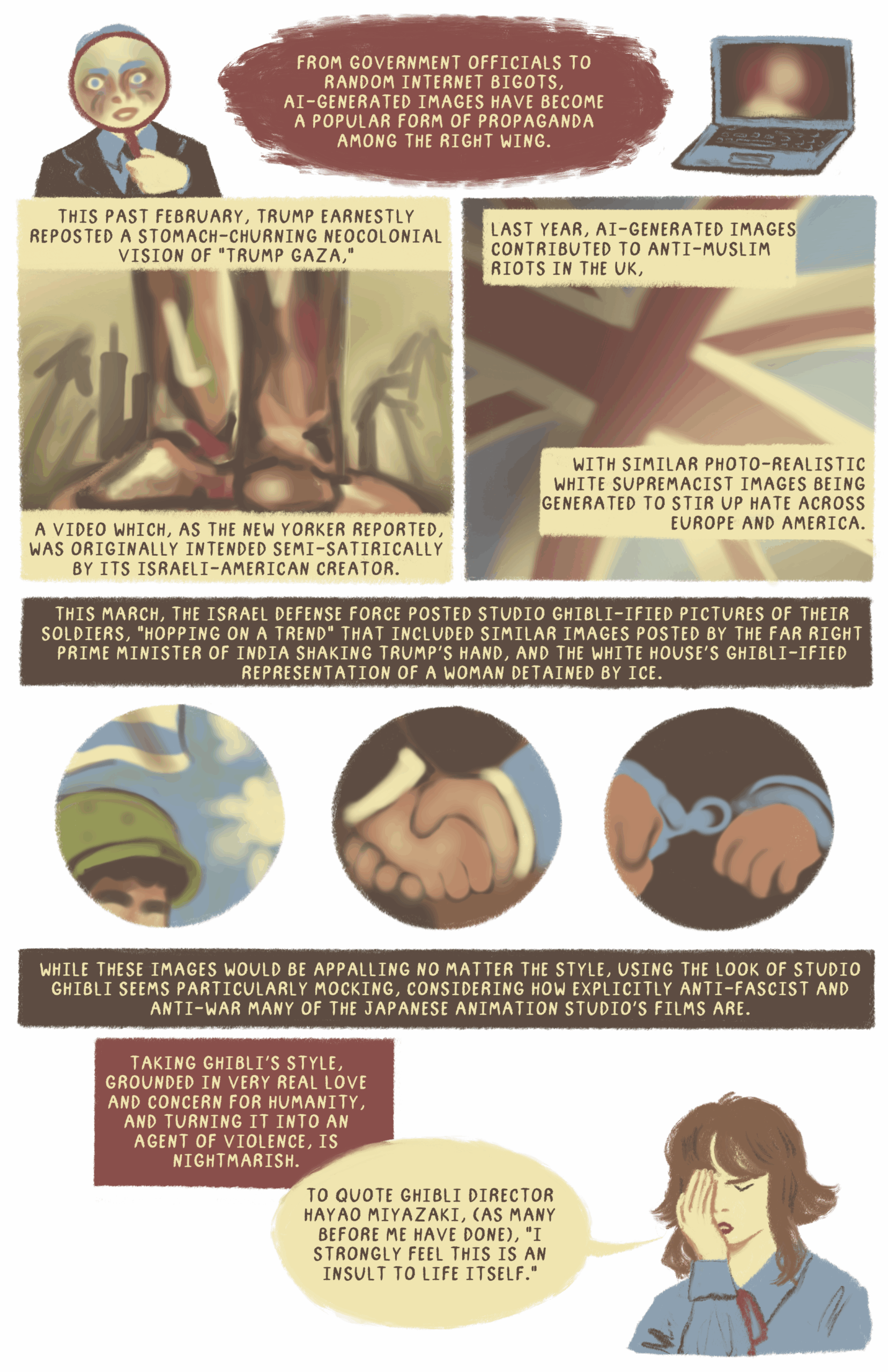
From government officials to random internet bigots, AI-generated images have become a popular form of image making among the right wing.
This past February, Trump earnestly reposted a stomach churning neocolonial vision of “Trump Gaza,” a video which, as The New Yorker reported, was originally intended semi-satirically by its Israeli-American creator.
Last year, AI-generated images contributed to Anti-Muslim riots in the UK, with similar photo-realistic white supremacist images being generated to stir up hate across Europe and America.
This March, the Israel Defence Forces posted Ghibli-ified images of their soldiers, “hopping on a trend” that included similar images posted by the far right prime minister of India shaking Trump’s hand, and the White House’s Ghibli-ified representation of a woman detained by ICE.
While these images would be appalling no matter the style, using the look of Studio Ghibli seems particularly mocking considering how explicitly anti-fascist and anti-war many of the Japanese Animation studio’s films are.
(in speech bubble): Taking that style, grounded in very real love and concern for humanity, and turning into an agent of violence, is nightmarish. To quote Ghibli director Hayao Miyazaki, (as many before me have done), I strongly feel this is an insult to life itself.
Page 2:
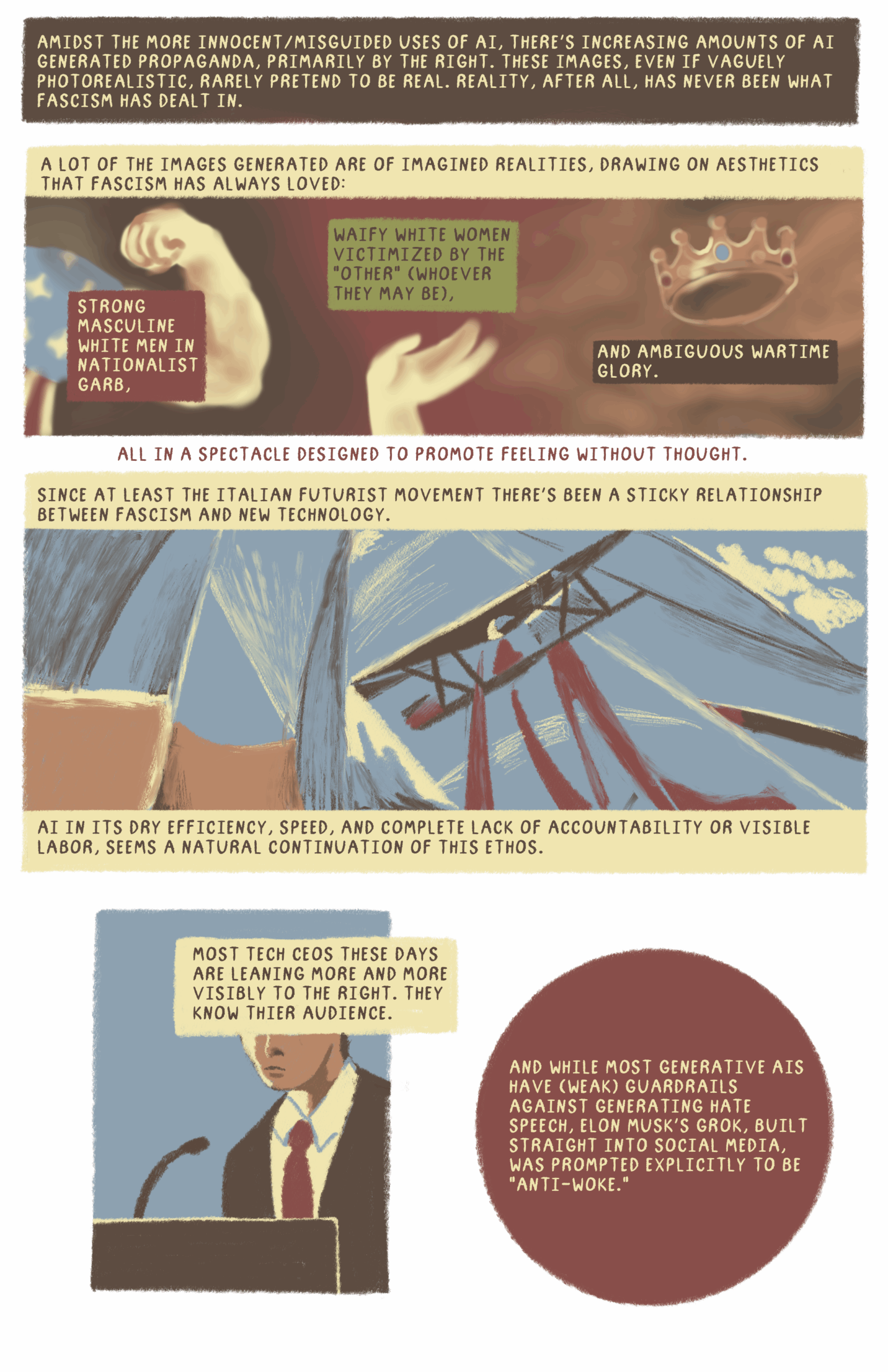
Among the more innocent/misguided uses of AI, we’re seeing more and more AI-generated propaganda, primarily by the right. These images, even if vaguely photorealistic, rarely pretend to be real. Reality, after all, has never been what fascism has dealt in.
A lot of the images generated are of imagined realities, drawing on aesthetics that fascism has always loved: strong masculine white men in nationalist garb, waify white women victimized by the “other” (whoever they may be), and ambiguous wartime glory. All in a spectacle designed to promote feeling without thought.
Since at least the Italian Futurist movement there’s been a sticky relationship between fascism and new technology.
AI in its dry efficiency, speed, and complete lack of accountability or visible labor, seems a natural continuation of this ethos.
Most tech CEOs these days are leaning more and more visibly to the right. They know their audience.
And while most generative AIs have (weak) guardrails against generating hate speech, Elon Musk’s Grok, built straight into social media, was prompted explicitly to be “Anti-woke.”
Page 3:
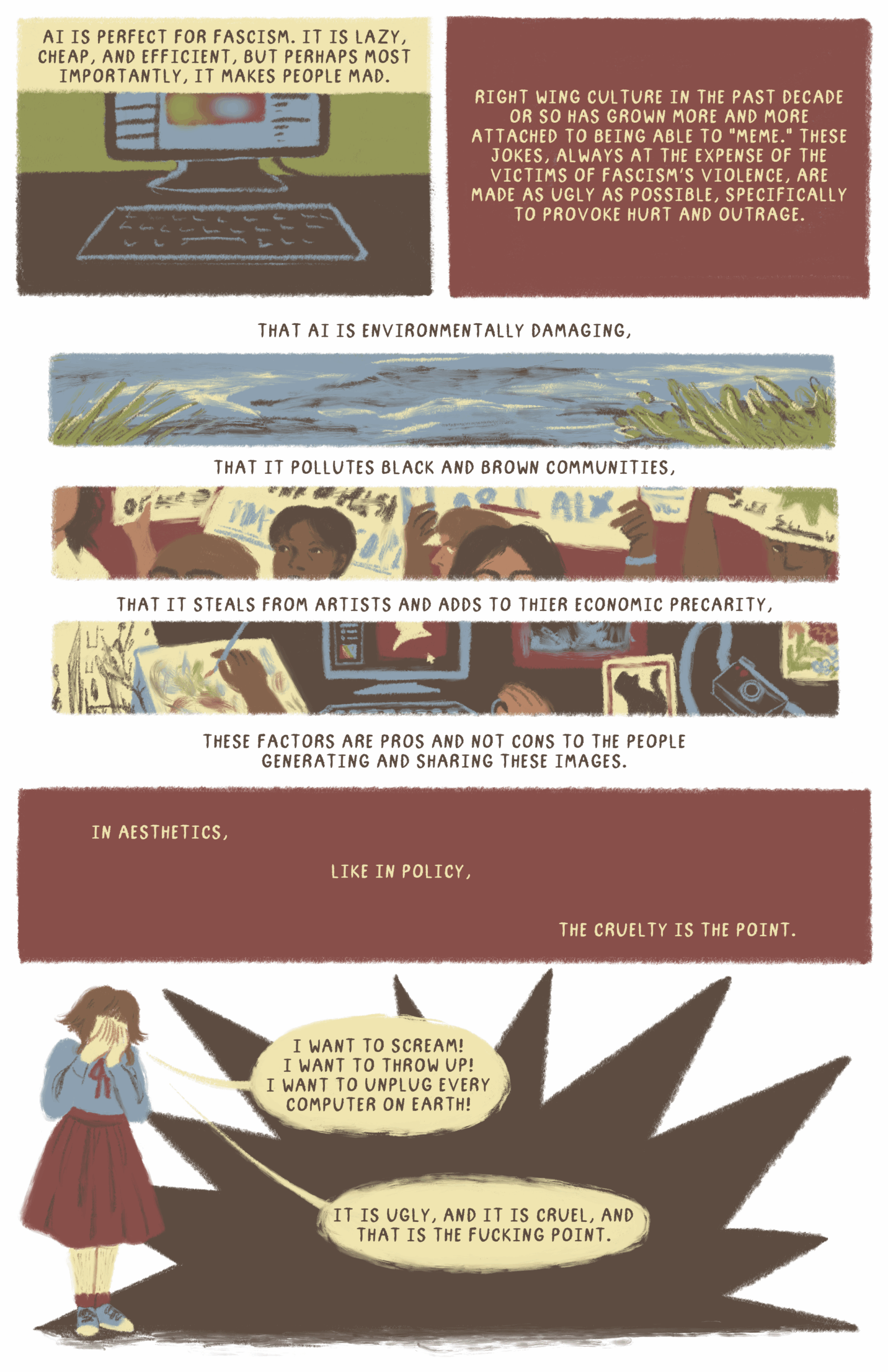
AI is perfect for facism. It is lazy, cheap, and efficient, but perhaps most importantly, it makes people mad.
Right-wing culture in the past decade or so has grown more and more attached to being able to “meme.” These jokes, always at the expense of the victims of facism’s violence, are made as ugly as possible, specifically to provoke hurt and outrage.
That AI is environmentally damaging, that it pollutes Black and Brown communities, that it steals from artists and adds to their economic precarity: these factors are pros and not cons to the people generating and sharing these images.
In aesthetics, like in policy, the cruelty is the point.
(in speech bubble):I want to scream! I want to throw up! I want to unplug every computer on Earth!
It is ugly, and it is cruel, and that is the fucking point.
Page 4:
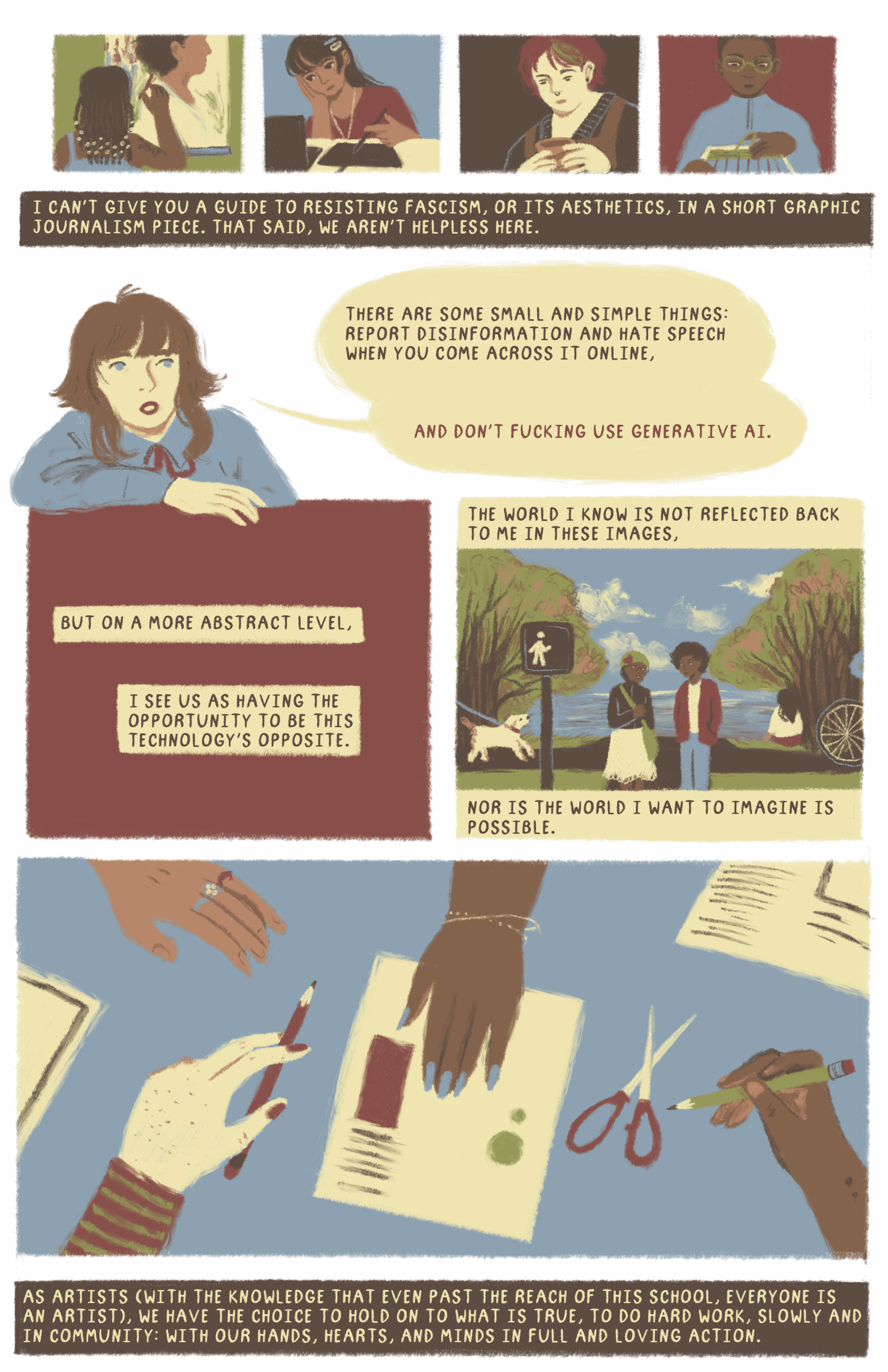
I can’t give you a guide to resisting fascism, or its aesthetics, in a short graphic journalism piece. That said, we aren’t helpless here.
There are some small and simple things: report disinformation and hate speech when you come across it online. And don’t fucking use generative AI.
But on a more abstract level, I see us as having the opportunity to be this technology’s opposite. The world I know is not reflected back to me in these generated images, nor is the world I want to imagine is possible.
As artists (with the knowledge that even past the reach of this school, everyone is an artist), we have the choice to hold on to what is true, to do hard work, slowly and in community: with our hands, hearts, and minds in full and loving action.