

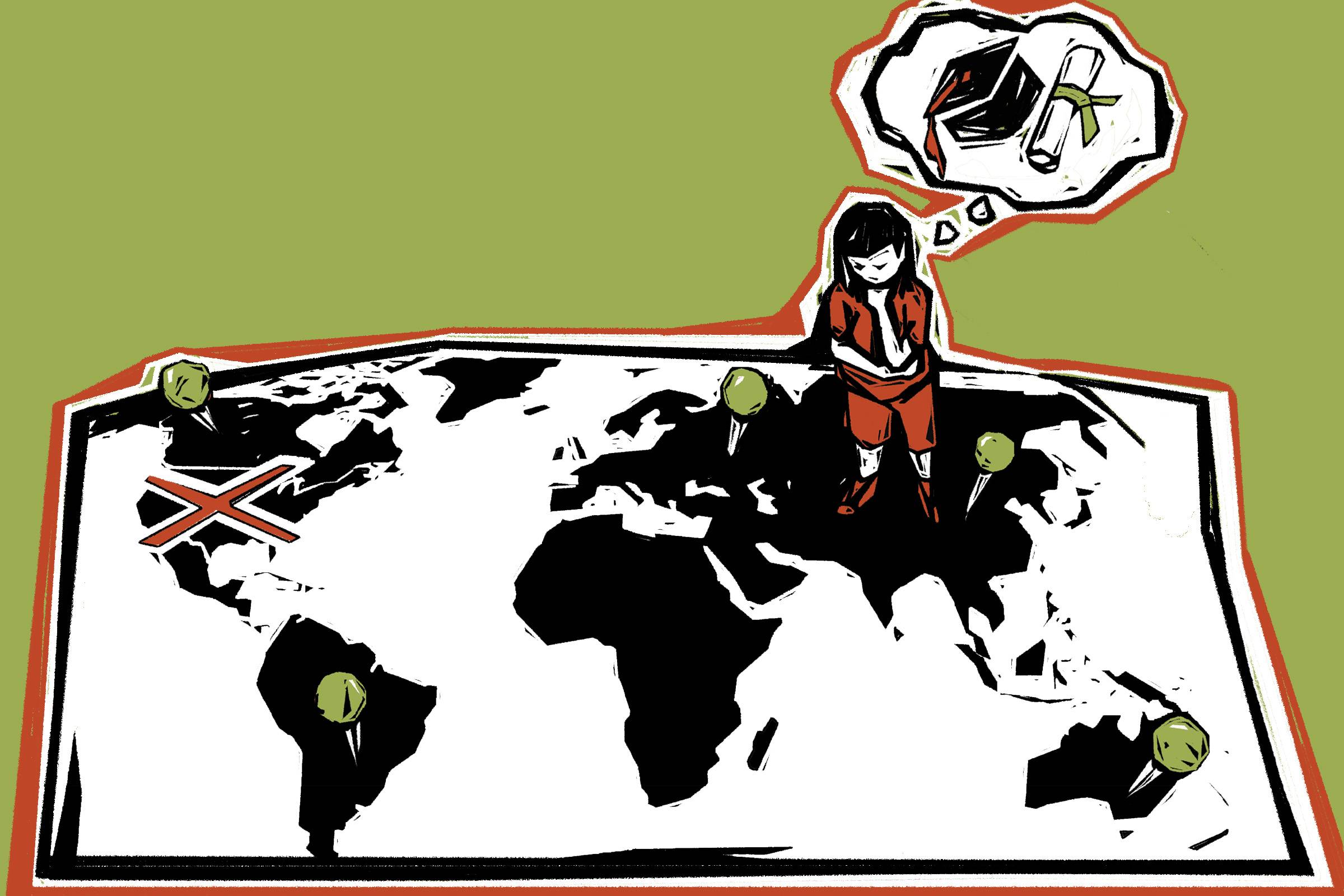
Unlike the chaotic executive orders of 2017, the Trump administration’s new wave of immigration restrictions is rolling out with fewer obstacles, and international students are among those most at risk.
On June 4, the Trump administration issued an executive order called “Restricting the Entry of Foreign Nationals to Protect the United States from Foreign Terrorists and Other National Security and Public Safety.” The order calls for a complete restriction of entry of foreign nationals from 12 countries, including Iran and the Republic of Congo, and a partial restriction of entry of foreign nationals from an additional seven countries, including Cuba and Venezuela.
According to the White House, the decision for a full or partial ban was based on a report generated by the secretary of state, the attorney general, the secretary of homeland security, and the director of national intelligence that identified “countries throughout the world for which vetting and screening information is so deficient as to warrant a full or partial suspension on the entry or admission of nationals from those countries.”
The Wall Street Journal reports a marked decrease in international enrollment at U.S. universities, particularly at the master’s degree level. I-94 data generated by the U.S. reflects a 28.5% decline in the number of international students arriving on visas to the United States in July 2025, as compared to July 2024. This data specifically pertains to the entry of international students into the U.S.
As reported by Forbes, part of this decline may be attributed to currently enrolled international students deciding not to leave the country for vacation or to visit their homes on the advice of their universities. Many universities, reportedly, issued such advisories to their international student communities in order to evade the possibility of the Trump administration blocking their re-entry.
NAFSA: Association of International Educators identifies the Trump administration’s travel ban on nationals of 19 countries. The temporary suspension of visa interviews and limited appointment availability are some of the key reasons for a decline in new international student enrollment in the Fall 2025.
Between May 27, 2025, and June 18, 2025, the peak visa issuance period for students seeking enrollment in U.S. institutions, student visa interviews were paused in accordance with directives from the Trump administration. Once the conducting of student visa interviews resumed, the U.S. Consulate was directed to implement new social media vetting procedures with rather scant guidelines. Consequently, this resulted in very limited, if any, appointment availability at the consulates in countries such as India, China, Nigeria, and Japan, among others. NAFSA reports that these bans and restrictions are likely to threaten an estimated $3 billion in annual contributions and approximately 25,000 American jobs.
In an interview with The Wall Street Journal, Wendy Wilford, the vice provost for international affairs at Cornell University, said, “How do you recruit the best and the brightest … when there’s an increasing perception of the U.S. as a highly unpredictable landscape for international students?”
The White House newsletter stated that it is taking these actions owing to reasons of national security and civil rights. In May 2025, the Secretary of State, Marco Rubio, explicitly called out Chinese students.
The newsletter also referred to the People’s Republic of China as one of the “adversaries” of the U.S. that is “exploiting the student visa program for improper purposes and by using visiting students to collect information at elite universities in the United States.”
So far, the State Department has revoked more than 6,000 international student visas, as detailed by the BBC in Aug. 2025. Some of the reasons cited include threats of academic espionage, support for Gaza, and alleged criminal behavior.
F Newsmagazine conducted a survey in order to gain insight into the concerns that the currently enrolled international student community at the School of the Art Institute of Chicago is grappling with. The responses, however, were few and far between, possibly owing to fear of retaliation.
The imminent challenges highlighted by the few students that did respond to the survey include visa status, unlawful deportation, uncertainty with regard to the Optional Practical Training program, concerns for personal safety, inability to visit home for fear of not being allowed to re-enter the country, and inability to exercise free speech.
SAIC’s administration has not yet released information about the final number of students enrolled in the school for Fall 2025, given that the deadline for adding and dropping classes passed on Sept. 5. The gathering, analysis, and estimation of this data is likely to conclude in October.