


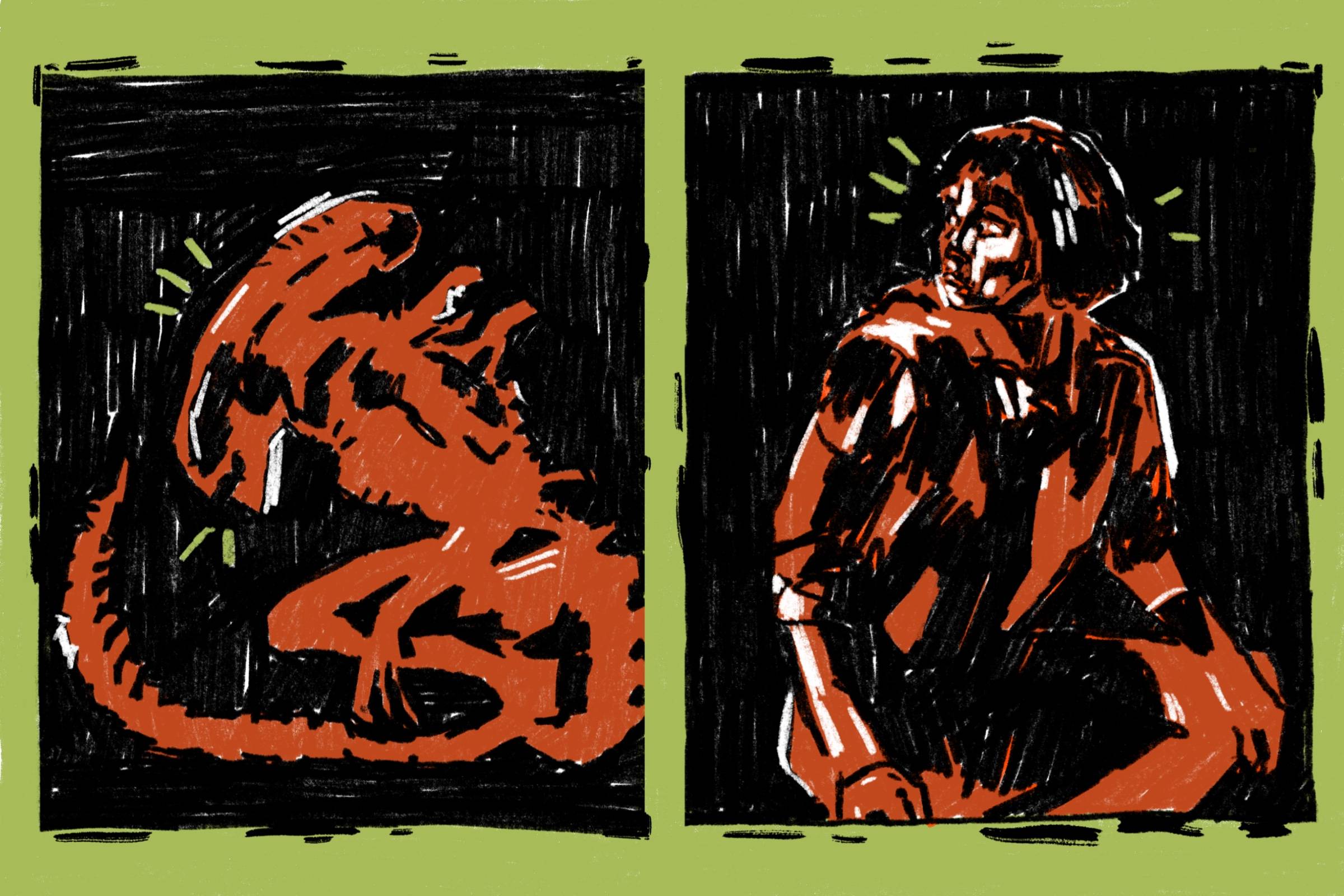
“Alien,” as a franchise, has always been fascinated by monsters. In the 46 years since the original 1997 Ridley Scott film, the monster that dominated the screen was the Xenomorph. It served as metaphor for sexual assault and was carried by an iconic Geiger-inspired design. Since the first film, there have been few alterations to the monsters of its world. There is almost a formula to making an “Alien” movie.
The newest installment in the “Alien” franchise, a television series called “Alien: Earth,” debuted in August on Hulu. This series, created and co-directed by Noah Hawley, gives us more monsters to go bump in the night.
“Alien: Earth” takes place after “Alien: Romulus” and before the events of “Alien.” However, you don’t need to have watched any “Alien” movie to enjoy the show, as a lot of its worldbuilding is unique.
The show’s biggest distinction from the films, by far, is location. Unlike the films, “Alien: Earth” doesn’t take place somewhere vague in space or on a distant planet. As the title suggests, the bulk of the plot takes place on Earth.
In the far future, humanity is governed by five corporations after democracy “didn’t work.” “Alien” has always been about living under a corporate regime. The first film prioritizes capturing the Xenomorph over the safety of the crew. “Alien: Earth” takes a page from Apple TV’s “Severance,” with characters owned by corporations and no possibility of a life outside of them.
The inciting incident of this bloody spectacle is two-pronged. First, humans have discovered a way to upload the consciousness of children into synthetic bodies. Unlike cyborgs, who are part human, and androids, which are purely synthetic, these hybrids offer the first chance at immortality humanity has ever seen. Second, a deep space research vessel is on a collision course with Earth, containing specimens from other planets, including Xenomorph eggs.
These other specimens add a sense of mystery to the series, as audiences by now know the Xenomorph and its abilities. There is a deeper focus on the characters’ lack of agency, including the specimens. The hybrid children are owned by a corporation called Prodigy, and as episodes progress, it becomes clear that the hybrids carry more kinship with the alien specimens than human beings.
The fact that the aliens aren’t the only monsters helps electrify this show. A cyborg named Morrow, in an attempt to procure a Xenomorph for his own corporation, Weyland-Yutani, begins secretly speaking to one of the hybrids. Remember: the hybrids are children, and this one has no idea how closely monitored he is by Morrow. It creates this interesting and unnerving chemistry on screen, watching a child be groomed to be an accomplice in a murder.
As I watched “Alien: Earth,” I kept thinking about the fact that, despite it being science fiction, the body swap had already happened in real life, years before the idea of the show was concocted. In the 1970s, brain surgeon Robert J. White performed the first ever head transplant between two rhesus monkeys.
In 2007, a girl had to have her left hemisphere removed from her brain due to complications in the womb nine months after being born. Thanks to a phenomenon known as neural plasticity, she was able to walk and talk like normal because her brain was making so many new connections.
The hybrids of “Alien: Earth” are simply uploaded from meat bodies into silicone ones, but the idea of an immortal human is getting closer to science and further from fiction.
What made “Alien” a movie audiences kept coming back to was the mystery of this world and navigating it just enough to know what was happening, but not enough to know what would happen next. “Alien: Earth” does a fantastic job pulling back the curtain on the world of “Alien” and gives us a stage where everything a casual viewer knows only heightens the tension of what could happen in any given episode.