


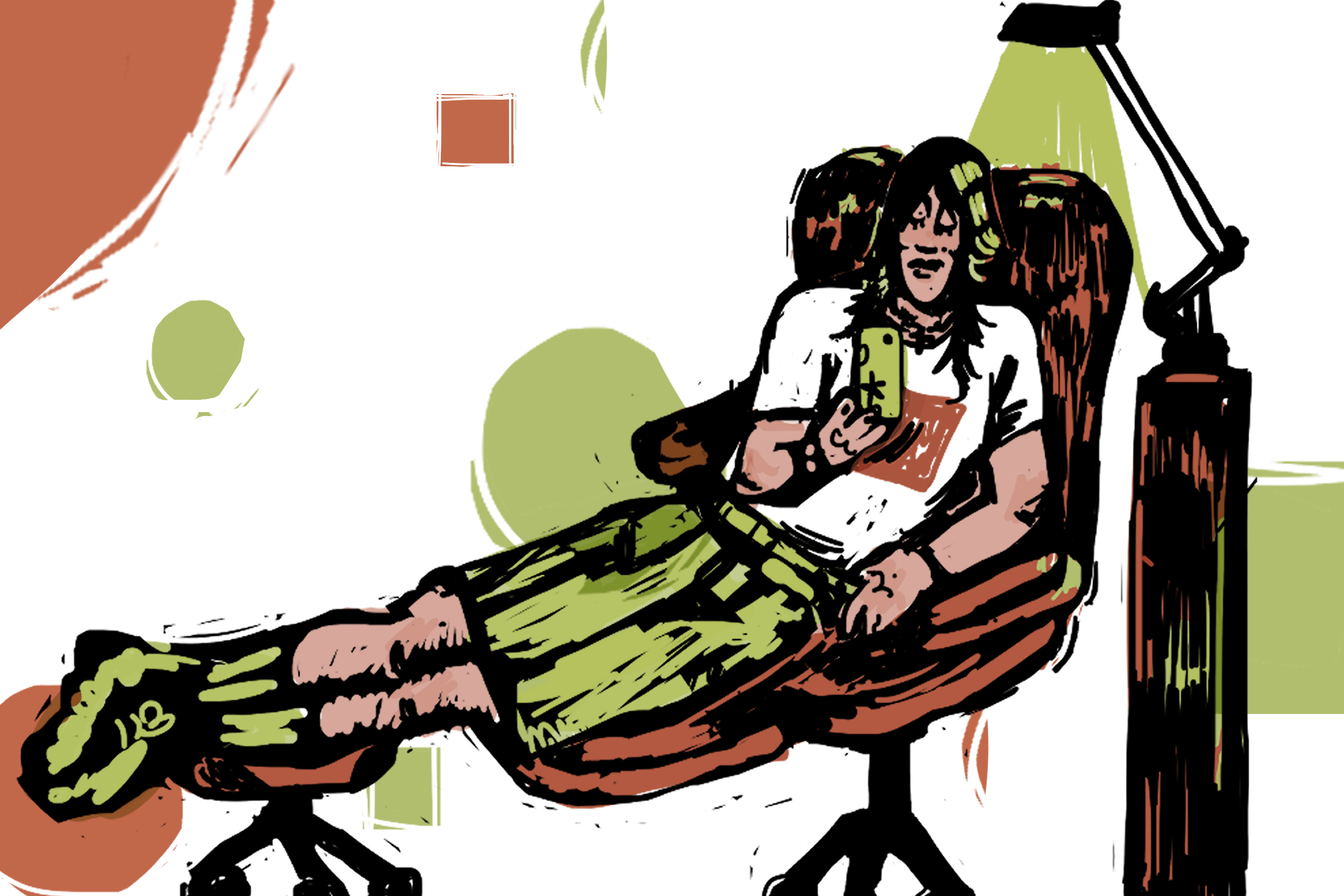
Gen Z grew up swiping, scrolling, and syncing, but somehow, all we want now is a chunky flip phone, a record player, and a velvet armchair shaped like a seashell.
Has Gen Z turned its back on modern technology? Obviously not. We still live online, but we love the vintage aesthetic. In a world full of mass production and stripped-down minimalism, I think we just miss color.
During and after the COVID-19 pandemic, everything felt gray – not just emotionally, but visually, too. Isolated in our homes, surrounded by neutral walls and endless screens, people craved stimulation and comfort. Bringing back ultra-pop color, like the highly-saturated pinks and oranges and playful energy of the 1970s, felt less like a trend and more like a way to cope. It made things feel warm, alive, and personal again.
As a design student, I’ve noticed this shift showing up everywhere: in moodboards, in studio critiques, and even in the kinds of objects my peers are drawn to making. There’s a real pull toward softness, texture, and nostalgia. Curves are back. So are glossy plastics, tinted glass, and fuzzy fabrics. People want their spaces and products to feel fun and warm again, not cold or overly functional.
You see it in the little things: the once-tacky glass blocks; those thick, translucent bricks that let in light while distorting it, are now trending on TikTok; people are customizing their old iPods, and the popularity of wavy mirrors and colorful tiling is on the rise. These choices go beyond aesthetics and resonate emotionally. They’re warm, tactile, and a little weird – and that’s the point. We are slowly phasing out the millennial gray. (Sorry, millennials.)
Mid-century and retro design offer something minimalism never could: emotional depth through form. Where minimalism often prioritizes restraint, neutrality, and reduction, retro design leans into expression. Objects from the mid-century era, like the Eames lounge chair, the Braun SK4 record player, or the Tizio lamp, weren’t just about solving a function; they were about shaping how a space felt. These designs embraced visual weight, color, and playful geometry, creating environments that were as emotionally engaging as they were practical.
Maximalism, at its core, isn’t about excess. It’s about narrative. It allows objects to hold presence, to say something, and to connect with people on a sensory and personal level. In contrast to the anonymity of minimalist design, maximalism reintroduces intimacy and identity into the everyday.
Gen Z has grown up surrounded by screens, cloud storage, and frictionless everything. So it makes sense that we’re reaching for objects that feel grounded, a bit imperfect, and proudly analog. There’s something special about turning a dial or flipping open a phone; it slows you down. These tactile moments feel more deliberate.
Brands are picking up on this shift. In 2019, Nokia re-released the 2720 Flip, their first flip phone in over a decade. The product wasn’t designed as a gimmick, but as an alternative to smartphones, with just enough features to stay connected without falling into the endless scroll.
To many young people, it feels like the physical version of setting a boundary. Fujifilm’s Instax cameras and Canon’s digital point-and-shoots are suddenly everywhere again, not just because they’re cute, but because they force you to stay in the moment. No endless retakes, no front cam checks, just click and go. There’s this quiet rebellion happening against hyper-efficiency. We’re choosing slower tech, mood lighting, objects that take up space. Design today is about shaping a life that feels more human and alive.
Retro doesn’t cancel out innovation. Gen Z can love the warmth of vinyl, the charm of flip phones, and the tactility of glass blocks and still be the first to experiment with AI. Maybe that’s the real Gen Z aesthetic: curating moments where the analog slows us down, while the digital keeps us moving. It’s analog vibes with digital efficiency. We’re not fully unplugging. We’re just choosing when and how to plug in.