

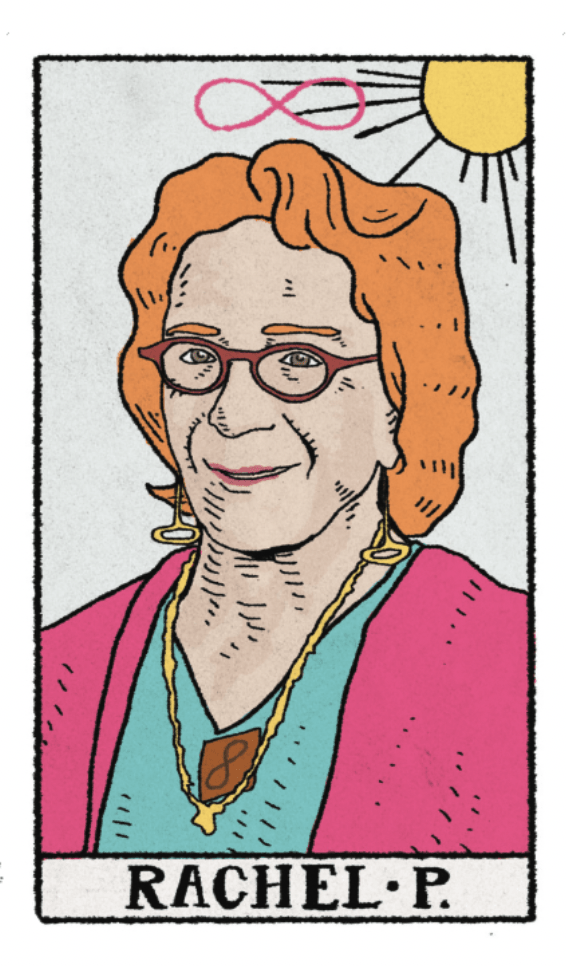
“Recently I was thinking about what epitaph I might want if I had a tombstone. … Finally, I came to something more simple and more personal — Story. It’s all story.”
— Rachel Pollack, writing for World Tarot Day, May 25, 2015
On April 7, transgender activist, Tarot expert, teacher, and science-fiction writer Rachel Pollack passed away at age 77 after a long battle with cancer. Pollack had an illustrious career, including writing the first openly transgender superhero, penning over 40 books, having been nominated for a Nebula Award, and working as a leading voice and teacher within the Tarot community. Pollack passed in her home in Rhinebeck, New York, with her friends and wife, Zoe Matoff, surrounding her. The news was announced publicly on Twitter by fellow writer and friend of 38 years, Neil Gaiman, on the day of her passing.
Pollack’s headstone will be placed on the first year anniversary of her death, as is Jewish tradition. So though we cannot yet know how Pollack’s epitaph will ultimately read, her own words about imagining what it could be ring true. Rachel Pollack’s life was story, and quite a story at that.
Conceptual, research-based artist Tiona Nekkia McClodden has written on the idea of posthumous caretaking and the way that younger generations can care for and hold up the life and works of queer artists and writers who came before us. Rachel Pollack’s life and art demands to be remembered.
To understand Rachel Pollack’s literary body of work, one must first understand her personal history. Pollack was born on August 17th, 1945 to a Jewish family in Brooklyn, New York. She went to New York University for her undergraduate English degree and earned her master’s at Claremont Graduate University in California. But in many ways, it wasn’t until 1971 that she really became Rachel.
At age 26, in the spring of 1971, Rachel Pollack went through a transition in her writing, spirituality, and identity. She published her first short story, “Pandora’s Bust,” in the “New Worlds Quarterly” science fiction magazine. At this time, she was also introduced to Tarot, which opened doors for her and defined her career. By 1980, she would publish “Seventy-Eight Degrees of Wisdom,” a landmark non-fiction Tarot-based book that came to be known as “the bible for Tarot readers.” Pollack once explained in an interview that she “sees [herself] as reading the cards, a card reader rather than a psychic, or a therapist. The cards began as a game, and this gives us permission to be playful and try new things.”
The biggest change that 1971 brought, of course, was Rachel’s gender and sexuality. It was then that she came out as a trans woman and a lesbian. In an essay reflecting on this time from her collection “The Beatrix Gates,” Pollack wrote, “I did not want to be a woman. I already was.”
1993 saw a new addition to Rachel Pollack’s life: her comic book debut. Pollack was the first transgender woman to write for a mainstream comic publisher, where she created Kate “Coagula” Godwin, “the first superhero to save the world with the power of being transsexual.” Coagula, whose powers were to dissolve or coagulate anything, was featured in DC’s “Doom Patrol,” for which Pollack was the writer from 1993 to 1995, having taken over for Grant Morrison after he left the series. “Doom Patrol,”originally created in the 1960s and continuing to run today, is a series that, as Rachel put it, “was all about people that had problems with their bodies.” Compared to contemporary trans characters in the comic book world, Kate’s character holds an elegance and nuance others fail to live up to. Most recently, Coagula made a return to the page in the “DC Pride 2022” special last June.
Before her passing, in the late summer of 2022, her family organized a GoFundMe for the 24-hour in-home care she would need. Well-known writers and artists such as Gail Simone, Gaiman, and Shelly Bond spread the news about the situation, and others like Cliff Chiang and Martha Thomases made significant donations. The goal was $15,000, and they raised over $30,000. After her passing, the GoFundMe has been updated to raise money for her headstone and memorial. The world is worse off for having lost Rachel Pollack, but after over half a decade of health complications, there is comfort in knowing she can rest now.
As I worked on this article, I did a Tarot reading, ruminating on Rachel’s legacy. I pulled the Ace of Wands, the Ten of Swords, and the King of Wands. The Ace, representing her life, speaks to a story of inspiration and creative spark. The Ten of Swords, which I read as her passing, is rest after a long time of fighting: It is an end, but also the chance to begin again. And finally, the King of Wands: Pollack’s legacy was as a leader within the queer community, the writing community, and the Tarot community. She was someone to look up to and hold in our hearts.
Rachel Pollack was a woman of stories, activism, and strength. As I opened with her words, it only felt right to close with them as well. In her 1995 essay, “Archetypal Transsexuality,” Pollack wrote about where trans and the divine meet: “Transsexuality comes to us with all the power of a divine force that will not be denied. If we recognize it and accept it as a true vision of the self then we may find it opens us to a life of spirituality and joy.”