

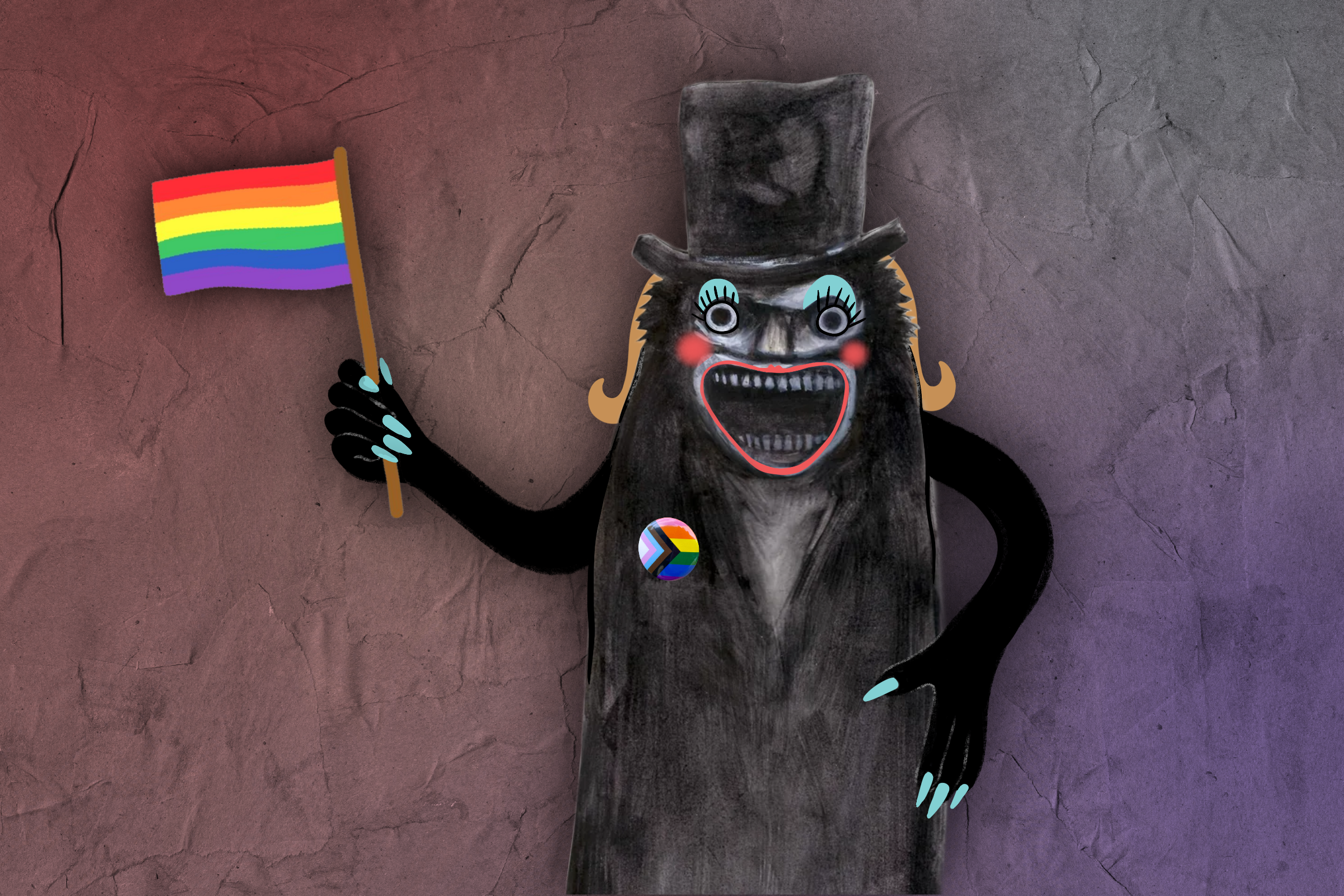
Imagine a cold, scary October night; you’ve just gotten home from watching “The Babadook” for the first time with your friends. You’re frankly still a little freaked out, but also interested in the movie’s history. You decide to Google the movie to learn more about its background… and find an onslaught of photos of the Babadook wielding a pride flag, and people saying he’s a gay icon, which is confusing because when most people think of gay icons, they would think of RuPaul, Cher, Prince, Dolly Parton, and honestly anyone other than a scary monster in the corner of your bedroom wearing a top hat. That is the story of my discovery of this humorous pairing of horror and queer activism. So, when my roommate asked me a couple of weeks ago if I wanted to rewatch “The Babadook” with him for a class, I responded, “Oh, I KNOW Baba, he is THE king of gays.” I was, however, met with immense confusion and a new opportunity to share the origins of my favorite queer icon with my friends.
“The Babadook” (vague spoilers incoming!) is a film about a widowed mother, Amelia, and her son, Samuel, who are haunted by the titular Babadook. He first appears in their lives as a book that Samuel picks out to have his mother read to him at bedtime. After realizing that it’s not a typical children’s book and is instead rather disturbing, Amelia throws it out, but it continuously reappears in their home. As the film goes on, Amelia becomes more and more distraught due to the haunting, and is eventually possessed. She and her son are then able to protect each other, and keep the Babadook in their basement. Many attribute “The Babadook” to being a story about how grief can take over someone’s life and affect the relationships around them, even ruining them. For example, Amelia wouldn’t celebrate Samuel’s birthday on the actual day because it was the day her husband died. Rather than acknowledging how her grief affected Samuel, she ignored it, and it started to cause him behavioral issues which affected Samuel and Amelia’s relationship. After all that happened with the Babadook, Amelia seemed to have learned how to understand herself, her relationship with Samuel, and the grief she had for her husband. We can see that reflected in how, at the end of the movie, she celebrates Samuel’s birthday on his actual birthday.
While usually a movie you might think of enjoying for the yearly spooky season, “The Babadook” was somehow in Netflix’s 2016 Pride film section for one Tumblr user who later posted it. While I wasn’t able to find a definite answer on whether this was a mistake that caused the film to actually end up in the Pride section, or if it was an edited image, it is what’s believed to be the start of the Babadook’s coming-out story. The post later blew up on Tumblr, leading people all over the internet to embrace their new homosexual hero.
Internet users then started to draw comparisons between the Babadook’s experience and queer people’s experiences in various ways. One main comparison is that he lived in the basement closet, and as many of us know, “the closet” is a term the queer community uses as a way to say someone isn’t out yet. Journalist John Paul Brammer once said, as quoted from an article by Alex Abad-Santos via Vox, “Haunting a small white family in an Australian suburb is a radical act, and the Babadook did that.” Which is true; the Babadook was breaking the norm just like many other queer people. Even the Babadook’s physical traits can be considered as such. I mean, when was the last time you saw a straight man donning a top hat, black lipstick, eyeshadow, beautiful long nails, and a fabulous trench coat? Or maybe he was a drag queen who took their Abraham Lincoln-inspired look too far. Truthfully, the Babadook just wants to be himself, but people fear him when he’s, in all honesty, a silly guy who just lurks about. (This take is subjective, of course.)
Even though the story of the Babadook’s rise to queer fame happened nine years ago now, and he is no longer in the spotlight, I think it’s fun to look back at the story and see how the LGBTQ+ community took the Babadook and made him one of their own. His queer legacy still lives on in the occasional yassified Babadook cosplay at Pride festivals and Halloween celebrations; such contributions to this interpretation can be found in recent years’ Tumblr posts. So, for this upcoming Halloween, when you gear up to watch a scary movie, maybe throw on “The Babadook” and remember that he’s not as scary as he seems — he’s just a little gay guy trying to make his way in the world, just like you and me.