

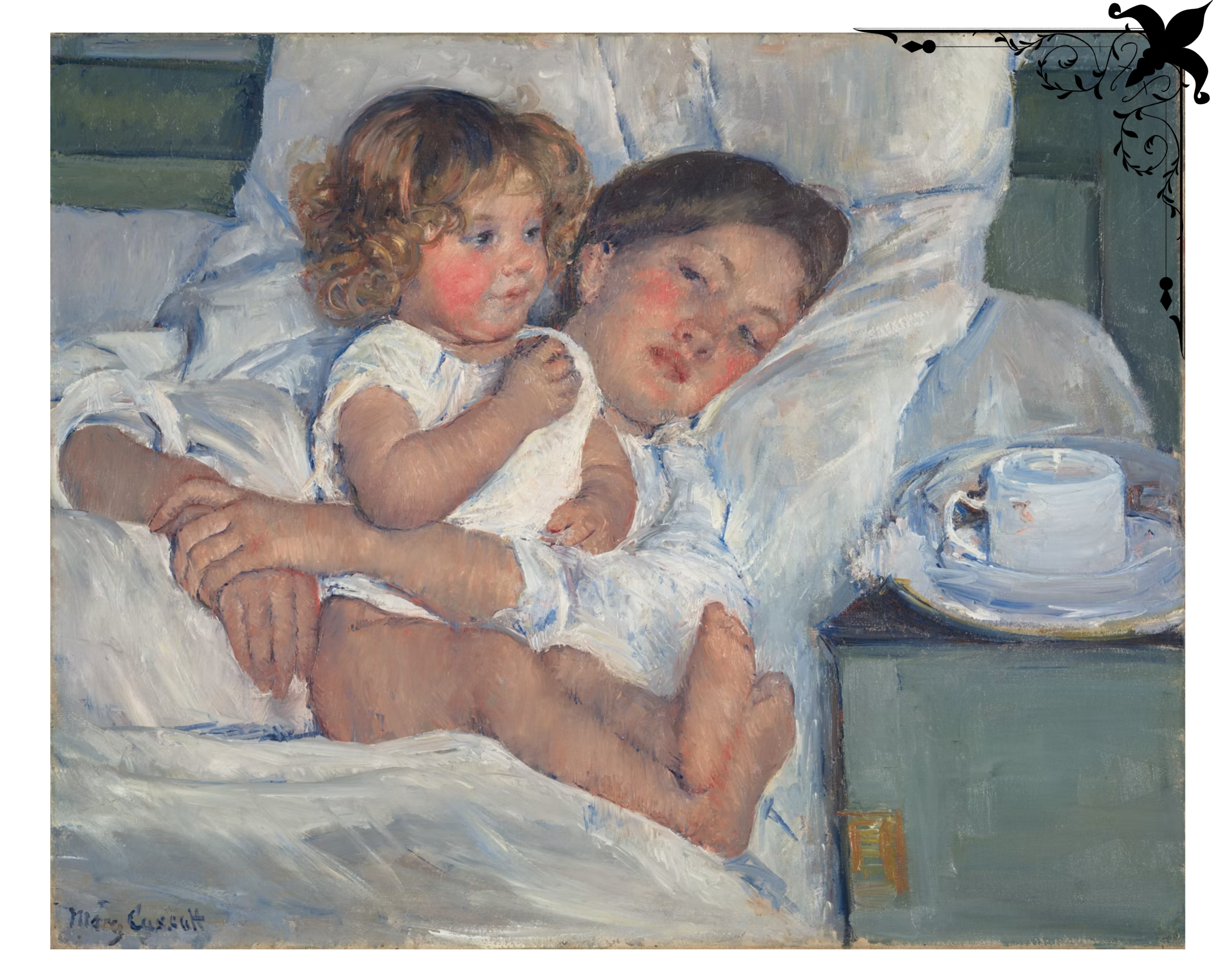
At first glance, Mary Cassatt and Lee Miller don’t seem to have much in common, but when visiting the two galleries, “Mary Cassatt: After Impressionism” and “Lee Miller: Fearless” at the Art Institute of Chicago in succession, it’s hard not to see a connection between the two.
The Cassatt exhibition contains some of the painter’s best-known works as the only American among the Impressionist group in 19th century Paris. The exhibit’s primary focus is on her foray into new mediums, taking inspiration from Japanese prints (some of which are also displayed in the exhibit to provide visual parallels and context).
Miller grew up during Cassatt’s lesser-known post-Impressionist career, and she rose to artistic prominence around the time of Cassatt’s death. It’s tempting to think of the two exhibits as something like the passing of a torch: Miller begins where Cassatt ends.
Miller, born in 1907, saw her career flourish as a model, the muse of Man Ray, and as a Surrealist photographer and photojournalist. Miller’s work was a perfect capture of the 20th century, whether she was photographing abstract and erotic shapes or the devastation of Europe during World War II. Cassatt’s work was emblematic of the transitional, experimental attitudes of the end of the 19th century.
Of course, while they complement each other, both exhibits hold their own and are well worth a visit, not just as two dots on a timeline of female artists in nineteenth and twentieth century creative thought.
Unfortunately, the Cassatt exhibit is impaired by its layout decisions. Due to heavy advertising and Cassatt’s popularity, crowds flocked to the special exhibition gallery, and gave something of the effect of the Red Line at rush hour. It was fairly difficult to actually spend time engaging in Cassatt’s work, because with dozens of fellow museumgoers craning their necks and pushing their way through the galleries, there was a constant pressure to keep moving swiftly. The somewhat confusing curatorial and layout decisions did not help, either; the order in which one was supposed to view the exhibition felt unclear, and the flow was more chaotic than cohesive.
The softness and intimacy of Cassatt’s work was not because of a lack of innovation or her chosen subject matter of women and children. One piece of exhibit text reads “Portraying traditional subjects of femininity, while committed to avant-garde expression, Cassatt innovated in unexpected places … She showcased a remarkable economy of line in her prints, high-key color and vigorous brushwork in her paintings, and a heightened sense of movement and touch with her strokes of pastel.”
There is a real excitement and intimacy in Cassatt’s paintings underneath the softness, and this only becomes more evident in her later work — especially her prints inspired by Japanese art. I left the Cassatt exhibition with a newfound appreciation for her work, and a sense that it was not only soft around the edges, sentimental and domestic, as I had initially seen it.
If Cassatt was notable for bringing a female perspective to the boys’ club of turn-of-the-century Impressionist art, Miller’s work was emblematic of the changing attitudes toward women and female artists in the changing world that followed.
Exhibit text reads that Miller “became a poster child for the Roaring Twenties, when lithe figures and boyish styles symbolized greater freedoms for women.” Nearly all of her photographs, whether erotically-tinged portraits of herself, Man Ray, and her fellow artists; images of churches and rooftops from her time in Cairo; or even an image of a condom stretched over a hand; are high-contrast, stark, and hard-edged, like the boxiness of a tailored 1920s silhouette.
The end of the Miller exhibit contains something particularly unsettling and brutal. A wall label explains that, even as the war was ending, some people were already dismissing reports of Nazi atrocities as propaganda or a hoax. Miller, who witnessed and photographed the camps firsthand, understood her work as crucial evidence of what had actually happened. “I IMPLORE YOU TO BELIEVE THAT THIS IS TRUE,” she wired to her London editor, Audrey Withers.
At a time when denial of the Nazi Holocaust is unfortunately growing in popularity, especially among young people who have not encountered the testimonies of survivors in person and for whom it has quickly become ancient history, Miller’s comment comes as a stark and frightening prediction.
Like Cassatt, Miller was known for portraiture, and many of the subjects she photographed were part of the artistic scene of the first half of the 20th century. However, unlike Cassatt, Miller did not often favor children as a subject, with one notable exception. When on assignment as a war correspondent in Europe during World War II, she took photographs of children begging on the streets of Budapest. One particularly disturbing, “Zone-of-Interest”-esque photograph shows two German children playing in their garden bomb shelter. The children’s parents owned a factory maintained by slave labor.
“I’m taking a lot of kid pictures,” Miller said, “because they are the only ones for whom there is any hope… and also we might as well have a look at who we’re going to fight twenty years from now.”
Of course, one can visit just the Cassatt or just the Miller exhibit, but I believe the two are best experienced in conversation with each other. Any visitor to these two galleries will walk away with a sense of the vast changes in art, aesthetic sensibilities, women’s liberation, and history that occurred between Cassatt’s prime and Miller’s.
“Mary Cassatt: After Impressionism” is open at the Art Institute of Chicago until Jan. 3, 2027; “Lee Miller: Fearless” closes on Dec. 7, 2026.
This article is part of a series called “What’s On At The AIC?” I find that I go to the Art Institute much less than I’d like to, and I’m hoping that this series will encourage me, as well as you, the reader, to take advantage of our world-class museum and the exciting new temporary exhibitions that are shown there.