


Art schools and higher education institutions across the country are under mounting pressure from declining enrollment, loss of federal funding, Trump administration policies that have deterred international student enrollment, and growing demands to demonstrate that degrees lead to financially viable careers from the U.S. Department of Education.
Many in the School of the Art Institute of Chicago community experienced the lasting effects of the $7.7 million budget deficit of the 2025-2026 school year, including faculty and staff reductions and the loss of overnight studio and building access. Though SAIC’s budget is currently balanced, the question of how to move forward as a school and community remains.
“SAIC Forward,” a six-page document outlining a three-year strategic plan, is set to be announced by the administration on Sept. 30. The plan addresses challenges facing SAIC and proposes changes intended to “better support [SAIC’s] academic vision,” with an emphasis on student experience and outcomes.
“We don’t feel as if this is a crisis where we have to make decisions tomorrow,” Provost and Senior Vice President of Academic Affairs Martin Berger told F Newsmagazine. “There are a lot of schools who are in total crisis and they’re just kind of cutting off limbs to try and survive, but we have the breathing room to take this year to plan thoughtfully.”
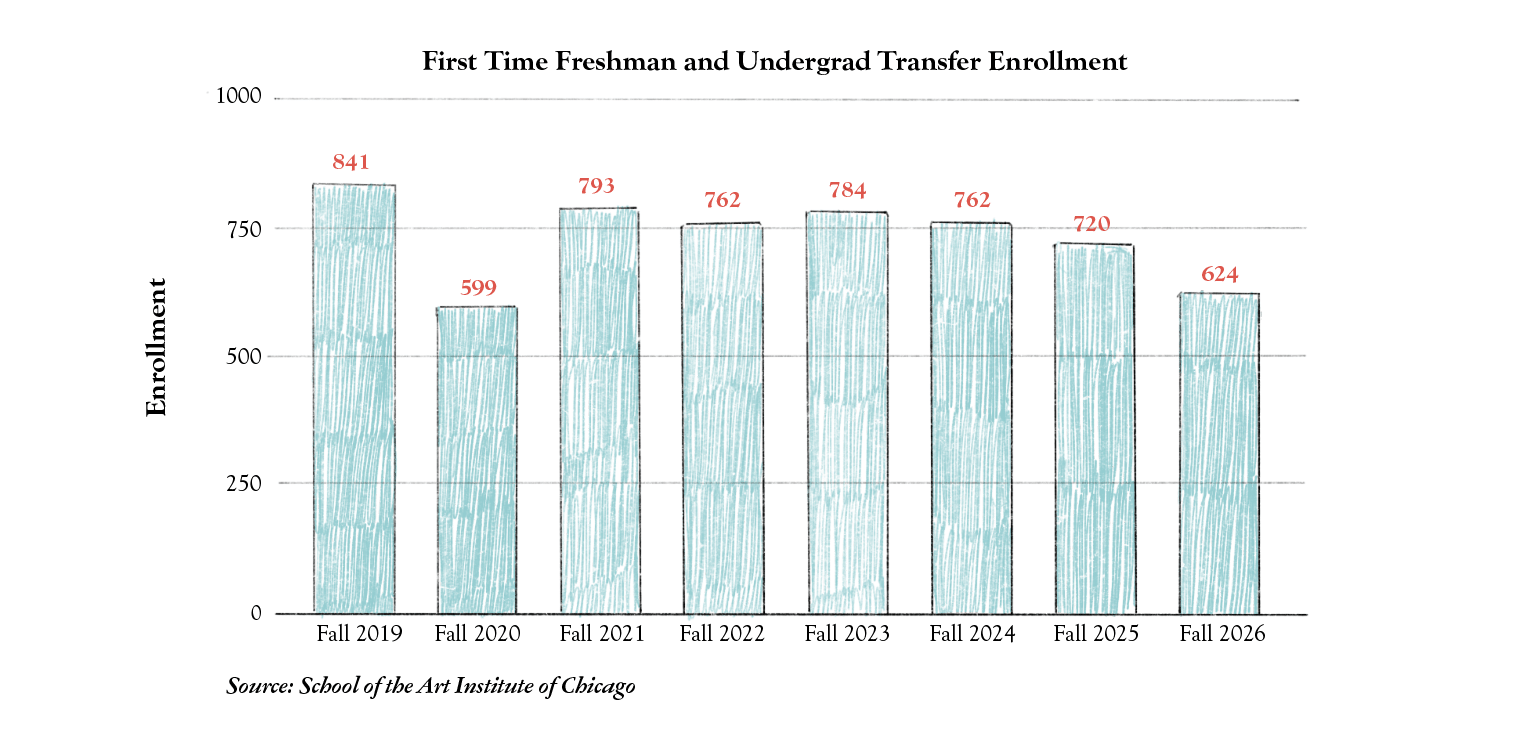
SAIC, like many high education institutions, relies on student tuition for the majority of its funding. But enrollment numbers are significantly dropping. Before the pandemic, in Fall 2019, 841 first-time freshman and undergrad transfer students enrolled at SAIC. In Fall 2025, that number was 720; and in 2026, it was down to 624.
“When we talk about being a smaller school, it’s certainly not that we’ve decided we want to be much smaller. The reality is all the external factors we currently face are effectively making the school smaller,” Berger said.
Berger spoke about SAIC’s need to run a balanced budget every year. The majority of SAIC’s budget is tuition-dependent, and additional funding comes from SAIC’s endowment and other auxiliary sources of revenue.
“If we have fewer tuition dollars that come in, we have fewer tuition dollars that we can spend on. So, inevitably, if there are fewer students, there will have to be reductions in faculty and staff, and that’s why we’re engaged in such a careful program right now, trying to determine what are the priorities,” said Berger.
The SAIC chapter of the American Association of University Professors released a statement on Sept. 23 pushing back against recent changes made by the administration and how those decisions have been made. The statement reads, “As faculty, our goal is to provide the highest quality of teaching and learning at SAIC and to support student outcomes. We perceive the administration’s recent cost-saving measures in areas affecting teaching and learning to be detrimental.”
An AAUP officer spoke to F Newsmagazine on behalf of the chapter. (The officer did not want to be named as they were speaking on behalf of the organization.)
“The school administration has presented these actions as necessary in order to balance a budget as enrollments fall,” the AAUP officer said. “But we perceive them as not only dangerous to teaching and learning quality, but ultimately dangerous to the school’s financial position.
Higher education often refers to this enrollment decline as the “demographic cliff,” driven partly by declining birth rates and compounded by fewer international students enrolling in U.S. schools.
California College of Arts is closing its doors in 2027. The New School in New York has laid off 68 staff and 19 full-time faculty members. Similarly, in New York, the School of Visual Art has a $22 million budget shortfall caused in part to low enrollment numbers and has cut major programs such as an MFA photography program. At the Maryland Institute for the Creative Arts, tuition has increased while the acceptance rate has risen and enrollment numbers have dropped. MICA lost almost $9 million last year. Just down the street from SAIC, Columbia College Chicago is reducing its faculty and cutting 11 degree programs. An additional nine Columbia College Chicago programs will merge existing concentrations. Rhode Island School of Design is one of the only art universities currently thriving, but even there, a recent report found that 60% of their students can’t afford needed art supplies.
Last year, roughly 50 faculty and staff members served on six committees researching priorities for the school, including retention, post-graduate outcomes, spending, and community priorities. Their recommendations were sent to President Jiseon Lee Isabara, who made the final decision on the focus of the three-year plan.
SAIC Forward has five core imperatives: “strengthening the interdisciplinary curriculum to better prepare students for post-graduation careers”; “integration of professional training as part of the curriculum”; “a holistic network of services provided to SAIƒC students”; “a supportive, engaged, and inclusive community”; and “creating a sustainable future for SAIC.”
“The entirety of the strategic plan was created with the student in mind. It’s a student-centered approach to help them succeed from the day they start at SAIC up until even after they graduate,” said Bree Witt, vice president of marketing and communications.
To better understand the SAIC Forward initiative, F Newsmagazine held a roundtable discussion with Berger, Witt, Dean of Graduate Studies Delinda Collier, Vice President and Dean of Student Affairs Rob Flot, and Interim Dean of Undergraduate Studies Andy Hall.
“Three years may seem like a long time, but in the scheme of higher education, strategic planning, policy change, and structural change, three years is very quick,” said Flot.
The 2026-27 school year, the first year of the three-year plan, will mainly focus on strategy, discussion, and building the framework for the following two years. But what change is SAIC Forward bringing now?
Academic Curriculum
There are two major curriculum changes outlined in the SAIC Forward strategic plan document. The first is creating “transcript-recorded concentrations within academic departments with required courses for students who want to attain competency in a particular field.”
Collier used the existing pathways in the Department of Photography as an example for how these new concentrations may work. “Photo already has a kind of prescribed curriculum for their students to follow because it implies that there’s technical knowledge they’re gaining, and that they need to do it in a structured way,” said Collier. The idea is that this could be replicated across various departments, where students have the option to follow a set path of 12 to 16 credit hours that could be reflected in the degree they earn.
“Our commitment to interdisciplinarity is unchanged. You can still, as a student, find your way, but if you want to zero in on something, you can do that,” Hall said.
It is still unclear exactly how the concentrations will work or which departments will offer them. Collier, along with Berger and Witt, said that the changes to academic curriculum would ultimately be a faculty decision. Faculty are meant to discuss curriculum changes throughout this year.
“We are concerned that [curriculum changes] will occur not just without meaningful oversight by faculty, but that as a result of that occurring without meaningful oversight by faculty, the decisions that get made in that process will be done through the lens of short-term cost savings and not through the lens of maintaining faculty oversight,” said an SAIC AAUP chapter officer.
The second major curriculum change is about strengthening “students’ business competencies with scaffolded ‘business of art’ courses.” There are no planned new courses or degree requirements, but an increased emphasis on existing classes that teach discipline-specific skills such as entrepreneurship, financial literacy, and legal basics.
“The idea is to be more intentional in bolstering those offerings,” said Hall.
Programs at SAIC may grow while others may be closed or combined with other departmental offerings.
“Faculty need to be making decisions about what are those important programs to preserve and to grow, and what are those that we can probably fold into something else or sunset,” Berger said.
“The recommendations phase is first, and then there will be a deliberative time to decide how best to implement those curricular changes because that also takes a lot of time. Once a new program is either approved or one is proposed to be sunsetted, there are mechanisms that have to take place,” said Collier.
Holistic Services and Career Readiness
Career readiness is a major part of the strategic plan. They intend to “track long-term, post-graduation outcomes and lifetime earnings against national average” to meet new federal standards that tie programs’ eligibility for federal student loans to their graduates’ earnings.
Student support services, offered by student affairs and academic affairs, will be revamped to better align with career readiness. The goal is to make a centralized, holistic network. This includes connecting with SAIC’s Career and Professional Experience division, the Writing Center, and the Disability Learning Resource Center.
“I recognize that we have in various areas very strong student support functions. They’re not always communicating with each other as well as I think that they can. We started planning for some reorganization in student affairs related to academic advising, career, internships, employer relations, and so forth,” said Flot.
First-year students will begin having career exploration conversations earlier, and the pipeline for internships and employers will expand.
Financial Aid
Financial aid is projected to provide need-based scholarships from SAIC as well as merit-based. Previously, SAIC scholarships were only merit-based. Need-based aid was given through the Free Application for Federal Student Aid and not offered directly from the school.
The plan also calls for accelerating consistent growth of the endowment to offer more scholarships.
Buildings and Facilities
There will be improvements to campus facilities once faculty have made curricular decisions. No SAIC building is currently planned to close. This includes the dorms as well as campus buildings that are rented.
Looking Forward
“[The strategic plan] is not something that’s coming from the top down. And so what it ends up doing is it lengthens the process, and the amount of time it takes. But ultimately, you end up getting a better outcome when you’re involving all these folks and making sure everybody has a voice,” said Witt.
Collier said that though it may not seem like it, it is an accelerated plan. “That reflects the urgency of the issues that we face societally across the higher ed sector,” she said.
According to Witt, input was gathered from 200 community members to form the SAIC Forward plan. “I think there’s going to be a lot of people that see, whether they were vocal about it or not, the things that they want for the school reflected in the strategic plan,” said Witt.
“When you invite people to the table in an inclusive manner, it takes longer. But it’s a better outcome, because you hear different voices at the table,” said Flot.
F Newsmagazine is committed to reporting on SAIC Forward as the changes to SAIC’s curriculum, policies, facilities, and community are made throughout these three years. If you have opinions you want to express about SAIC’s new strategic plan, please reach out to [email protected].