


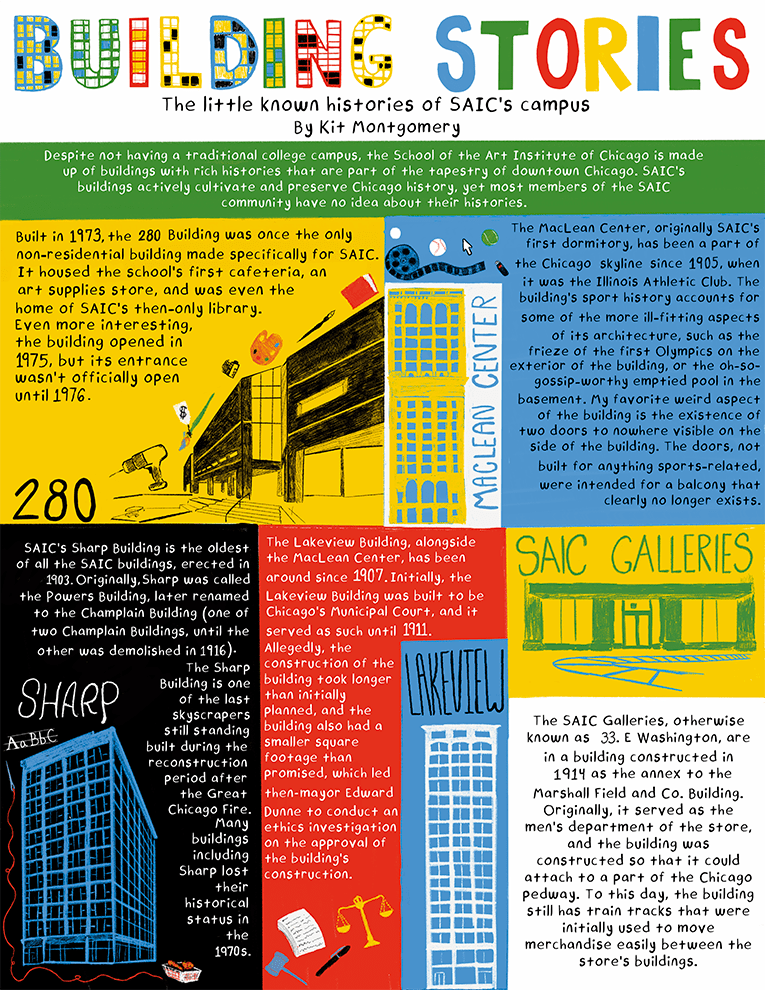


Despite not having a traditional college campus, the School of the Art Institute of Chicago is made up of buildings with rich histories that are part of the tapestry of downtown Chicago. SAIC’s buildings actively cultivate and preserve Chicago history, yet most members of the SAIC community have no idea about their histories.
The MacLean Center, originally SAIC’s first dormitory, has been a part of the Chicago skyline since 1905, when it was the Illinois Athletic Club. The building’s sport history accounts for some of the more ill-fitting aspects of its architecture, such as the frieze of the first Olympics on the exterior of the building, or the oh-so-gossip-worthy emptied pool in the basement. My favorite weird aspect of the building is the existence of two doors to nowhere visible on the side of the building. The doors, not built for anything sports-related, were intended for a balcony that clearly no longer exists.
The Lakeview Building, alongside the MacLean Center, has been around since 1907. Initially, the Lakeview Building was built to be Chicago’s Municipal Court, and it served as such until 1911. Allegedly, the construction of the building took longer than initially planned, and the building also had a smaller square footage than promised, which led then-mayor Edward Dunne to conduct an ethics investigation on the approval of the building’s construction.
Built in 1973, the 280 Building was once the only non-residential building made specifically for SAIC. It housed the school’s first cafeteria, an art supplies store, and was even the home of SAIC’s then-only library. Even more interesting, the building opened in 1975, but its entrance wasn’t officially open until 1976.
SAIC’s Sharp Building is the oldest of all the SAIC buildings, erected in 1903. Originally, Sharp was called the Powers Building, later renamed to the Champlain Building (one of two Champlain Buildings, until the other was demolished in 1916). The Sharp Building is one of the last skyscrapers built during the reconstruction period after the Great Chicago Fire still standing . Many lost their historical landmark status in the 1970s.
The SAIC Galleries, otherwise known as 33. E Washington, are in a building constructed in 1914 as the annex to the Marshall Field and Co. Building. Originally, it served as the men’s department of the store, and the building was constructed so that it could attach to a part of the Chicago pedway. To this day, the building still has train tracks that were initially used to move merchandise easily between the store’s buildings.