


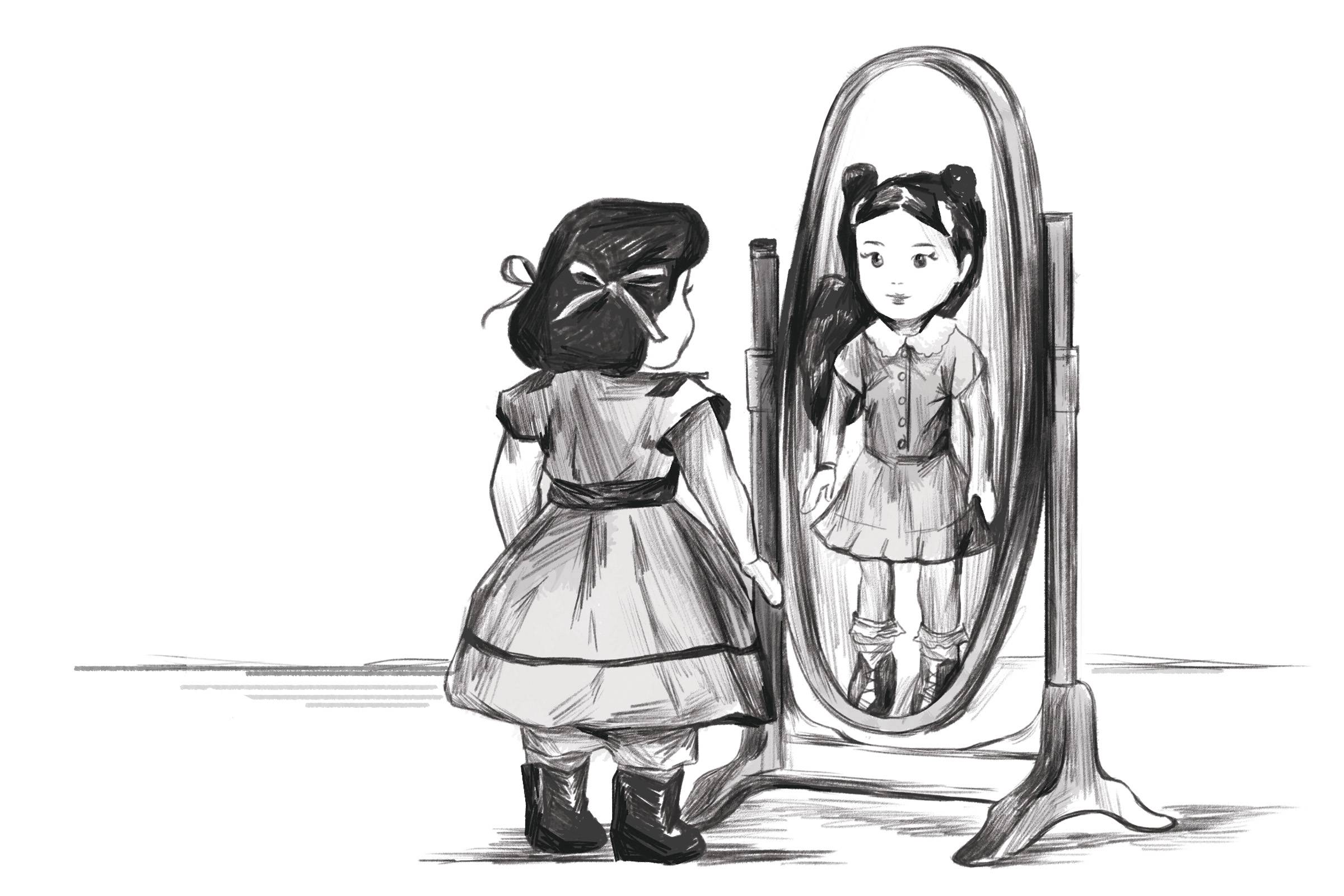
You know the Vine where the little girl smugly tells someone offscreen, “I think I know more about American Girl dolls than you do, genius”? I’ve always felt a kinship with her.
I got my first American Girl doll in 2005, right after Mattel bought the company. I was four years old and had begged for one for at least a year; my broke grad-student single mom somehow scraped together the money to reward me for being a good sport while she finished her Ph.D. She asked me which doll I’d like, and I picked Kirsten, mostly because my friend already had Samantha and because I liked the way the name “Kirsten” sounded.
Kirsten was a Swedish immigrant to the Minnesota frontier in 1854. She wore calico dresses, aprons, and bonnets, which my mother faithfully recreated with felt and hot glue for my Halloween costume that year.
The doll’s hefty price tag was certainly beyond the reach of many families. At least in the first 20 or so years since the company’s founding in 1986, you got what you paid for. Founder Pleasant Rowland, a former schoolteacher, created the company as a high-quality, educational alternative to more superficial dolls on the market. Anthropologist Helen Schwartzmann told the Los Angeles Times in 2000 that American Girl was “the anti-Barbie doll.”
Unlike dolls made in the likeness of idealized women with supermodel proportions, American Girl dolls actually looked like little girls, with chubby cheeks and flat feet. (For those of us with feminist moms who thought Barbies and Bratz were bad for our self-image, this was a selling point.)
In the years following the company’s 1998 buyout by Mattel – incidentally, Barbie’s parent company – American Girl introduced changes to the doll line that many fans felt betrayed the integrity of the company. They introduced contemporary dolls and baby dolls; brand collaborations with Disney, Harry Potter, and (Surprise!) Barbie.
Perhaps most infamous among fans was the short-lived revamping of the historical line as “BeForever,” with redesigned outfits that prioritized brighter, more kid-friendly colors and cheaper materials over historical accuracy.
Mattel rolled back the BeForever rebrand, but many of the unpopular changes stayed. There are still plenty of devoted fans, but these decisions have taken a financial toll. Especially in a recession, people aren’t willing to shell out nearly $200 for a doll that doesn’t feel special. According to CNBC, American Girl’s sales in 2023 had fallen to $200 million, a third of the $600 million revenue the brand was bringing in annually during the peak of its popularity.
Things went from bad to worse in February of this year, when American Girl announced that, for the 40th anniversary of the company, they would release a line of “Modern Era” dolls inspired by the classic historical characters that made the brand famous.
The dolls’ period costumes are replaced by trendy styles a tween girl might wear in 2026; Kirsten, my personal favorite doll, is out of calico and loop braids and now dons space buns and a twee minidress with a Peter Pan collar. I’m enough of a purist about the original dolls that this remodeling feels like undermined the original purpose of the dolls; sort of one last slap in the face to those of us who loved American Girl for what made it different from other toy companies
I could maybe get behind the “Modern Era” line as a fun and creative way to introduce these original characters to a new generation, if it weren’t for one more concerning aspect of the redesign: the new renditions of the characters are noticeably skinnier than their original counterparts.
To be fair, this is one line of dolls, mostly geared towards adult collectors and capitalizing on our nostalgia. The original American Girl dolls are still very much available for purchase, and they look like healthy nine-year-olds. But I think I can speak for most adult fans of the brand when I say (in a George Bluth from “Arrested Development” season 4 episode 2 at 9:40 voice), “We don’t want these.”
Life According to Tessa, a popular doll YouTuber, said in a video on the subject of the rebrand, “All these new designs say is, ‘I live in Pasadena, I have a 16-hour screen time, and I love going to Sephora.’” Tessa taps into another reason behind the brand’s decline: American Girl, and other toy companies, must now contend with the fact that tween girls – historically, American Girl’s core audience – are abandoning pretend play in favor of social media, makeup, and skincare, at increasingly younger ages. There’s even a name for the phenomenon: “Sephora kids.”
Pretend play is seen as increasingly childish and uncool, so it’s no wonder that companies like American Girl are desperately trying to make their dolls more glamorous to compensate. It’s unfortunate, because the whole point of American Girl – why Pleasant Rowland created the brand in the first place – was to provide another option for girls who weren’t keen on the model of femininity and consumerism that Barbie represented.
This line of skinnier dolls points to another cultural trend. While a spokesperson for American Girl told the New York Times that the slimmer redesign was intended for increased “ease of play” for younger girls, and that the dolls are not intended to look skinnier or older than the original 18-inch line, it is hard to ignore that the redesigns feed directly into shifting cultural trends involving beauty and body positivity.
Whether the redesign is an intentional result of the rise of skinny culture or not, what do these “Ozempic-ificed” American Girl dolls say about the death of the body positivity movement and about what is considered an acceptable female body in 2026?
With the ease of access of GLP-1 drugs and shifting aesthetic tastes, there have been plenty of reports over the past couple of years of the body positivity movement of the 2010s being “over.”
Former outspoken activists for fat positivity have lost dramatic amounts of weight. Low rise jeans and other turn of the millennium trends that necessitate slender bodies as part of the “look” are back. In short, concerningly skinny is “in” again.
I find myself immensely grateful to have spent my teens in an era that, at least ostensibly, celebrated bodies of all shapes and sizes. Sure, the pro-eating disorder content was still there, but it seemed mostly to be confined to small, dark corners of the internet.
Naively, I took body positivity for granted. I assumed that it was not a trend but a point of genuine cultural progress, and that the fatphobic zeitgeist of the early 2000s was dead for good. I never could have predicted that a couple miracle drugs and a rightward cultural shift were all it would take to discard every bit of progress that had supposedly been made in a staggeringly short amount of time. In the past couple of years, I’ve watched as everyone from celebrities to friends stopped snacking and started shrinking.Those who couldn’t afford the significant price tag of GLP-1s resorted to counting calories obsessively and using Adderall and cigarettes as appetite suppressants, just as their mothers’ generation had twenty or thirty years ago. So I think I speak for myself and plenty of other former weird little girls who maybe played with dolls a little longer than their friends did in saying it’s depressing to watch American Girl go down this road too.
Perhaps Mattel believes that slender, glamorous dolls are what it might take to bring tween girl audiences back to doll play, but frankly, maybe the reason little girls in 2026 would rather spend their allowance on skincare products than dolls is because toy companies aren’t taking them seriously. American Girl became a beloved brand by creating a line of lovingly crafted, historically accurate dolls that encourage kindness, intelligence and progressive values – and dolls that actually look like the nine-year-old girls they’re intended for. Girls wanted real representation, not the condescension of tacky color palettes and dolls on diets. If American Girl wants to remain a force for good in the world, and indeed if it wants to stay afloat as a company, they should return to what they did best.