

Transcript:
Panel 1:
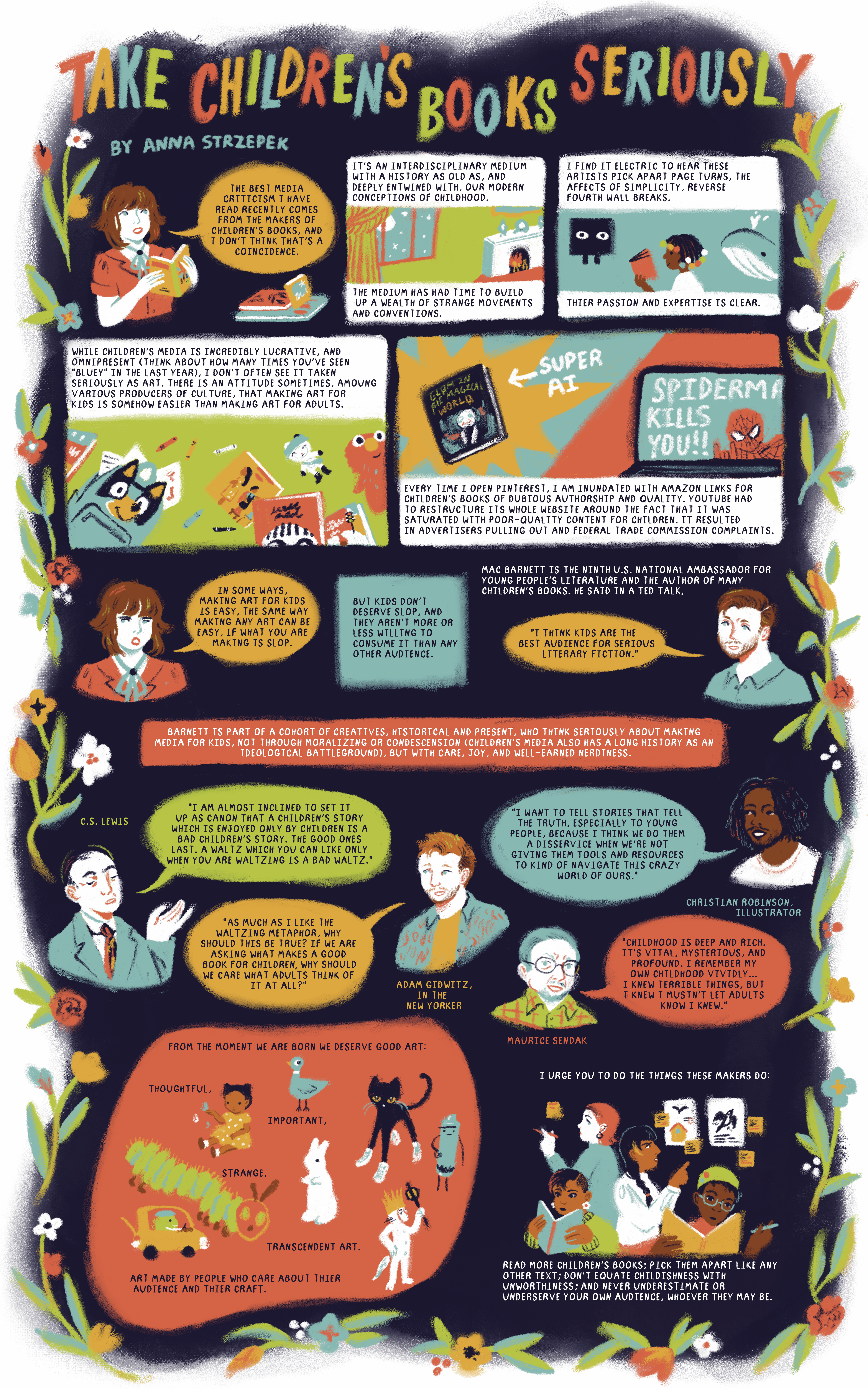
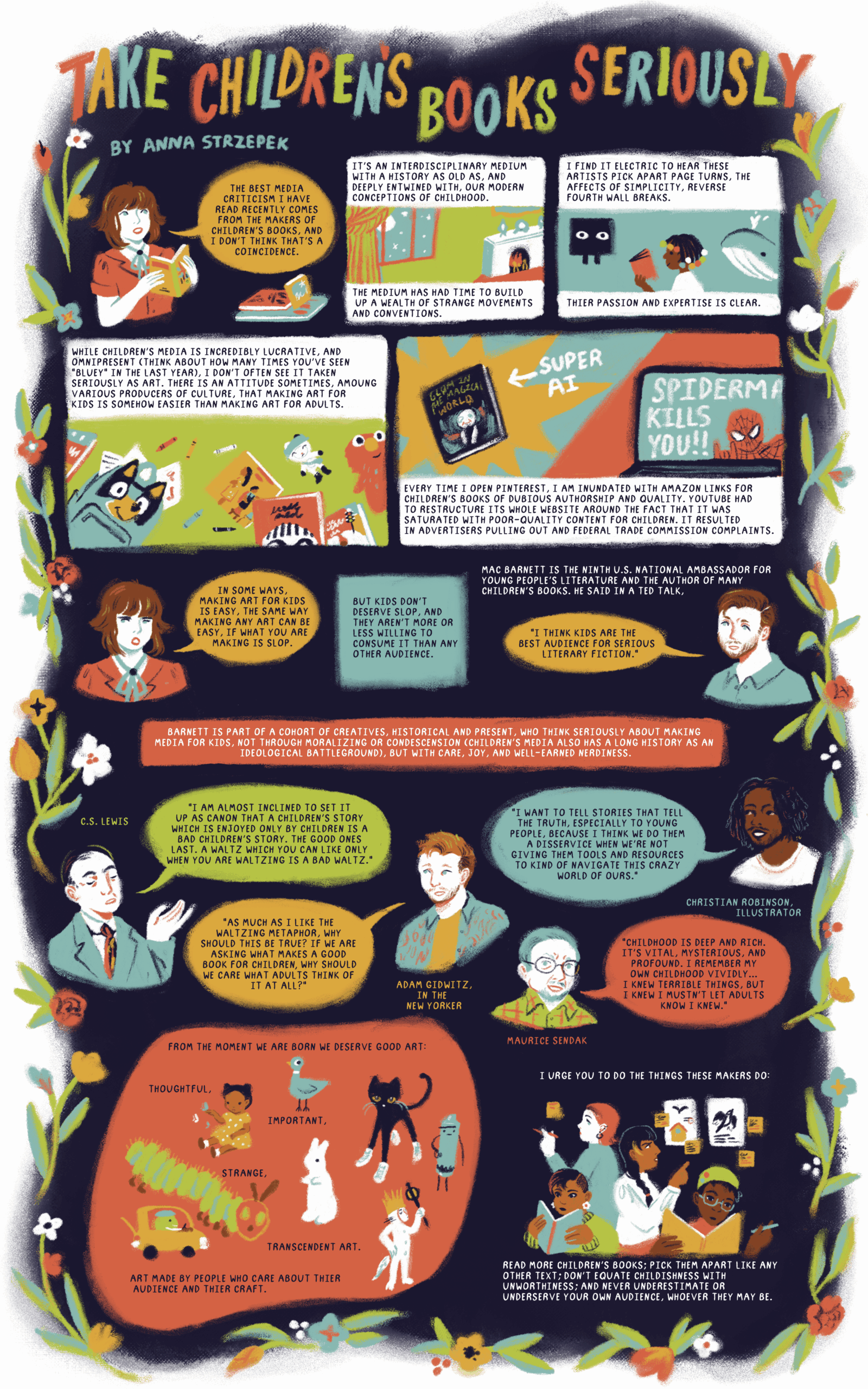
The best media criticism I have read recently comes from the makers of children’s books, and I don’t think that’s a coincidence.
It’s an interdisciplinary medium with a history as old as, and deeply entwined with, our modern conceptions of childhood. The medium has had time to build up a wealth of strange movements and conventions.
I find it electric to hear these artists pick apart page turns, the affects of simplicity, and reverse fourth wall breaks.
Their passion and expertise is clear.
Panel 2:
While children’s media is incredibly lucrative and omnipresent (think about how many times you’ve seen “Bluey” in the last year), I don’t often see it taken seriously as art. There is an attitude sometimes, among various producers of culture, that making art for children is somehow easier than making art for adults.
Every time I open Pinterest I am inundated with Amazon links for children’s books of dubious authorship and quality. Youtube had to restructure its whole website around the fact that it was saturated with poor-quality content made for children. It resulted in advertisers pulling out and Federal Trade Commission complaints.
Image: joke about AI/Celebrity children’s books and Youtube children’s content.
Panel 3:
In some ways, making art for kids is easy, the same way making any art can be easy, if what you are making is slop.
Panel 4:
But kids don’t deserve slop, and they aren’t more or less willing to consume it than any other audience.
Mac Barnett is the ninth U.S. National Ambassador for Young People’s Literature and the author of many children’s books. He said in a ted talk, “I think kids are the best audience for serious literary fiction.”
Barnett is part of a cohort of creatives, historical and present, who think seriously about making media for kids, not through moralizing or condescension (children’s media also has a long history as an ideological battleground), but with care, joy, and well-earned nerdiness.
Panel 5:
Several speech bubbles:
“I am almost inclined to set it up as a canon that a children’s story which is enjoyed only by children is a bad children’s story. The good ones last. A waltz which you can like only when you are waltzing is a bad waltz.” C.S. Lewis
“As much as I like the waltzing metaphor, why should this be true? If we are asking what makes a good book for children, why should we care what adults think of it at all?” Adam Gidwitz, in the New Yorker
“I want to tell stories that tell the truth, especially to young people, because I think we do them a disservice when we’re not giving them tools and resources to kind of navigate this crazy world of ours.” Christian Robinson, illustrator
From the moment we are born we deserve good art: thoughtful, important, strange, transcendent art. Art made by people who care about their audience and their craft.
I want to urge you to do the things these makers do:
Read more children’s books; pick them apart like any other text; don’t equate childishness with unworthiness; and never underestimate or underserve your own audience, whoever they may be.