

Humanity cares so much about saving media. Staggering amounts of time, effort, and resources are put into home archives, or even bigger archives like archive.org and its wayback machine. People care about media like flash games and lesser-known books from the 1800s.
In Dec. 2025, F Newsmagazine printed an article about lost media — that is, media which has become inaccessible, either because digital access disappeared or because of intentional deletion. It’s a fantastic article by Kit Montgomery, and you should go read it.
But the media that people often go crazy to save is watchable content — movies, television shows, performances, video essays. There’s another form of watchable content that I don’t hear people talk about archiving — short-form.
We’re all familiar with short-form content and how addictive it is. I could write several essays on whether or not short-form content is worth saving — after all, there are some great six-second videos out there. Memes from the time of Vine, that guy with the magic tricks, excellent tutorials, and micro-video essays. But for every well-made video, there are at least ten ads, shitposts, AI slop-posts, or Tumblr posts read over “Minecraft” parkour.
Where is all that data living right now? In November, TikTok reported that 1.3 billion videos on its platform have been labelled as AI-generated. Over 100 million pieces of content are uploaded to TikTok every day. How do we decide what we have space for? Who decides? What happened to all the content that was posted to Vine? Even if we still have it, how can you possibly find anything specific? How much media are we willing to dedicate resources to preserving?
I think if you see AI as an artform, it seems more worthy of archiving. However if you see AI as deplorable and not real art or creation, then it all should be burned. We used to have this argument about Photoshop. Is art made with Photoshop — e.g, digital collage, illustration, etc. — real art? The way people feel about this issue is inextricably linked with how they feel about artificial intelligence.
Social media has been overrun with short-form content since at least 2013 with the rise of Vine and then Musical.ly, and its rebrand as TikTok. When easily consumable short-form content meets easily creatable generative AI tools, we find a new circle of hell: AI slop.
AI slop, Merriam-Webster’s 2025 word of the year, is “digital content of low quality that is produced usually in quantity by means of artificial intelligence.”
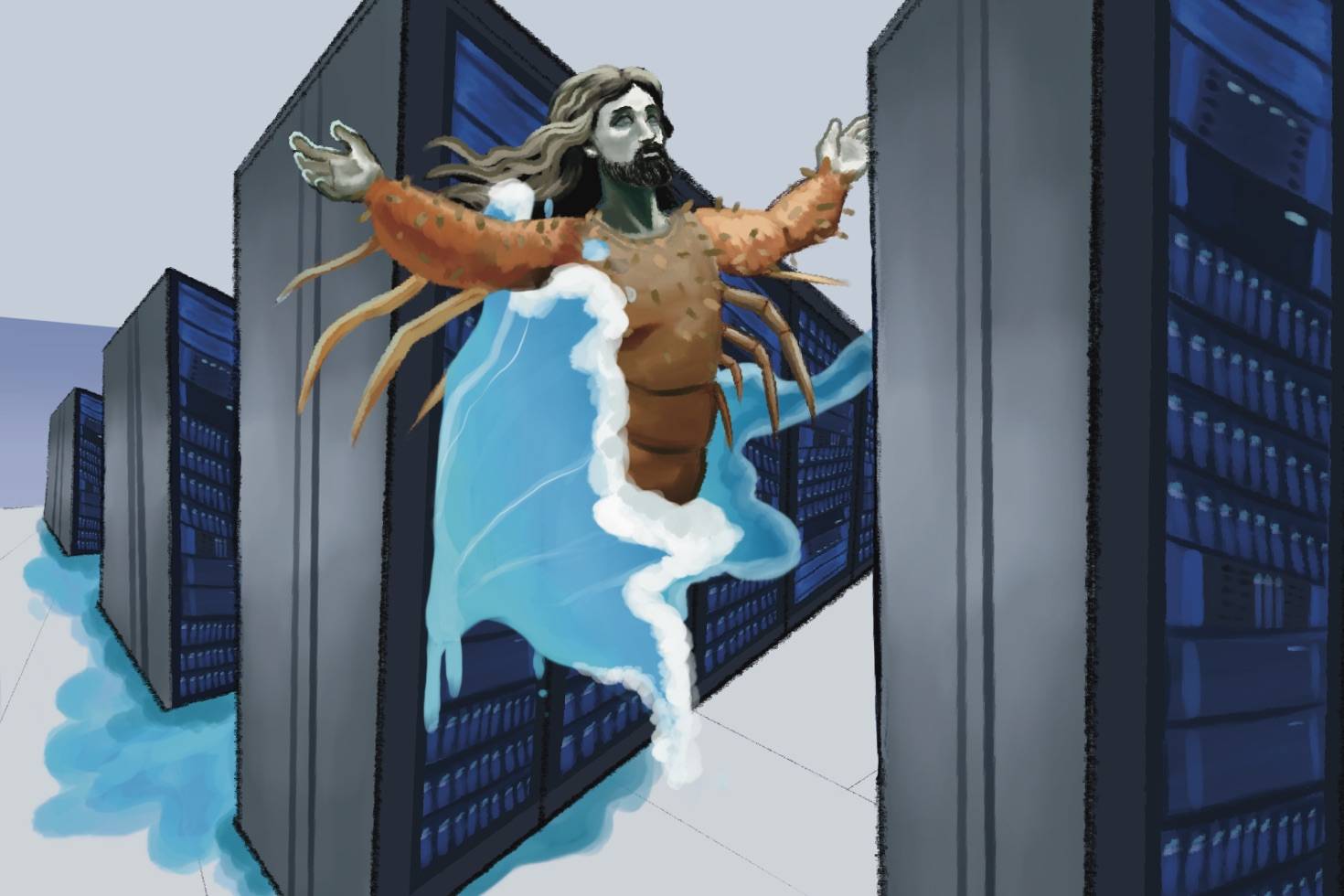
“Shrimp Jesus,” a viral 2024 facebook meme, was powered by slop. Hundreds of AI generated images of Jesus Christ combined with shrimp and crustacean limbs spammed the platform, generating engagement through sensationalism. “Shrimp Jesus” is the perfect content in a world driven by clicks and rage-bait. Quality isn’t emphasized — quantity and reactions are.
AI imagery isn’t new at this point — we used to (and sometimes still do) make fun of how bad it is. Now AI is more convincing, easier to make, and everywhere. To an art student whose practice is deeply rooted in intention, decision-making, meaning, and craft, (fashion student here, nice to meet you), slop is insulting. It should be insulting to anyone who creates content. Yet it floods platforms. Yet audiences on social media give incredible power to this, by definition, low-quality content. AI slop is beginning to run the attention economy, especially on Facebook, a platform whose demographic is less skilled at spotting slop and ignoring trolls. And that’s not even touching AI slop as propaganda.
It’s human nature to create things — even, and especially, bad things. People have access to these tools. Meta as a company has “gone all in” on AI investment. People will keep creating content like this until legislation and regulation is passed against it. My question is this: where does it go? Where does Facebook keep shrimp Jesus? Who is archiving Trump Gaza? Trump Gaza is an AI generated video depicting Trump and Elon Musk in paradise — a peaceful Gaza, complete with shiny skyscrapers, luxury cars, and a towering golden Trump statue. The video was posted to Donald’s Trumps own Instagram account.
One guideline of archiving is that it should be devoid of censorship, as a way of protecting intellectual freedom. Whether or not to archive AI-generated content specifically has sparked controversy in archiving circles. Is Trump Gaza worth archiving for its propagandic qualities or because of its political and historical significance? Is something dumb as shrimp Jesus also worth archiving?
You can still find plenty of old content on Instagram, Facebook, YouTube and even smaller sites like Tumblr. Posts from 2010 can be searched for and scrolled back to. Of course, we should talk about the reason it’s worth it for tech giants to keep that media — the data associated with it, worth trillions in ad revenue. Will our data live longer than the billions of 30 second videos we’ve made?
Whether or not you think the content should be archived, we should know where it goes. It takes water to generate content with AI — does it take electricity to store it? How much energy and maintenance do Meta’s servers require? How fast does it expand?
Social media data, including posts and user data, are stored in data centers — large collections of servers in warehouses. This is where “Shrimp Jesus” lives, and likely where it was created. In addition to storing data, data centers also run applications — such as generative AIs.
The number of servers in the U.S. is growing — an April 2025 report estimates as many as 4,000 servers in the U.S., with states competing to build more for the “construction jobs, local tax revenue and future business opportunities” they bring to the state. In July, Donald Trump signed an executive order to utilize federally owned land and resources to build data centers in order to pursue “American manufacturing and technological dominance.” However several states have started passing legislation against building more servers. A Georgian state law maker introduced a moratorium bill for datacenters because of rising electricity and water costs — a direct result of powering artificial intelligence activities. The state also seeks to end tax cuts for the centers, as well as publishing their water and energy use. Rising energy costs also seem to have caught the Trump administration on their back foot. In November and December of 2025, Meta spent 6.4 million dollars on ads to convince people — particularly policy makers — that datacenters are good.
Which brings us to the archives we do have.
In late 2025 nonprofit And Other Stuff, (owned by Jack Dorsey, previous owner of X, formerly twitter), funded DiVine, a revival of the now-defunct Vine. DiVine claims to have filters for AI content, and it has restored more than 100,000 previously lost Vine originals. The restoration is thanks to a backup performed by Archive Team, a “loose collective of rogue archivists, programmers, writers and loudmouths dedicated to saving our digital heritage.” Evan Henshaw-Plath, who goes by Rabble, reconstructed the videos from Archive Team’s backup, as well as information on past Vine users and engagement metrics like views. While 100,000 is not a small chunk of videos, Rabble estimates many millions of videos are still missing. He cited millions of K-pop videos specifically, as they likely weren’t archived in the first place.
File backups aren’t the only way to preserve lost media — most viral vines have been viewable through YouTube “Vine Compilations” — playlists or long videos or of edited-together Vines, usually titled something like “Clean vines you can show your grandparents,”or “Vines that cure my anxiety.” Many lost k-pop vines have been archived this way. But even these are flawed. For example, the playlist “Vines I can’t live without” has five hidden videos. Are these videos that have been deleted? Privated? Using YouTube as an archive still ends up being ephemeral.
So many of these questions are subjective. I’ll leave you with my biggest one: who gets to decide what is saved?