


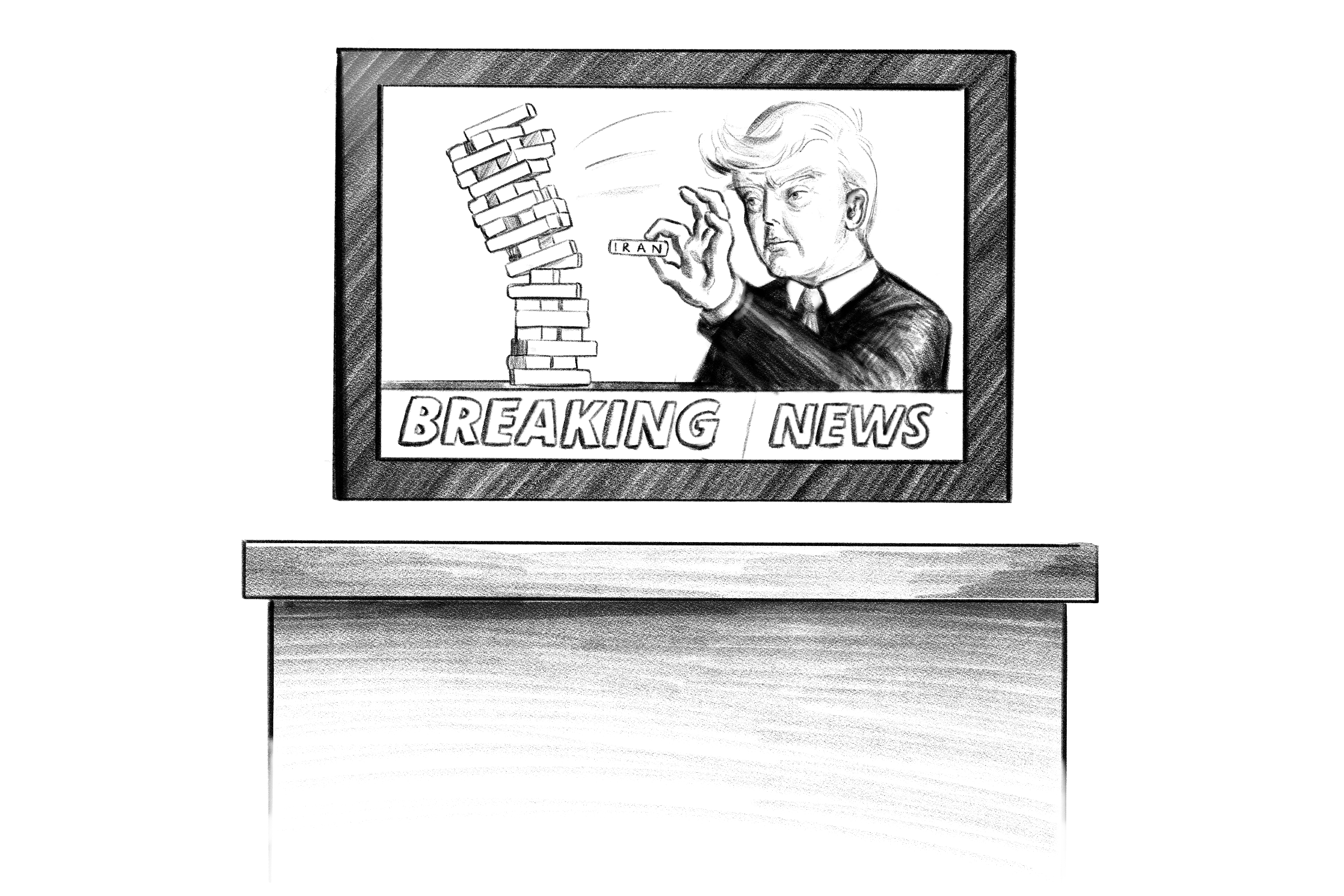
President Donald Trump’s second presidency, similar to his first, has left many American citizens dissatisfied and hopeless for the future of the U.S. According to The Economist, Trump’s approval rating as of publication is at net -17, with about 56% of Americans disapproving, while 38% approve.
The deployment of U.S. Immigration and Customs Enforcement into major cities and the use of military weapons to “defend the American people” against Iran are two recent, impactful decisions Trump has made. Protests have erupted as a response to these policies and the overall management of the government.
Other countries have mixed views on the U.S. Last year, PewResearch released the results of a survey that asked the citizens of 24 countries for their opinion on the United States. Many countries view the U.S. more negatively. In 2024, 61% of the participants who lived in Mexico saw the United States as favorable. Last year, that viewpoint had decreased to 29%. Sweden sees the United States as unfavorable at 79%, while Israel sees the United States as favorable at 83%. The ratio between countries that view the U.S. as favorable and unfavorable is even, at 49%.
News organizations in different countries have reported on the U.S. with opinion and reported pieces, with different focuses but similar viewpoints. Firstpost, a publication in India, reported on Renee Good and Alex Pretti being killed by ICE agents. In an opinion piece, the writer Makarand Paranjape dispelled the idea of the United States fighting another civil war. He detailed how the U.S. has a lot of internal division politically, in its elections, courts, media, and law enforcement. Paranjape writes, “In the meantime, the world looks on, not without sad bafflement and disappointment.”
An opinion article published by Asharq Al-Awsat, a news publication based in Saudi Arabia, analyzed the relationship between the United States government and European governments as a whole. Jumah Boukleb writes that it is a “marriage of convenience” because the U.S. and European governments argue a lot, but the belief that Russia and China are threats is what stops the “divorce.” Boukleb adds that he believes the “cost of separation” — as in, full economic and military independence from the U.S. — is too high for Europe. He also writes that he believes that the United States’ government needs to rebuild trust with European countries, since the majority of Western infrastructure is dependent on this partnership.
In Spain, La Vanguardia published an opinion article in April commenting on one of Trump’s posts on Truth Social. “A whole civilization dies tonight” is the phrase that the author, Jordi Juan, focuses on in the piece. Catalina Ángel Gómez, their reporter in Tehran, reported to Juan that Iranian citizens are in fear and disbelief at the “violent intimidation by the United States.” She said that Iranians have been using themselves as human shields near power plants and they are recording on their phones to document incoming attacks. ”No one knows for certain what’s going on in Trump’s head,” Juan writes.
GhanaWeb released an opinion piece on the U.S.’ current political goal to “destroy” Iran in April. Alhassan Ahmed, the author, said that he believes the U.S. has wasted trillions on the war for oil and went into detail on how this war has affected European economies. Since Europe now relies on oil from the Middle East and not Russia, gas prices have gone up significantly. Ahmed writes that through this war and previous history, the U.S. is creating a “new Taliban” in the process to gain political dominance.
Wen Wei Po, a publication based in Hong Kong, framed the war differently. The author, Fan Hongda, writes about how the war is being executed by both the United States and Israel against Iran. Hongda writes about how Trump first said the war would only take two days, then four days, then four weeks; but now the war is “just getting started.” The author believes that the U.S. and Israel underestimated Iran’s ability to retaliate, citing the damage of Israeli cities and U.S military bases.
Colby Cosh in the National Post on April 14, 2026 criticizes Trump heavily. He writes that he believes that Trump is shameless and that “self-praise” is his “entire technique as a public figure.” He reports from Canada on Trump’s AI-generated post of himself as Jesus healing an injured man, from April 12, posted on Truth Social. Trump, according to Cosh, took down the image once he received backlash from Evangelical Republicans. Cosh questions Trump’s own ties to Christianity and ends his article by questioning what a “normal politician” would do in this scenario.
“We will never know the cost of the devastation caused by these wars,” Antonio Gershenson writes in his article for La Journada, a publication in Mexico. Gershenson further explains that destruction, misdirected bombing, and damage to the environment will be an irreversible result of the war. He talked about how the bombs would poison the air and how he imagines that Trump would say this is all “collateral damage.” Gershenson writes that Mexico needs to start thinking about how they are going to survive if an energy crisis occurs. He ends his article with this question: “When will we achieve peace?”