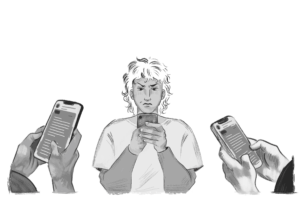


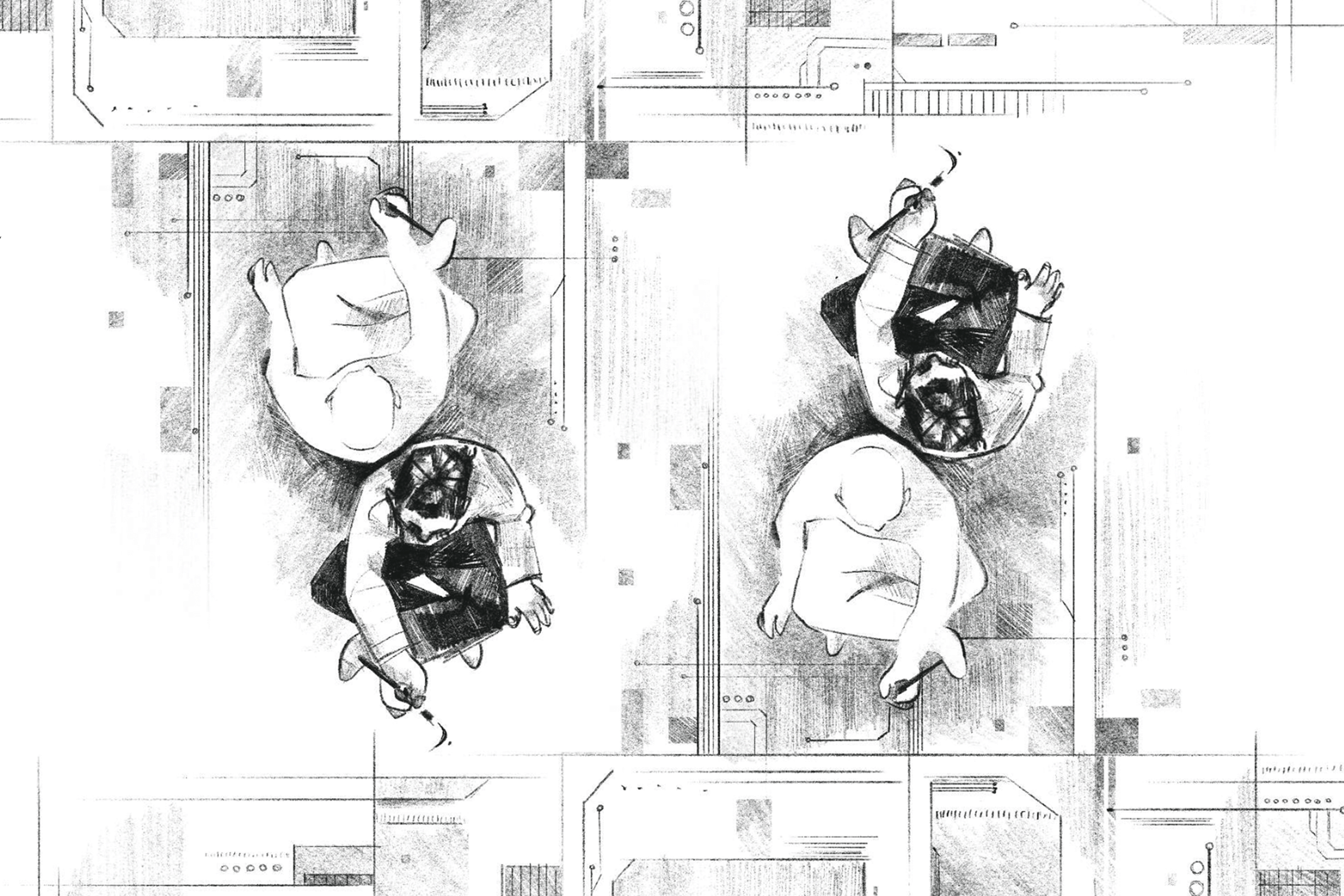
Although many students at the School of the Art Institute of Chicago have an aversion to the use of artificial intelligence in their creative work, some, especially in departments that utilize technology-based tools, have found ways to use AI tools within their practice.
Cara Yan (BA 2027), a student in the Department of Visual and Critical Studies, mainly uses AI when focusing on architectural spaces. Yan found she could create smooth transitions between materials like fur and glass that she felt were difficult to achieve in reality by using an existing image and generating replacement content in specific areas of the image.
“My goal is not to deceive the viewer, but rather I have discovered that this type of AI-generated image breaks through the material limitations of our current reality, thereby offering a new – and, in my view, fascinating – material-based visual experience,” Yan said.
When trying to recreate her dreams and images from her mind with AI, Yan was often dissatisfied. She initially chose to study AI because so many people were talking about it, and she felt it was an unavoidable topic. Yan said that after finishing Doug Rossman’s “Artificial Intelligence” course in the Department of Art and Technology/Sound Practices, she realized that AI “doesn’t have to be the only direction or solution for the future.”
Many professors consider AI a hindrance to student learning, especially in departments with writing-heavy assignments like the Department of Art History. However, there are a few studio professors who teach AI tools or with AI in mind and ask students to critically analyze how AI functions in our world.
Rosman’s 4000-level course is offered both this and next semester. Rosman also teaches “Language Games: Dialoguing with AI” with Gionata Gatto in the Department of Architecture, Interior Architecture, and Designed Objects.
The “Artificial Intelligence” course covers AI technology and tools, “with the intent of giving students a critical understanding of how AI works and functions in our culture,” Rosman said. Rosman has been experimenting with AI in his practice for almost a decade, mostly to understand its increasing role in our lives. Working with emerging technology as an artist and educator, he said that he feels responsible for providing space for students to be curious and critical with new technology.
Eric Fleischauer, a professor in the Department of Film, Video, New Media, and Animation, teaches a professional practice class called “The Digital Dark Age.”
Fleischauer found through class discussions that many students were averse to the use of AI in art. By asking his students to use AI as a tool rather than having AI make the work, he wants them to “confront their preconceived ideas and directly engage with AI in their creative process,” Fleischauer said. He is looking for his students to come at the assignment with a critical lens and to consider its possible relationships to conceptual art, technology, and creativity.
Nickii Schamborski (MFA 2027), a student in the Department of Art and Technology/Sound Practices, explores how digital ecosystems and politics affect bodies and daily lives. “Cyber Cindy,” Schamborski’s film, follows its titular character on a journey to reimagine their childhood through AI by crafting visions of queer belonging beyond strict gender norms.
“While exploring and questioning their own queer desires through technology, they expose Al’s role as a contemporary oracle, a system that claims omniscience while concealing its military origins and economic interests,” Schamborski said.
For their performance class, Schamborski composed “Nickii AI,” a piece where the audience visits a room to ask questions to what seems like an AI version of Schamborski. It is actually the real Schamborski streaming from another room, creating an illusion of artificial intelligence.
“This performance questions what it means to be an artist in times of AI, and how our perception of humanity, empathy, and connection suddenly change when we can simply prompt a machine for conversation,” Schamborski said.
Liang He (BFA 2026) made installations to explore the question of consciousness in AI, and said that that AI has been a liberating technology for art making.
“My main concern toward most use of AI creation today is about the laziness from the product user, which leads to very universal results and only enhances the inherent problems in these products. Real artistic engagement with AI should come with understanding and experimental spirits to the technology,” he said.
Sophia Salganicoff (MFA 2026), a student in the Department of Visual Communication Design, has used AI to imagine a missing fragment of her family history to respond to how the growth of AI-generated historical imagery on social media has formed an industry of “data mining our pasts.” By using AI to visualize her family’s diaspora history, she confronts “inherent losses that come with diaspora and the huge gaps in ancestral history.”
Salganicoff recognizes how AI models hold biases and oversimplifications. Salganicoff believes that using AI requires “engagement with the system itself, the rationale for using it, and transparency with the audience about any deployment of artificial intelligence within your work.”
Salganicoff engages with the mass presence of AI images to understand what it means to experience the human condition. She hopes that her use of AI brings to light how AI is used to “sanitize and cleanse our own humanity.”