

The lights are off, and it’s dead in the middle of the night. The only thing lighting your room is the dim, bright light of your computer screen. You’re looking for something to watch on YouTube. You click on a video titled “Rosswood: Part 1,” which appears to be a normal docu-series by a man named Alex Kralie — but you start to realize that something is off. Then, each passing continuation of the series falls more into desperate, grueling psychological horror.
This is the experience of watching “Marble Hornets: Rosswood”, which premiered in Aug. 2025, and is a sequel series to 2009’s “Marble Hornets” — one of the oldest, most well-known YouTuber horror web series. The original series follows the character Jay Merrick, a film student, as he uncovers the secrets to his friend Alex’s cancelled film of the same name. During this pursuit, Jay is antagonised by a creature named the Operator.
Many would recognize The Operator as Slenderman: the blank-faced, unnaturally tall horror icon that took the internet by storm in the early 2010s. Slenderman is a huge contribution to what we now know as the creepypasta community. Creepypastas are shared horror stories that were copied from one place on the internet and pasted to another, allowing them to spread rapidly (creepy, copy-pasted, creepypastas — get it?). Often, these stories were written as if they were true, despite being obviously fictional.
Long before the hyperconnected form of social media we have today, the internet was a vast field of chat forums like 4chan and AOL. In the 2000s, things began to change as web hosting platforms like Angelfire made it easier to make a website, growing the accessibility of the internet to average people.
On Dec. 30, 2000, Ted Hegemann started an Angelfire blog detailing a new cave system he and his friends had found in the form of a cave diver’s journal. Stranger and stranger things would happen in the cave, like odd hieroglyphs, experiencing hallucinations, and an odd figure lingering within the cave.
“Ted the Caver” piqued widespread interest because the blog was updated and written in a way that appeared to be real. Indeed, many parts of the story were based on reality. Hegemann used his real-life first name, the cave is a real cave that exists in Utah, and he did go in it with his friends — making all of the photos he shared on the blog all real. “Ted the Caver” blurred the lines of what was real and what was fiction during a time where it wasn’t easy to verify the truth, and it spread across the net like a digital version of an Urban legend.
Many declare “Ted the Caver” to be the first creepypasta.
While Hegemann may have been the first, Slenderman perfected it. Predating the “Marble Hornets” series, the character of Slenderman was created by Eric Knudsen under the pseudonym Victor Surge in June 2009. Knudsen submitted two black-and-white images to the “Something Awful” forums, each featuring an extremely tall, blank-faced man in a suit, who would occasionally be equipped with large black tentacles. These images, like the story “Ted the Caver,” mixed the real world with fantasy.
Similar to urban legends, every time the story was copied and pasted, details of the creature and images would change and expand. This allowed people across mediums to add to existing lore. Massively popular horror games like “Slenderman: the Eight Pages” or webseries like “Marble Hornets” introduced him to new audiences and established common lore attributes of Slenderman.
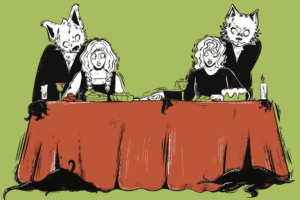
But Slenderman wasn’t the only character that existed in the creepypasta community, and the community loved a crossover. Many fans liked the idea that Slenderman had a mansion in the woods where all the biggest creepypasta characters could essentially hang out, basing the mansion setting off of the video game “Slenderman’s Shadow.”
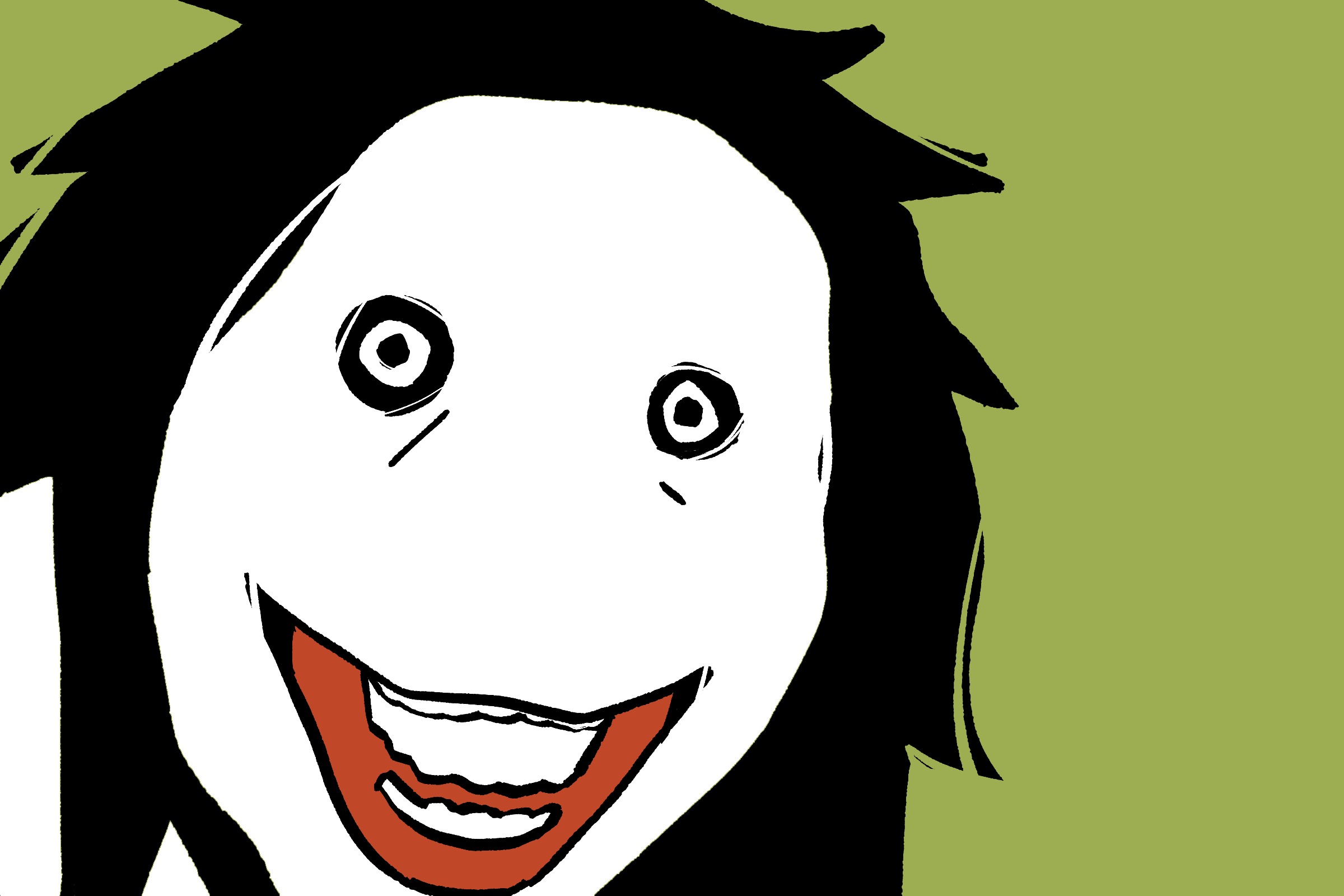
Jeff the Killer was a common addition to the mansion. His origin was similar to Slenderman, with a disturbing photoshopped image being posted to a forum, later turning into the story about a bullied child turned serial killer. Although the story of Jeff the Killer left much to be desired, fans loved him. They would dress as him at pop culture conventions, make fan art, and videos, some even made their own original characters to interact with Jeff like Nina the Killer.
There are many creepypastas that exist beyond the Slenderverse. Characters like Sally, Smiledog, and Nurse Ann, as well as stories like “Abandoned by Disney,” “Ben Drowned,” and “The Russian Sleep Experiment,” spread like wildfire. Over time, some fans characterized the characters, especially the male variety, in increasingly silly and even romantic ways. The lore of these characters and the love that fans had for them ran deep.
During the late 2010s, the extreme fanatic energy of the creepypasta community faded for many reasons. In 2014, two 12-year-old girls lured their friend, Payton Leutner, into the woods and stabbed her 19 times to “appease” Slenderman. Leutner survived the attack. The incident sparked a conversation about children’s exposure to horror online, and played a hand in many distancing themselves from the Slenderman creepypasta lore.
Furthermore, if the tragedy of Payton Leutner wasn’t enough, the final nail in the coffin could be the Slenderman 2018, directed by Sylvain White, with a dismal 8% rating on Rotten Tomatoes, it signaled that audiences just didn’t want to see more Slenderman. Thus, many newer characters didn’t reach the same peak that Slenderman or Jeff the Killer did. But, Perhaps the biggest reason creepypasta faded away was that a lot of the original young fans got older and grew into other, equally niche interests, including other horror genres.
The internet, and internet horror by proxy, has changed over its decades of existence. Although Creepypasta may not be as popular as before, online horror itself hasn’t died. It evolved into other genres like mascot horror and analog horror. Some will continue to say the internet has changed for the worse, with the increased amount of AI generative slop and the endless sea of ads, but that makes the nostalgia all the more important in order to remind us that the internet can still be that fun, creative, horrifically wonderful place.