


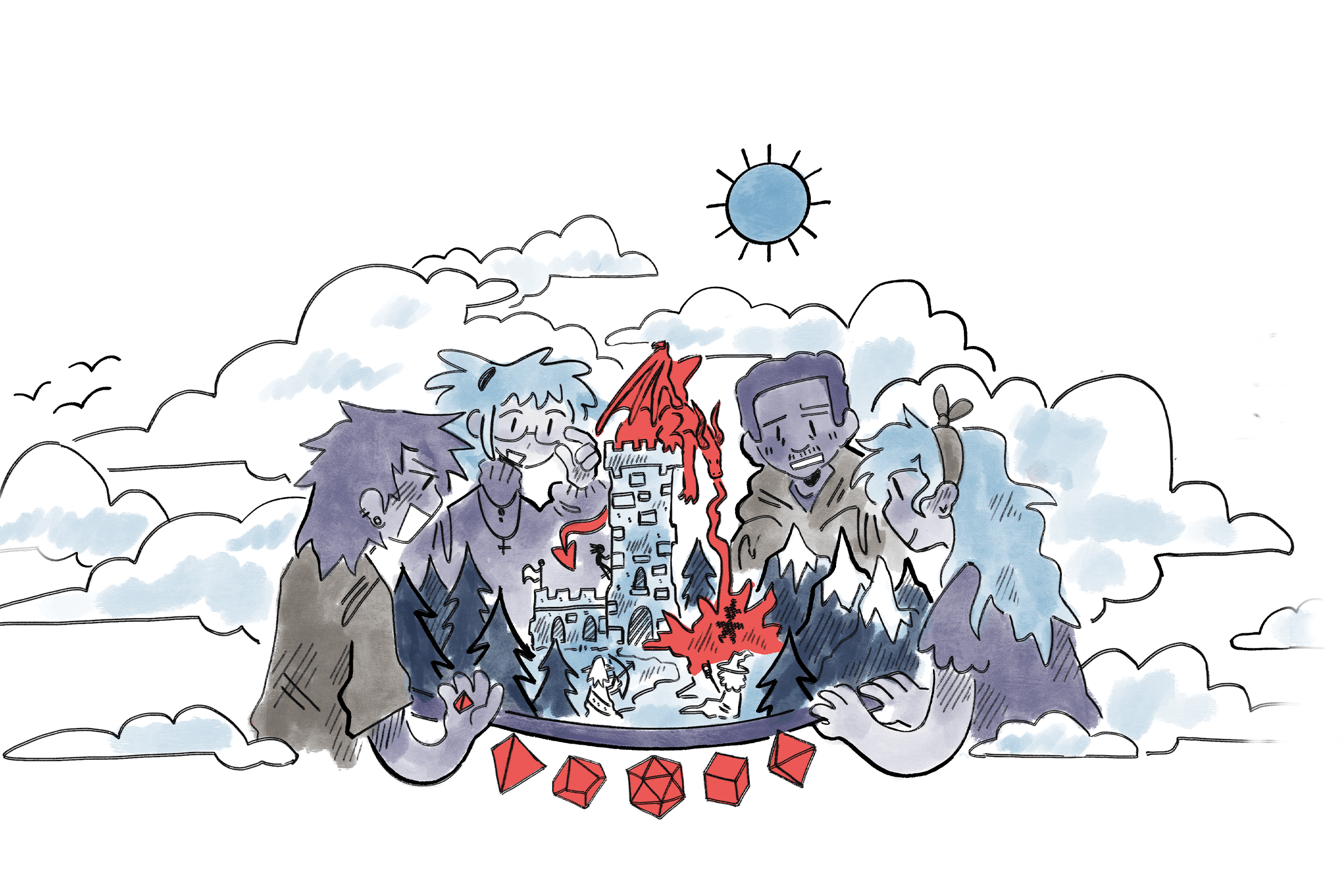
Dungeons & Dragons is a tabletop role-playing game where you and a group of friends tell stories together. I’ve been playing D&D for eight years, and during that time, the game has helped my friends and me through the hardest times. I love D&D, and will be playing til the day I die. Whenever people learn how much I love D&D, inevitable questions arise:
“Oh, I’ve always wanted to play. Could you teach me?” “How do you play?” “How hard is it to learn?”
Despite breaking out from nerd culture and into the mainstream, D&D is one of the most needlessly complicated games to exist. The first ever commercialized tabletop strategy game, D&D was conceived by Dave Arneson and Gary Gygax and published through their company, Tactical Studies Rules, in 1974. The game was later bought by Wizards of the Coast, who were in turn bought by Hasbro. Throughout this time, there have been six editions of the game, each getting more concise and palatable. Regrettably, it still feels like punching sand when trying to explain what D&D is.
This article is for every friend who’s ever asked to play, or anyone who wants to try out D&D but is overwhelmed by the rules and social folkways.
Despite my hyperbole, it’s actually really easy to play. When I first started playing, I was 12, and even though I had almost no grasp on the rules, it was the most fun I had at that age. You do not need to be good at D&D to have fun playing it. There is no way to “win,” so as long as you and your friends are having fun, you’re doing it right.
Where do you start?
First, you need to wrangle some friends together, preferably ones you don’t mind looking silly in front of. The official “Dungeon Master’s Guide” recommends you have a gaming group (otherwise known as a party) of three to five people. I’d recommend starting with three. You could theoretically play D&D with just two people, but one of the best elements of the game is debating with your friends.
Then you will need to pick a time to meet. D&D can be a massive time sink, but how long you play or how often you meet is entirely up to you. Most games are a part of a campaign, meaning they are played over multiple sessions. (The exception is the one-shot: an adventure played in a single sitting.) Some groups meet every week and play three hours, others only meet once a month but make a day of it.
You also don’t have to meet in person! Discord, Skype, whatever you prefer — you can play D&D from anywhere.
But what do you actually do?
Once you’ve established your group and you’ve set out a time to meet semi-regularly, you all get together to play pretend. I’m serious! You don’t need much more than that. D&D, at the end of the day, is a collaborative roleplaying game in which you and your friends tell stories together. The nature of those stories depends entirely on you. The genre? The tone? The setting? — Completely up to you!
But if that’s not your speed, or the task of creating your own adventure is too daunting, there are books you can buy at comic book shops and game stores with scripted-out stories.
How do we tell this story?
There are two categories of people when playing D&D: the party, consisting of the Player Characters (referred to as PCs); and the Dungeon Master. Think of the PCs as the characters in the story. They are the heroes pushing the plot forward, and each person who acts on their character’s behalf is sort of like their writer/performer.
Then there is the Dungeon Master (also known as the DM), the person responsible for narrating the story and playing the non-player characters in the world. A game can’t exist without both, and each role brings its own fun. Generally, the DM is in charge of creating the world in which the story takes place and having a general plot for what the story will be, with some healthy room for improvisation.
Doesn’t D&D have a bunch of weird dice?
While you could theoretically play D&D without them (though at that point, maybe you and your friends should just write a book), dice play an integral role in D&D. The dice are used to determine whether players are successful in their actions, or events and elements left to fate. They create a playful sense of chaos that makes every session unpredictable, even for the DM.
There are seven kinds of dice, with a variety of sides: 20, 12, 10, eight, six, and four. Dice sets come with two 10-sided dice; one has 00s.
What about all those rules you mentioned earlier?
Think of the rules as the foundation for storytelling. What if every time you wrote a sentence, you had to reinvent the syntax necessary to complete it? That’s what rules are to D&D — syntax. Having a small number of rules can help ground the story and give it a sense of weight. That said, not everyone is a grammar expert, in the same way not every D&D player is a professional game designer.
People who play D&D generally do not have all the rules memorized by heart. There is this wonderful thing called “looking stuff up” that you can do any time you are stuck or confused.
When deciding which set of rules you want to use, I recommend using the “2024 Free Rules,” which you can find online at dndbeyond.com. Don’t feel pressured to read every tiny detail. If a rule bothers you, feel free to change it! This process of modifying or inventing rules for your specific gaming group is called “homebrewing” and happens at almost every table.
When I first started playing D&D, it was just a way to hang out with friends and blow off steam in video game-esque fights we narrated to each other. We never rolled a single die. Now, D&D is my comfort zone to slip into a deep immersive narrative, and I’m the DM. We spend hours getting into character and exploring the world I lay out for my players. Bonus points if I can get my friends to cry.
There is no right or wrong way to play the game. A successful session of D&D is one where everyone leaves the table wanting more.