

Meekling Press, a self-described “very small press” in Chicago, goes out of its way to print experimental works in exactly the right form. Founded by alumni of School of the Art Institute of Chicago’s Master of Fine Arts in Writing program, Meekling publishes works that they care about on a printing press over a hundred and thirty years old. The first installment of their new seven-part chapbook series, “Chill Horizons,” arrives on November 1.
I met with Meekling editors Rebecca Elliot, John Wilmes, and Anne Yoder at their headquarters (Rebecca’s apartment) to discuss their printing press, upcoming projects, and “pataphysics.”
Founded in 2012, Meekling began when co-founders Elliot and Wilmes decided to take control of the publication of their own writing. Wilmes said, “When Rebecca and I graduated, we had anxiety about what to do next. Rebecca was starting to get really good at book designs and had a lot of energy on that front. I had this manuscript, and I wanted to do something with it. Eventually, we just decided to start publishing on our own.”
Their first piece was Patty Yumi Cottrell’s “The Jury of Sudden Hands,” a delicate book arranged of loose letterpress pages which features vivid prose shorts on each page. The book was created with a small letterpress, since replaced by the floor-standing platen press from the 1880s that they now use to print covers and postcards.
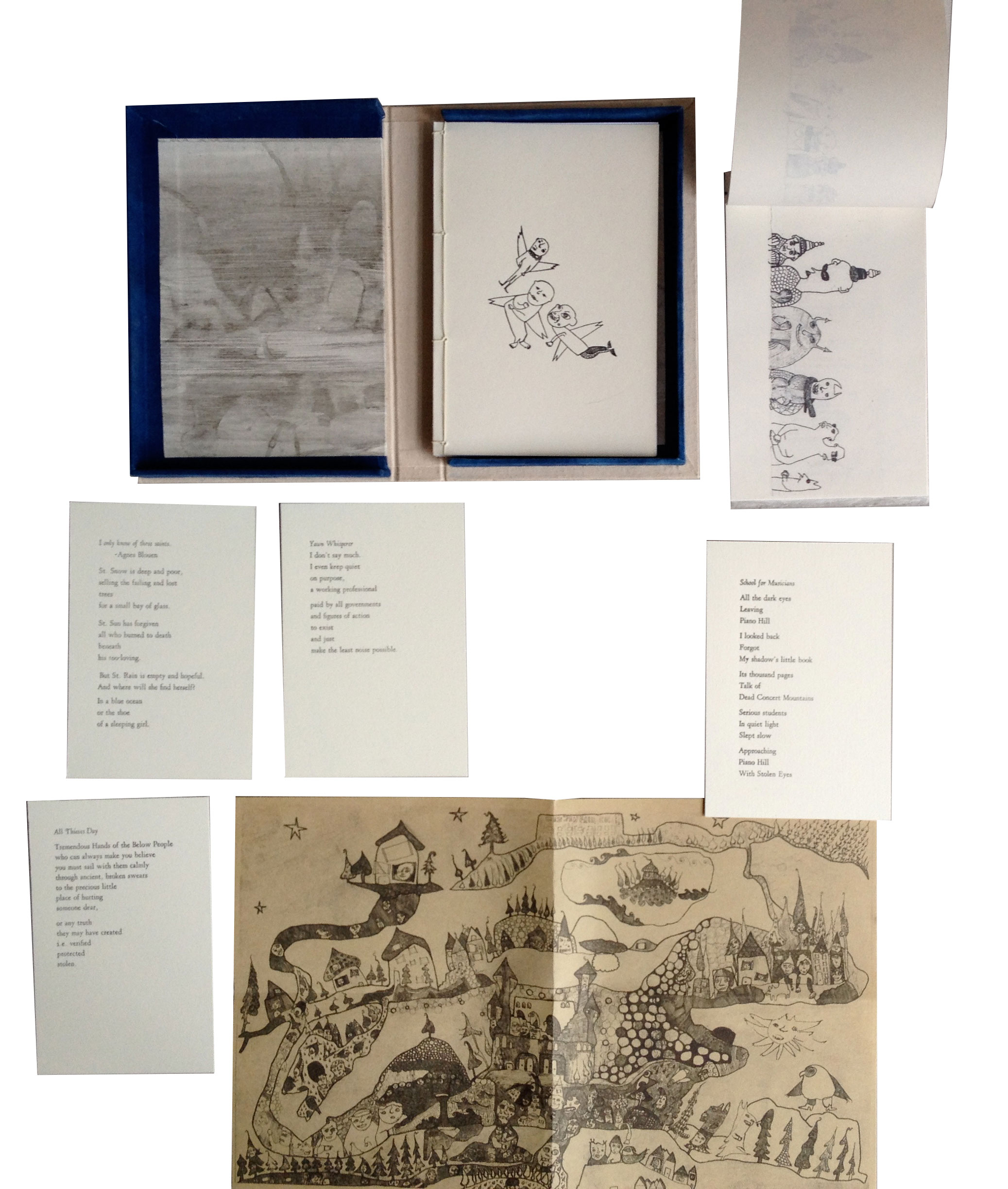
Meekling typically makes about fifty copies of each of their books. Wilmes said, “We’ll do different versions of a book, because some of them are incredibly detail-oriented and take a long time to make, like Erin Kautza’s book.” The elaborate work, “Muscles Involved”, slides out of its case to open into a long scroll. Wilmes continued, “We made thirty copies of this. Then, we also have a much easier to produce version of the book, because the poems are great, and we want them to live on without spending a million years making each copy.”
Dan Ivec’s “On the Stairs” also includes limited edition and regular prints, with the limited edition print featuring the artist’s detailed childlike drawings. Another publication, Miranda Steffens’ “Peripheral Vision,” includes a hypnotic web and sound component.
The press also released a series of six e-books on floppy disks with letterpress covers, now housed by the Joan Flasch Artists’ Book Collection. Elliot explained, “They have our floppy disk books, which are eBooks, uploaded on floppy disks.” Yoder added, “The challenge is finding a computer to read it.”
Meekling also hosts a series of writers’ talks, called “TALKS,” which parody their own format. The series satirizes panels often given on typography and language, which are popular in the small press world.
Yoder said, “The one stipulation for the lectures is that they have to be made up in some way. I think we decided we wanted to do something a bit more performative, or have a reading series that wasn’t a reading series. It wasn’t just everyone gathering for people reading from their books; I think we were influenced by the pataphysicians. Alfred Jarry is the original. Pataphysics is kind of a make-believe science. It fit the format of “TALKS” as a faux-lecture series. A lot of people have Powerpoints of some kind.”
“I was influenced by Dan Ivec’s performances,” Elliot said. “He does these great performances where he’ll show his drawings and then talk about them like they’re photographs from his trip.”
Wilmes said of the “TALKS” series, “Our last one, by Woody Leslie, was very fictional. It was about the molecular tendencies of typology. He would talk about letters like they were these naturally occurring things. His devotion to the fiction was incredible, to the point that when he sent us a pitch I had to look into it for a while before I realized it was not real. He has a book printed and everything under this pseudonym, H.F. Henderson.” Yoder said, “It basically outlines a whole theory of molecular typography and the attractions of the particles of the letter, as if they’re elements. It’s like, a comma is a dead dot particle, deteriorating.”
“My favorite was when he was talking about when the half circles of an ‘O’ fail to combine. He was like, that’s how we get parentheses.”
Asked if the new Chill Horizons series has any overarching theme, Yoder said, “I think there is a similarity, but I can’t really pin down what the aesthetic is. There’s a certain fragmentation.” Wilmes said, “If anything, I would say there’s a formal connection. There’s definitely more than one book that uses nontraditional arrangement of text on the page. But I would say that in terms of plot themes or anything, not at all.”
While Meekling has solicited work from individuals in the past, they opened up to the Chicago writing community for the Chill Horizons series, which features works by Heather McShane, Suman Chhabra, Evelyn Hampton, Holly Lee Warren, Hannah McHugh, Mairead Case, and Brad Vogler.
Wilmes said, “In this series we had the most pointed plan about what we wanted, and we had a call out for entries. So we got a lot of submissions from people we’d never met. That was the hardest thing, deciding who to publish. Where in the past we just had a lot of friends where we said, you’re brilliant, let’s make a book together.”
The first fifty of the series will come with a limited edition print to accompany each chapbook, and Meekling is still seeking artists for the later ones. Yoder said that the press looks forward to expanding their boundaries with the set.
“We have so many interesting submissions from people we don’t know. That’s really exciting,” she said. “And plus, it’s really great stuff,” Elliot added. Wilmes said, “We were like, oh, maybe we’ll get four books we can publish. We ended up getting seven. So, it was more than we were ready for, frankly. But it’s awesome.”