

As art students, we often face the question “what is art?” Everyone answers differently: art is whatever an artist does; it’s skill related; art is whatever causes an emotion in the viewer; or art is whatever a person does to share their emotions, regardless of the medium. Even if you find an answer to this question, we, the artists ourselves, sometimes like to divide art in “high” and “low” categories. A portrait, for example, is more often considered a “high” art, but a caricature is obviously an example of “low” art. For people who are involved in fashion, Dior is “high” fashion, but Zara is “low.” However, food is almost never a part of any “art” conversation. We consider food to be utilitarian at best, something we all consume to stay alive, almost never a form of expression to be considered and evaluated. Chicago’s Michelin-star rated Next restaurant proves that food is art, and deserves to be consumed not only as a means of generating energy for oneself, but as a narrative to live through.
Next, which opened 15 years ago in the heart of the chic Fulton Market neighborhood, changes its menu every four months. Each menu takes on a different concept, and it transforms every aspect of the restaurant itself, from decor and staff’s uniforms to the menu design and the wine card. This summer, Alan Mileykovsky, the executive chef of Next, is presenting the menu, named “Wall Street 1987.” For him, it’s both a take on the day in life of a yuppy stockbroker and a reference to the cult classic restaurants of ’80s Manhattan. A 10-course meal will take the guest on a day-long trip on October 19, 1987, AKA Black Monday, the day the Dow Jones Index lost more than 22% of its value.
Before you even get any food, at the door, you are greeted by Prada suit-wearing staff. They direct you to your table in a dining room filled with art; paintings on the walls, magazine covers of the time, and sculptures positioned throughout the room. It has a distinctly ’80s feel, yet it’s hard to articulate why. At the table, you are given a newspaper, which not only gives you key headlines from the year 1987 but also provides reviews of the key restaurants that the menu pays homage to. You’re served a dirty martini, made table-side with handmade olive brine, a special gin crafted by Macalan, and finishing with custom-made metal toothpicks for the olives. It is hands down the best dirty martini I’ve ever tried.
The tasting begins with a savory tart — filled with braised challot, topped with rabiola cheese mouse, and embellished with caramelized orange. Light, yet filling, this dish represented the beginning of the day for a stockbroker..
It is followed by a brunch classic from Manhattan’s Four Seasons Hotel restaurant –- shrimp cocktail. A dish so simple and seemingly pushed to its limit, as the sauce completely transforms the taste of cold shrimp and turns it upside-down. It is hard to imagine a better version. Still, Next and its culinary team perform something unexpected, adding a twist by altering the classic sauce. The new sauce presented by Next is not as sweet as the classic one, as it leans more towards the spiciness of horseradish and the tang provided by an ingredient that I was unable to identify. Playing with the classics, they created a completely new dish.
One of the last appetizers is a crepe pouch, filled with jamón, topped off with black caviar, and tied together with a single chive. One of the less impressive dishes of the night, it does not offer anything eye-opening or revolutionary. At this point, black caviar topping anything feels unnecessary and acts more as a status symbol, which, given the menu theme, works well thematically, but in terms of taste, doesn’t offer anything besides the pretty visual and possibly some additional saltiness to an already salty jamón.
Completing the appetizers section is a playful twist on oysters. The only presence of oysters is found in the shell-shaped plates that the food is served — in reality, it is a complicated salad with razor clams at its core, covered in melted cheese, served with perfectly toasted bread covered in honey and butter. By playing with expectations, Next’s team flips the typical “high-class” oyster into the more accessible, both in price and taste, razor clam.
After the appetizers, the main courses take you on a trip across several iconic restaurants and between multiple different food philosophies. Starting with a traditional mix between French and Italian cuisine, the guests are served pasta with morel mushrooms. One of the less playful and experimental dishes, it is still compelling, and it serves as a nice break between innovative and unique flavour pallets.
Right after pasta, guests are served with an exceptionally well-made chicken Kyiv. The twists that interrupt and, in a sense, disrupt this traditional dish are the sides — caramelized lemon, freeze-dried broccoli, and emulsified carrot with peas. When you cut into the chicken, the combination of butter and herbs exploding on the plate, covering all the surrounding sides, creates a visual experience reminiscent of Jackson Pollock’s best abstraction.
Following that, a turbot with a Spanish twist of a chorizo sausage sauce is presented. In the presentation of these dishes, my server mentions that at the time, chefs were trying to find new inspiration, and in those attempts, they started looking at regions outside France and Italy for new ingredients and flavour profiles. Again, a unique and unexpected combination of fish and meat, which works surprisingly well together, not overpowering each other, but rather presenting a new and serendipitous interpretation.
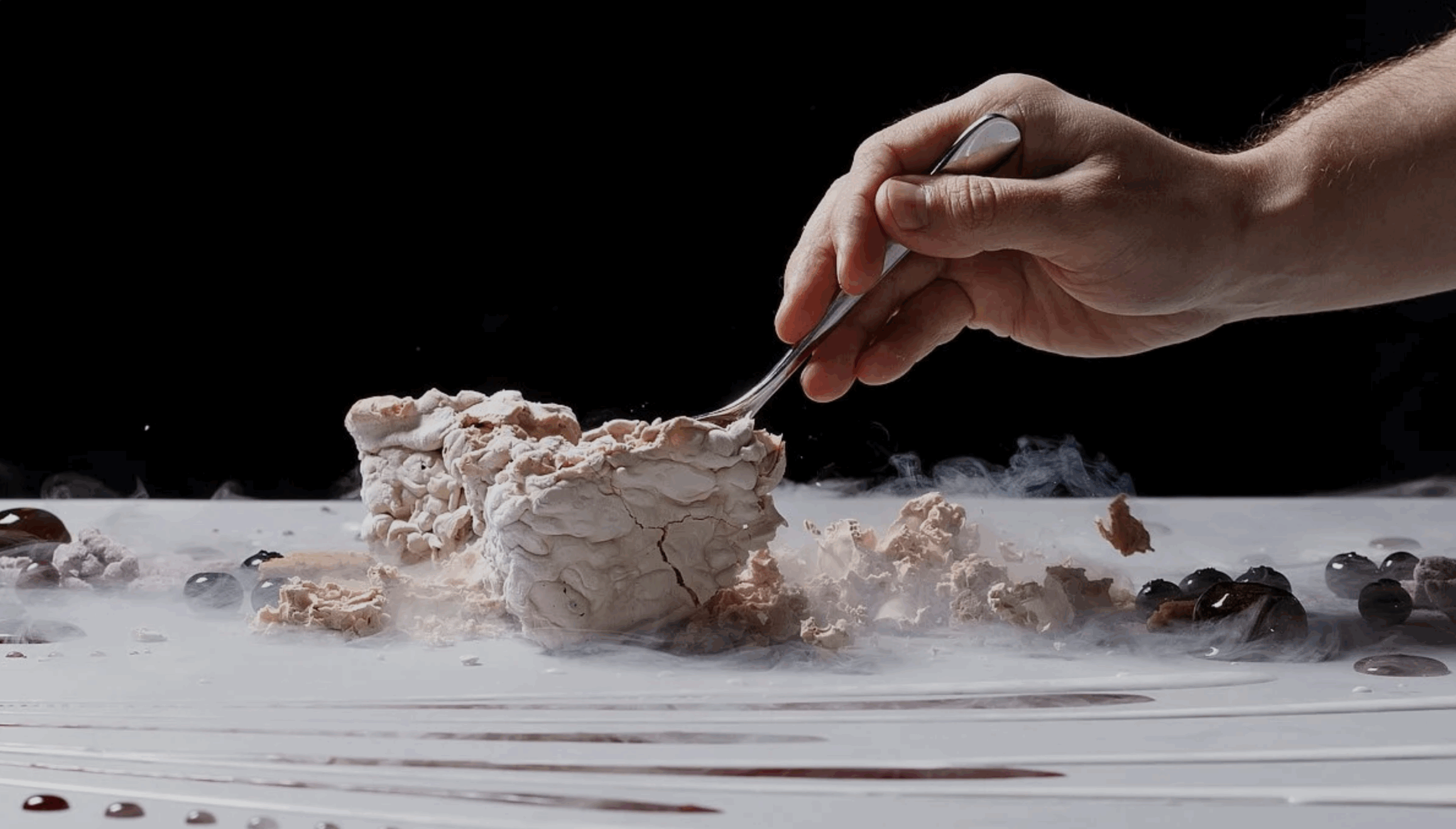
Before the final main course, the menu offers an intermission, a small break, to cleanse the palate. Bergamot and basil sorbet acts as a palate cleanser, accompanied by a sparkling peach soda. A simple-sounding quick bite turns into one of the most surprising courses of the night. Some might feel like this part does not belong in the menu and feels out of place, as its presentation appears too sci-fi compared to all other dishes, or because the palate cleanser is not something that we are used to in any other restaurants. But the taste overshadows any possible doubts. The peach soda resets both tasting buds and the eater’s mind, before diving deep into the final course. I can’t imagine a better intermission, and a more suitable one.
As a last main course, the guests are served steak, without which a menu inspired by 1980s Wall Street would have felt incomplete. Again, we are told that in the search for new flavours and cuisines, chefs travel around the globe, so this steak is inspired by tropical, South American flavors. Personally, I couldn’t figure out where the tropical inspiration manifests itself, but the steak was so magnificently done I didn’t have time or reason to think about other parts of the dish.
The closing act is dessert: a baked Alaska filled with pistachio ice cream. As a part of the presentation, Caribbean rum is set on fire and poured over the Alaska outer shell, to give it a charred appearance, smoky aroma, and slightly burnt taste. Thematically, it represents the stockbroker’s money burning in flames at the end of the notorious black Monday of 1987.
This menu works. It does everything right, without playing it safe or trying to appeal to a specific group of people with certain expectations. The whole experience feels intentional and well-thought-through. The service is immaculate, and the whole night felt like it was planned minute by minute. Chef Alan Mileykovsky, the man behind this concept, clearly loves the era he is paying homage to, and he has a lot of fun doing it. Not every new menu at Next works out and leaves a pleasant feeling and aftertaste —many diners have noted online the lack of consistency when it comes to menus’ success. Wall Street 1987 is definitely one of the menus that worked exceptionally well.
What Next and their head chef proves is that food and fine dining is a part of “art” conversation. It ticks off all the necessary points to be considered art: it requires skill, expresses emotions, and, most notably, it evokes emotion within diners. A well-curated menu is not as easily achieved as we might imagine. It takes as much precision as a painting, as much planning as a fashion show, and preparation and rehearsal on par with performance art. After leaving Next, I found myself reliving the experience for long enough that I can not imagine it being anything but Art at its highest.