


One of the most common reasons students choose a particular class is the professor teaching it. Some students will take two to five classes with the same instructor; others will take the same class up to three times because they love the class and the instructor who teaches it so much.
But this spring, when School of the Art Institute of Chicago students register for fall semester classes, they may not be able to find their favorite professor or class on the roster.
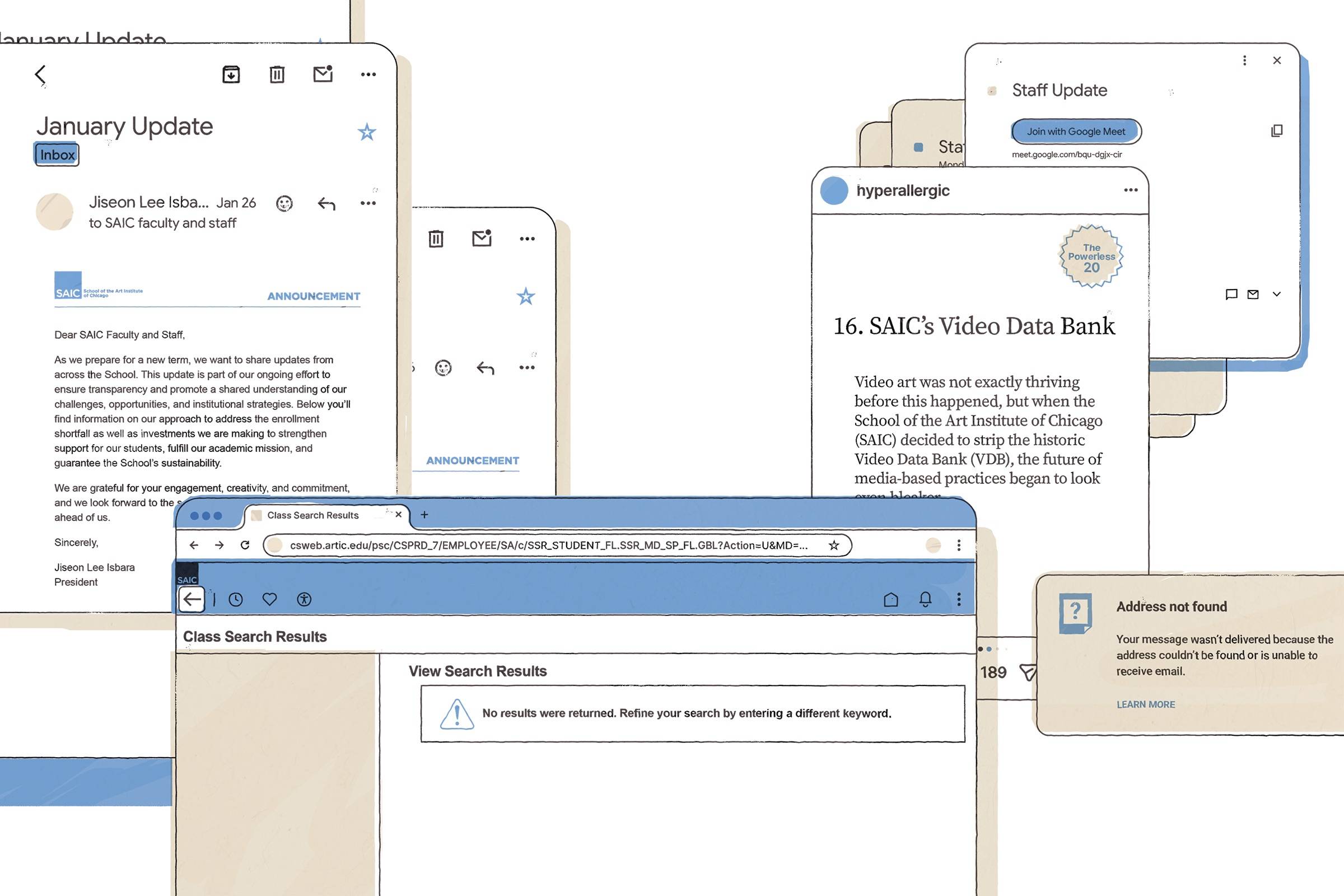
On Jan. 26, SAIC President Jiseon Lee Isbara and three other administrators announced in an email to faculty and staff that 16 Non-Tenure Track faculty, approximately 2% of SAIC’s faculty, would be part of a “reduction” — meaning they would not have their contracts renewed. The email explained that this is because the school will be offering fewer courses in Fall 2026 due to lower enrollment numbers. In Fall 2025, SAIC experienced a 3% decline in student enrollment.
According to the email, the dean’s office told each academic chair the total number of courses their department could offer and asked for course reduction recommendations. The email did not provide information about which faculty members had lost contracts, what departments they taught in, or which classes they taught.
All 16 faculty were AICWU union members. The NTT branch of AICWU has since been corresponding with the affected faculty to pursue impact bargaining and submit information requests to the school about how and why these decisions were made.
These reductions are in addition to the 20 full-time SAIC staff who were laid off at the end of last year. Accounting for just under 5% of the staff at SAIC, eliminated positions included the senior positions of the Video Databank, the advisor for Free Radio and ExTV, and positions in Campus Resources for Information and Technology.
After three years of working at SAIC’s Video Data Bank as the digital collection and media manager, Elise Schierbeek was given an hour’s notice that her position no longer existed. Schierbeek said she received a calendar invitation to a meeting labeled “Staff Update.” She met with the dean of the Library and Special Collections and a member of Human Resources in a room on campus she had never before entered. She was told her position had been terminated, given an HR packet, and then directed to leave so they could set up for the next person they were meeting.
Schierbeek was escorted by security to collect her things and say goodbye to her coworkers.
“It was so sad not to have privacy or trust. I felt like I had committed a crime,” said Schierbeek, who is also an alumnus of SAIC, receiving a BFA in 2019.
Schierbeek said, “The layoff has left me in an extremely financially precarious position during a record breakingly bad job market.”
Schierbeek, who grew up in the Midwest and considered Chicago home, had to look for work outside of Chicago. She is moving to San Francisco for a job as the collection manager and film restorer at the San Francisco Film Preserve.
The administration announced the staff layoffs in an email in November, emphasizing that it was “an extremely difficult decision, and we are deeply saddened by the impact this will have on the individuals who are leaving us.” They added that they didn’t anticipate further school-wide staff reductions this year.
In the January faculty reduction email, there was no expression of sadness about the individuals whose classes were cut.
Bree Witt, vice president of marketing and communication, said that chairs were asked to consider “the curricular needs of the departments, with attention to required courses, historically under-enrolled courses, and courses best designed to prepare students for post-graduate careers,” and to “prioritize the positions of faculty who had cross-disciplinary expertise or who possessed required, specialized skillsets.”
Witt added, “There are no plans for further school-wide faculty or staff reductions as a means of addressing budget or enrollment challenges.”
In a statement sent to F Newsmagazine, the AICWU executive board said, “We are deeply saddened to lose the knowledge and care of our affected colleagues, but grateful that we have a contract which affords us a seat at the table for impact bargaining. This loss, along with the loss of staff and the shrinking of the Video Data Bank, will resonate across SAIC.“
The 16 layoffs do not include any faculty who chose not to renew their contracts, retired, or were let go for non-enrollment-based reasons. Witt said, “Any resignations or retirements that have taken place are not included in this number — those are decisions made by individual faculty members. They happen all the time and are not tied to the reduction related to enrollment.”
While some departments said they did not have to “let go” any instructors, this does not account for faculty who are no longer employed due to the new truncated union contract renewal process. As part of the recently signed SAIC and AICWU NTT faculty collective bargaining agreement, NTT faculty must accept their letter of appointment within 10 days of receiving it.
N, a lecturer in the Fashion Design department who asked not to be named as she hopes the school may rehire her in the future, had been teaching at SAIC for 13 years. She missed the letter of appointment that she was sent and a follow-up email. Her spring course was still on the registrar with a full roster and a waitlist. Towards the end of winter break, when she tried to access her class through PeopleSoft, SAIC’s self-service portal, she couldn’t. She learned it had been reassigned.
“It was reassigned to an older colleague whose teaching I respect — so I know the class is in good hands — but still, this was part of the shock I felt,” said N.
N reached out to her department and the school administration to see if there was anything that could be done about reinstating her position.
“I was laid off, and they didn’t say it was about my performance. They said it was about the school not having enough enrollment from international students and having to reduce things. I didn’t hear that it was really about me, personally,” said N.
The email N received from the dean of faculty, which N shared with F Newsmagazine, said, “This decision reflects factors such as enrollment levels in the courses in your department and the department’s need for faculty who can cover a broader range of courses required in the curriculum. There will not be a new contract offered at this time, but you will be placed on a recall list.”
“I would argue that I am capable of doing that, so it was also part of my feeling of surprise that they were laying me off,” said N.
“[Being laid off] was a shock. It’s difficult for me financially, so I’ve been trying to pivot,” said N, who also spoke about having a young child at home to support.
The school is likely paying special attention to courses that provide career readiness post-graduation as a result of an executive order signed in 2025 that adds job placement data to the requirements for college accreditation. Abigail Glaum-Lathbury, the head of the Fashion Design department, said that these changes impacted the decision-making.
“In terms of the class reductions, what that means is that we are prioritizing classes that clearly support these pathways, and looking at running some of our classes that may have less consistent student interest every other year instead of every year,” Glaum-Lathbury said.
The individuals laid off, most of whom don’t want to speak on the record as they’re actively searching for jobs, say that they have been impacted financially and professionally.
Privacy laws have prevented F Newsmagazine from obtaining a full list of departments that have lost faculty and staff. Many department heads said they do not want to confirm or discuss personnel and hiring decisions. Outside of layoffs, departments across the school are having to make significant financial changes.
Jina Valentine, head of the Printmedia department, said she feels lucky that their department hasn’t had to make significant course reductions or any faculty changes. However, she spoke about how hiring searches have been postponed, as well as some smaller maintenance projects within the department and the 280 Building.
According to Aimée Beaubien, head of the Photography department, all NTT faculty contracts in their department have been renewed, but several adjustments have been made to the course schedule. Some courses — like the Photo Topics, Graduate Projects, and introductory photography classes — have fewer sections offered. Other classes — like Advanced Black & White Photography — have been removed from the schedule.
“Course cancellations are disruptive for students and faculty alike. Our goal is to balance fiscal responsibility while maintaining a strong, vibrant, and accessible curriculum for our students,” said Beaubien.
The Fibers and Material Studies department has also been able to keep all its instructors while shouldering course reductions, removing three undergraduate studio classes and three and a half Graduate Project slots.
“FMS has very high enrollment with waitlists, so I’m hoping that once SAIC upper admin understands the future enrollment, then FMS will be able to add back some or all of these grad and undergrad classes that have been cut from the 26-27 schedule,” said Christine Tarkowskil, the head of the department.