

Russian fashion designer Gosha Rubchinskiy gained popularity in the West in the mid-2010s after stars like Ye, formerly known as Kanye West, Justin Bieber, A$AP Rocky, and Lil Peep, amongst many others, were seen wearing his clothes. His signature Cyrillic branding became a staple of the fashion world and has inspired designers such as Heron Preston and Demna Gvasalia to include it in their collections.
Rubchinskiy, who started his eponymous brand in 2008, almost instantly gained an iconic status in Russia. In the early 2010s, he was discovered by the legendary Rei Kawakubo and became a part of the Comme des Garçon brand family, with his clothes being sold at Dover Street Market internationally. Although Rubchinskiy quickly rose to fame, his biggest breakthrough came when he was invited to do a show at the 90th anniversary of Pitti Uomo, a prestigious biannual menswear trade show held in Florence, Italy. After the show, he appeared in the Business of Fashion 500 list of most influential people in the fashion industry. Then, he was rumored to become Burberry’s next creative director, even making a collaboration with the brand, which debuted at his 2017 Autumn-Winter show, staged in Kaliningrad, Russia. That show became the first one in a series which later became known as his “Russian Trilogy.” After the show in Saint Petersburg and the following show in Yekaterinburg in 2018, Rubchinskiy seemed to be at the height of his career until an allegation of inappropriate conduct with one of his models surfaced online. Following the allegations, Rubchinskiy announced the closing of his brand in 2019.
Following the closure of his brand, Rubchinskiy went radio silent for a brief period, but soon announced that he was working on a new brand, GR-Uniforma. That endeavor, however, was short-lived and, despite positive reviews in the press, ended up lasting for less than two years. Rubchinskiy then tried to open a club in Moscow, Russia, at which time I got to meet him and formed a brief friendship. Unfortunately, this venture did not succeed either, and went silent again.
The silence was broken in December of 2023, when Ye announced Rubchinskiy as the new creative director for the Yeezy brand. Although promising, this collaboration did not bring anything new to either creative, except for some controversial merch, featuring an “F— Adidas” T-shirt among other items with Cyrillic alphabet writings on them. After Ye’s infamous posts online in which he referred to himself as a Nazi, Rubchinskiy announced his departure from Yeezy in early 2025, at the same time announcing the return of his eponymous brand.
Since the 2025 announcement, Rubchinskiy has dropped roughly 30 items online, none of which seemed to be anything but merch for himself, which consisted of basic items with his signature “Гоша Рубчинский” logo printed on them, in anticipation of his first proper return collection. Finally, after over a year of promotion, he announced on June 11 that his new collection would be called “Forum” and would be presented on June 15.
Staged in a recently renovated Soviet movie theater with the same name as the collection, Forum, the show was small even for the Moscow scene, with roughly 70 people attending. According to a journalist who attended the show, who requested anonymity for professional reasons, this building was a gift to Rubchinskiy from one of his investors and will become the first flagship store for the brand. The catwalk, as well as the walls, were covered with unfinished wooden panels, with Simon Galinov’s painting of a buzzcut back of the head as the backdrop, reminding me of his last show in 2018, staged in front of the famous painting by Erik Bulatov.
The fashion show, comprised of roughly 40 looks, can be split into four thematic groups, each with a distinct source of inspiration. Although, when presented on the runway, the groups were mixed together and split by color, rather than by theme. The main inspiration that shines through almost in every piece is Japan. Rubchinskiy mixes internationally renowned Japanese workwear, specifically tobi pants, with Western pleats at the front. Another pant style he takes inspiration from is traditional Japanese hakama pants — traditionally worn over kimono. Kimono-style bombers and denim jackets are another novelty for the Rubchinskiy brand. Both Japanese-inspired items pop up throughout the collection alongside the designer’s signature deep V-cuts, in a variety of unconventional materials and colorways. The choice to leave models in socks also appears intentional, drawing parallels with Japanese traditional tatami mats and barefoot walking. These new interpretations of Japanese traditional clothing are not surprising, as his brand is especially popular in Japan, and my source reported an abnormal number of Japanese buyers present at the show, all speaking highly of the collection and Rubchinskiy himself.
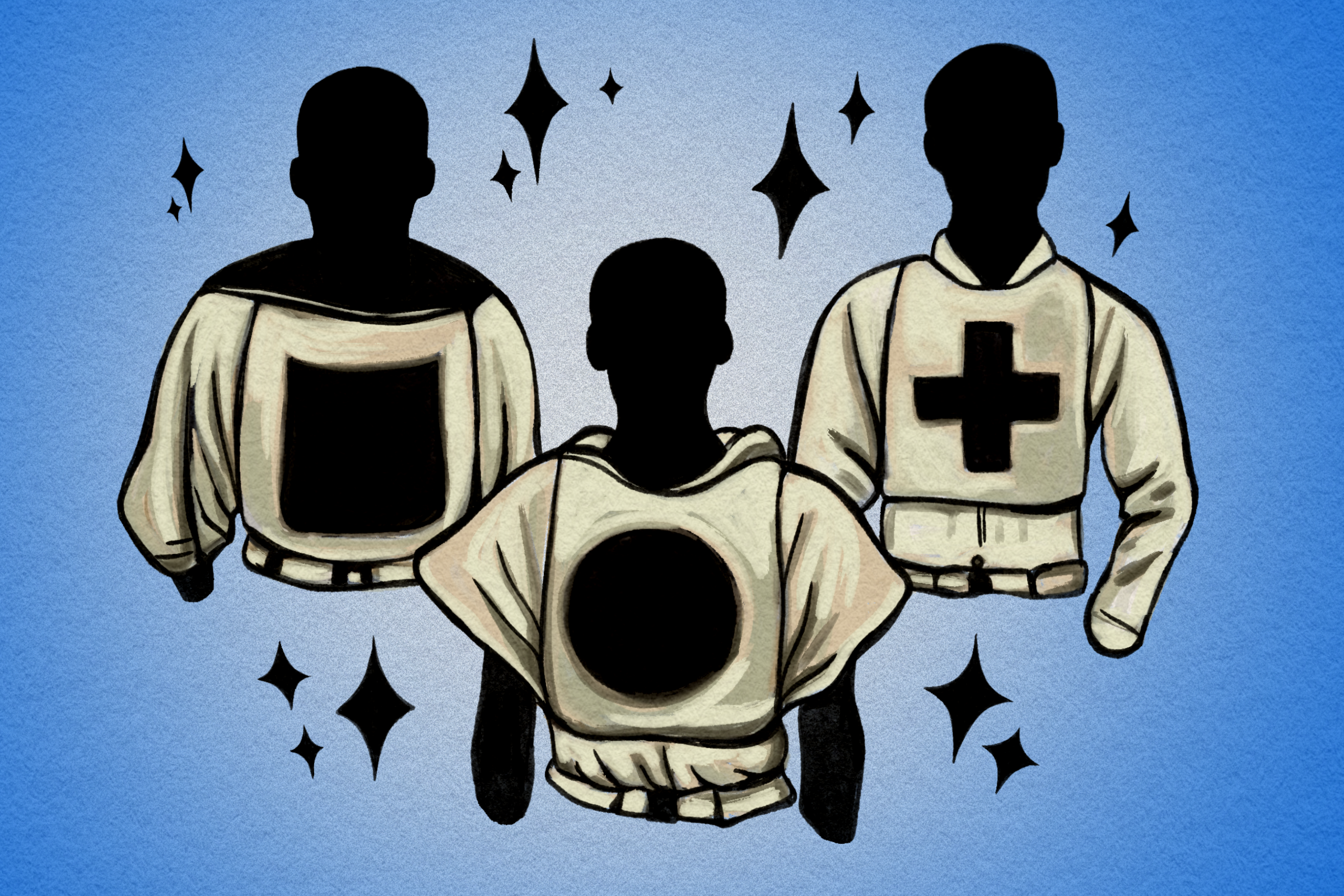
Another big source of inspiration for this collection comes from the Russian avant-garde, specifically Kazimir Malevich, the pioneer of Suprematism. Suprematism is an early 20th-century abstract art movement started in Russia, which focused on basic geometric shapes over realistic depictions of real-world subjects. Another big part of this group is the revolutionary opera of the time, “Victory over the Sun,” for which Malevich created the stage design. Unusually colorful sweatshirts, T-shirts, tracksuits, and coveralls come straight from the sketches of the opera’s costume designs and artworks made in support of the opera, which premiered in 1913. Black suprematist figures on a white background, which Rubchinskiy turns into prints, are direct quotes from Malevich and his masterpieces “Black Square,” “Black Cross,” and “Black Circle.” Most of the pieces in the group with avant-garde inspiration also feature deconstruction, tying them to contemporary Japanese designers, possibly as a nod to Rubchinskiy’s old business partner, Rei Kawakubo, with whom they split ways after the allegation of inappropriate conduct. In this group, some items were folded over before prints were applied, creating creases and uneven prints. The polo shirts and coats were worn backward and asymmetrically, resulting in fresh and new looks for common clothing items and for Rubchinskiy’s brand.
The final two parts of the collection featured more standard inspirations for Rubchinskiy. Both of these sections drew from 1990s-era Russia, featuring looks inspired by both military and civilian clothing trends of the time. Spread across almost all 40 looks, these inspirations manifested in black leather coats; bomber and biker jackets; military-style green shirts, sweaters, and tank tops; Burberry-esque trench coats, Navy-inspired belts, hats, striped patterns, sport-style shorts and tracksuits, 90s fanny packs, and distinct sunglass styles.
Following Rubchinskiy’s brand from the early 2010s, studying his career closely and knowing him personally, I would be lying if I said that I did not anticipate his comeback. I was only 16 years old when the brand closed, seemingly indefinitely, and hearing that he is returning with a new collection eight years later was a pleasant surprise that I was looking forward to. However, seeing the collection on the podium, I wonder if he should’ve stayed in retirement, a living legend for all Russian young designers, representing the unachievable dream of international success and recognition.
The collection itself is not necessarily bad; it is just very bland and uninspiring. Everything he showcased, he has done before. He already used Malevich as inspiration in his Autumn-Winter 2017 collection and Adidas 2018 World Cup capsule, as well as referred to El Lissitzky, another Russian avant-garde icon, in his GR-Uniform collections. He has already used Russia’s 1990s style as a source of inspiration for each and every collection he has ever done. But if before he managed to interpret it in a new way each time, this time it appears as a collection of “greatest hits.” He is seemingly reusing the same shirts he had in the A/W 2017 collection, in the case of the old police uniforms, as well as his F/W 2018 collection, where he heavily used the military style of the Soviet and early post-Soviet army.
The endless tracksuits and basic hoodies, even if they are presented in new colorways, seem outdated. Even the new Japanese-inspired direction he is taking is seemingly a recycling of his own old concept of “east meets west,” which he used to explain why he stages his show in Russia, outside of fashion weeks. People who follow Gosha, as many people refer to him, have seen it countless times before.
The fashion world has changed so much in the past eight years, shifting completely from the streetwear-style fashion that Rubchinskiy himself helped popularize, but it seems like all of these changes have missed Rubchinskiy completely. Seeing “Forum” is like opening a long-forgotten can of soup: it’s still okay to consume, but not very tasty, either, and you wouldn’t miss it if it rolled behind the fridge.
While discussing the show with my source, she surprisingly told me: “Most people here didn’t like the show either, but it doesn’t really matter because we remember the old Gosha; most people don’t even know he existed.” And it is true — most young people in Russia, or anywhere in the world, don’t remember Rubchinskiy’s old brand, or the atmosphere that surrounded it. For them, the concept of “Rubchinskiy’s greatest hits” will work, because they will be impressed just as I was impressed when I was 15. I first decided to become a fashion designer after seeing Gosha Rubchinskiy’s fashion show, and I haven’t regretted it once. More than 10 years later, maybe he will inspire a new generation of designers to reach for the stars, even if he himself has long fallen to the ground.