

The Whitney Biennial is held every two years at the Whitney Museum of American Art in New York, and has long served as perhaps the most visible stage for contemporary American art. The 2026 show opened to the press on March 3 at 10 a.m., and we were there for it. We arrived from Chicago the night before as two international student reporters — one from South Korea and one from Germany — here to see what American contemporary art claims to be right now.
The morning after we arrived in New York, we stood in front of the Whitney Museum. It was early in the morning. The wind and rain blew onto our faces while we tried to perform as professional culture journalists so we could sneak into the press opening of Whitney Biennial. We walked past the security, signed in at the press desk, and we were ready for our day. The free croissants and coffees were already gone, the chairs had all been claimed, and many people were standing in the back. These limitations felt like the art world today.
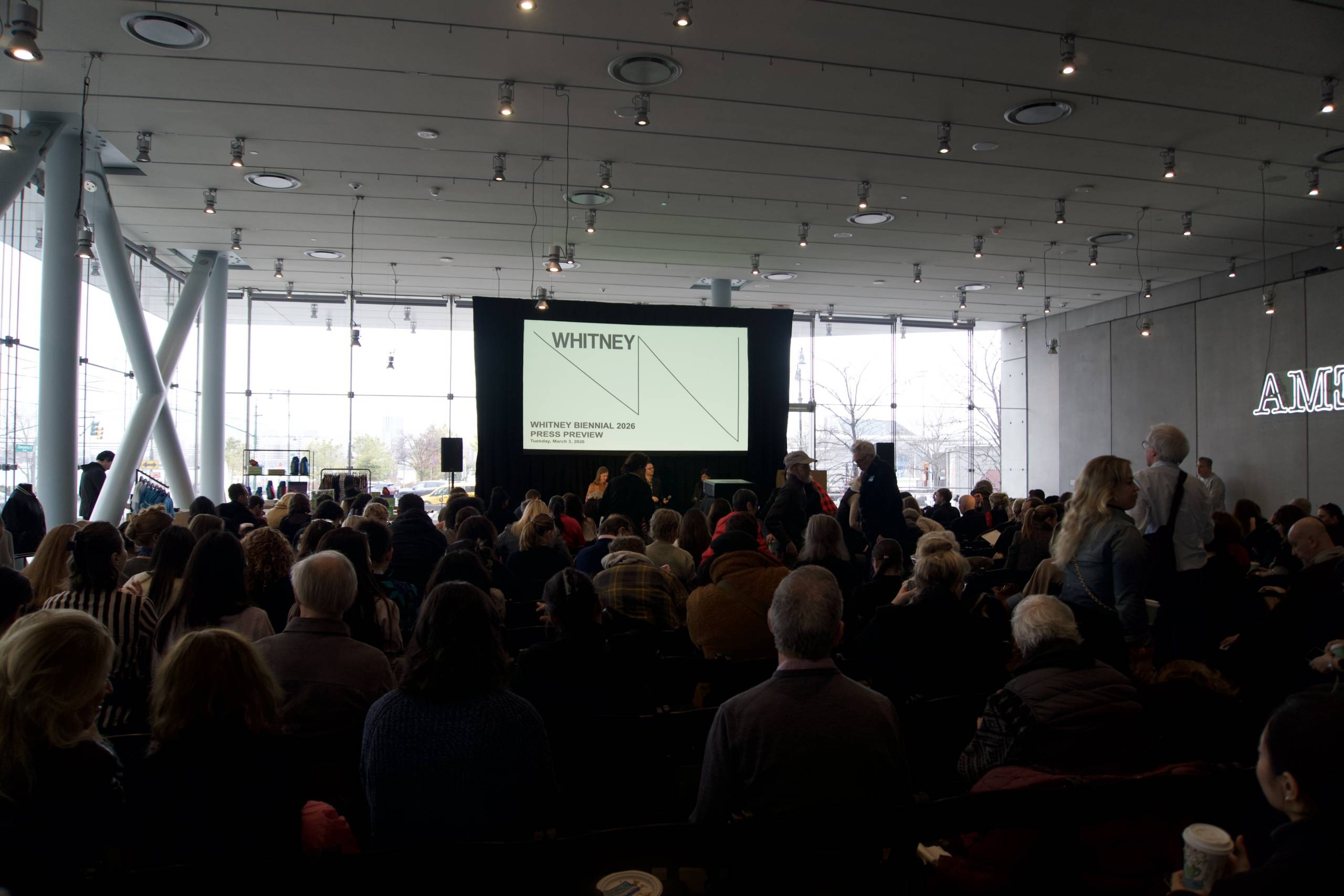
As two young emerging artists finding our way, we feel like we are navigating within the ruins of the art world’s capital. We have both heard and witnessed the controversies around the biennial: questions of representation, a crisis of relevance, and its deeper compliance with the donor class. As German and South Korean artists, this was our first time at an event of this scale in the U.S., yet everything felt so familiar.
Germany’s and South Korea’s contemporary art worlds were shaped by American institutions like the Whitney in the beginning of the 20th century. We came here as two international students to not only understand how “American artists define culture,” as the Whitney’s promotional material claimed, but also to see firsthand what position the United States takes exhibiting in the epicenter of the West’s decreasing prominence on the global stage.
| CULTUS, Zach Blas
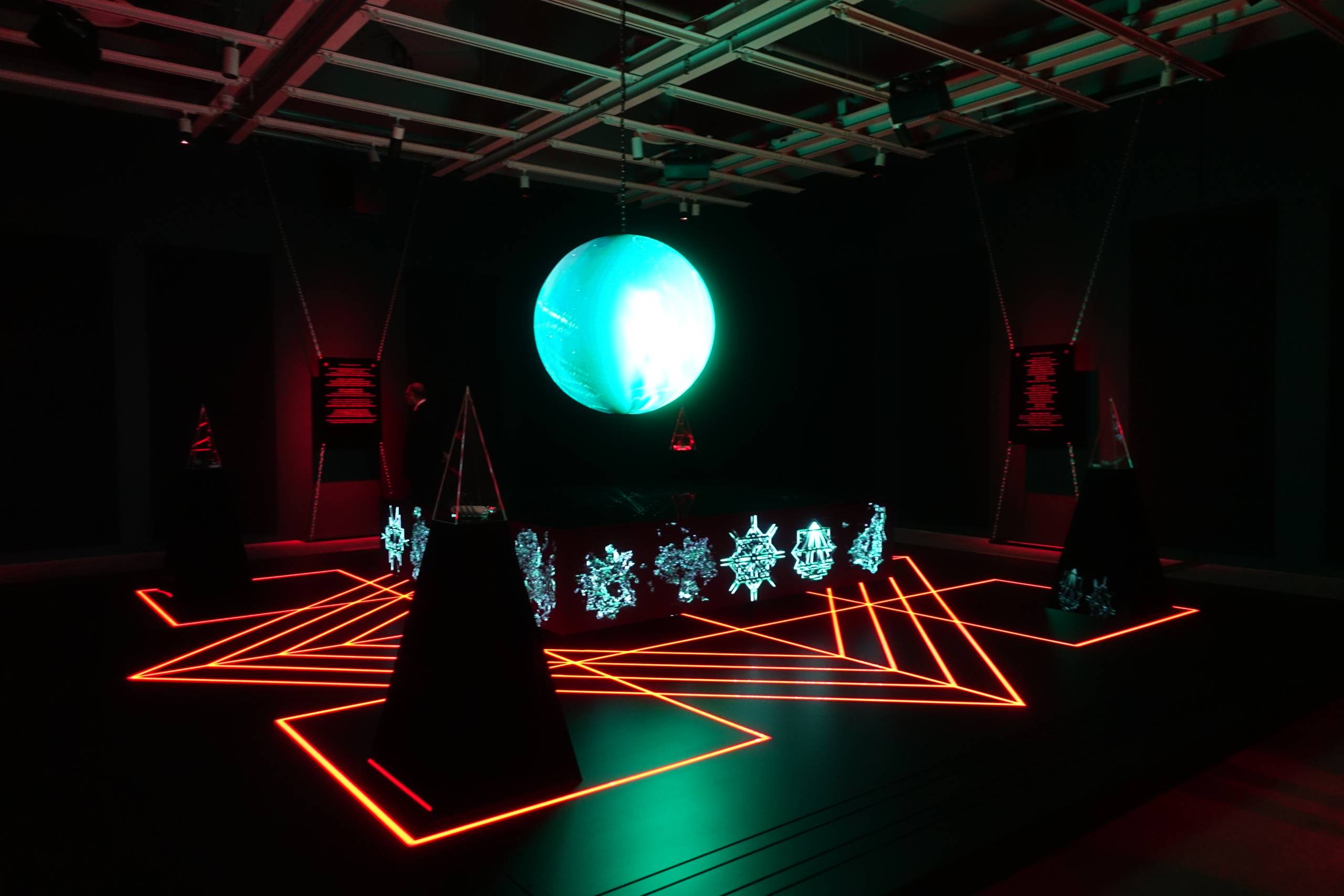
Before we entered the actual main floors of the Biennial, loud digital noise led us to CULTUS, an immersive media installation by London-based conceptual artist Zach Blas. The sounds reminded us of a low-quality techno holy final boss with its synthetic voice in heavy, high-pitched beats. We saw the vivid neon lights from a whole staged altar scene, its edges glowing in red and white. At the center stood a projector-mapped sphere, a totemic avatar that seemed to be a speaking entity in the room.
We both immediately noticed that this place looked like the occultist basement of tech CEOs like Sam Altman, Elon Musk, or maybe even the inquisition room of Peter Thiel — figures who are interested in world domination through venture capital. It felt like a recreation of America today, obsessed with digital mysticism and occultism’s grip on the new digital manosphere.
It felt like being inside a nostalgic computer game, while at the same time raising more questions as the whole installation mirrored the overstimulating AI-generated imagery we now scroll past on social media every day. While the work’s spectacle focused on the spiritual, dark, and hypocritical ideology of the tech occultist, we kept having difficulties researching a navigation through the dystopian artistic vision and the actual reality of this ideology and how it affects us right now. What does it mean to recreate the techno dystopia in 2026 — three years after CULTUS was made? The accelerations we lived through brought us to a point where we began to question the recreated visuals, when the image becomes more of an appeal than a critique.
| System’s Void, Sung Tieu
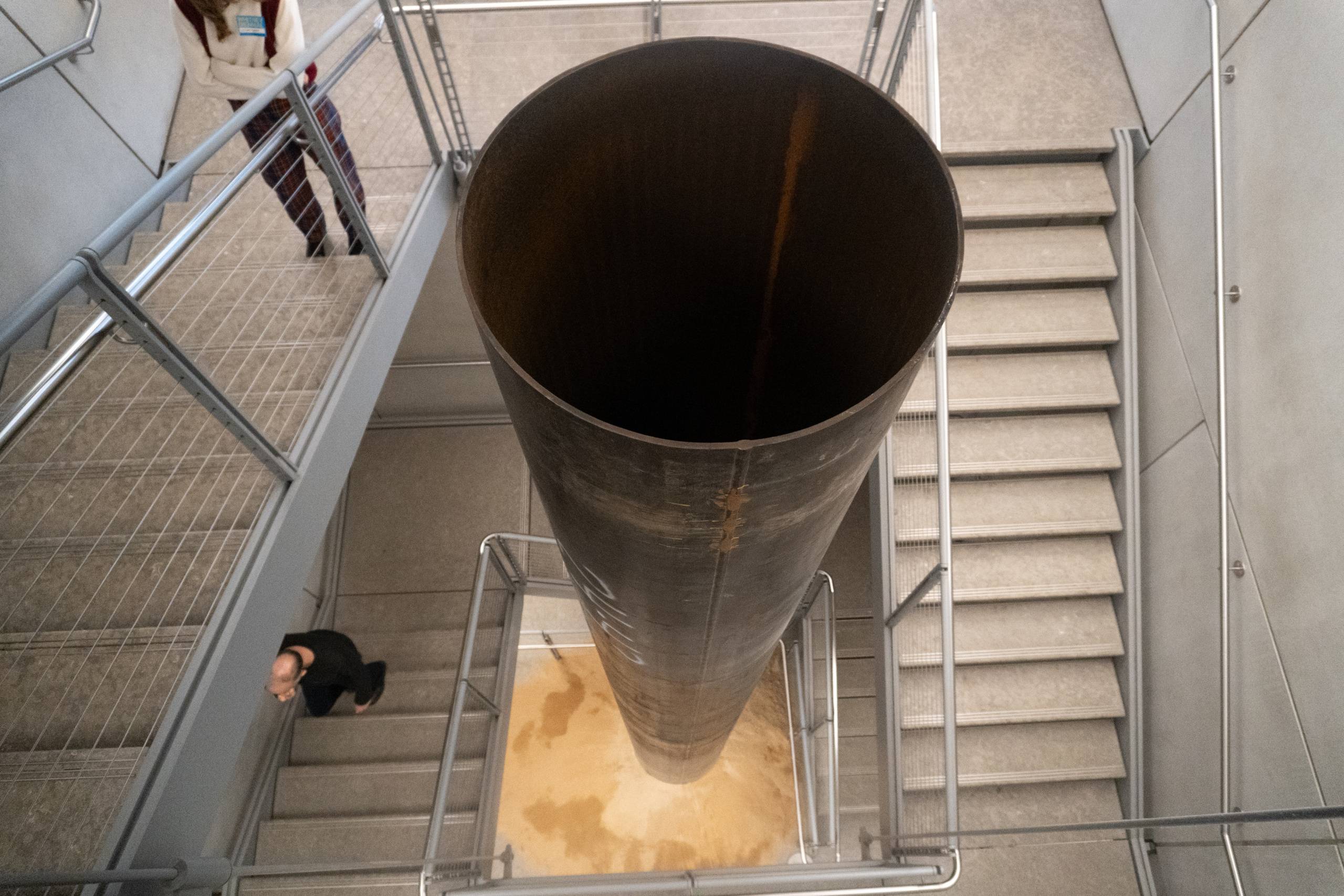
Walking out of the artificial basement environment, we heard another sound. As the chants from the CULTUS faded, we followed a long metallic echo through the stairwell. In the middle stood a huge metal pipe by Sung Tieu, like a new rusty column that didn’t seem to belong in this clean, modern building. Going up, the walls at different levels displayed projected words and serial numbers that shifted as we climbed.
Tieu has become a leading voice in Germany for research-based art. She has succeeded in being represented in the most important shows worldwide, including the São Paulo Biennial, the 15th Gwangju Biennale, and the MIT List Visual Arts Center. At her big solo show in KW Institute for Contemporary Art in Berlin, she continued her artistic practice on administrative violence. Together with the late Henrike Naumann, she was chosen to represent Germany at the upcoming Venice Biennial.
With System’s Void, Sung Tieu materializes “Capiltaistic-PSYOP” America, the country as a land of managed absence. “PSYOP” stands for Psychological Operations, first conducted in 1918 to influence foreign audiences, then turned inward toward American citizens during the Cold War. They are said to continue, even today, shaping domestic society through media, entertainment, and digital platforms.
Working with data scientist Gary Allison, Tieu surfaced the chemicals the United States endlessly renames to hide their effects on breathing. Rather than producing something new, she deploys the existing infrastructure to reveal how mediality itself shapes the discourse. On the wall were thousands of names of chemicals, renamed again and again to obscure their harm. The pipe standing in the middle of the institution represented the underlying supply infrastructure; metallic sounds echoed the hazard gas report.
Walking up the stairs, we thought of the scene where these pipes were buried all over the cities and landscapes of America. It seemed to symbolize the ways in which societies gaslight and are gaslighted interchangeably.
Pushing the door open on the fifth floor, we entered the main hall.
| Untitled, Andrea Fraser/ figurative paintings of Carmen De Monteflores
On the right side of the hall, we saw the three sculptures of babies lying on the pedestal, lined up, and carefully covered in plexiglass, alongside the huge figurative female body paintings in the background which were drawn by her mother, Carmen De Monteflores. The piece gave the impression of an incubator.
In the exhibition catalog, Andrea Fraser, a performance artist known for her institutional critiques and media installations, mentioned how her mother’s artistic practice inspired her in her youth. She mentioned her institutional critiques as both authority-questioning and on the other hand, taking revenge on the art world that rejected her mother.
The original 2024 version of Untitled was supposed to be shown with her video work from 2003, which depicts the artist having sex with an art collector. Borrowing her expression, depicting Fraser as the prostitute and the sculpture as the offspring.
The piece made much more sense with the video, embracing the toddler sculpture as the part of her critique of the art market. However, what was supposed to be a critique seemed to merge with her desire for artworks (offspring) to be unconditionally loved, creating an irony of isolation through the material she chose: un-hardening wax, covered and secured.
We hoped to see another institutional critique, sculpting the future. Instead of her original intention, it seemed to us that the work we now saw was emphasizing her private desires, even using her institutional power she accumulated with her past works to bring her mother to the biennial, to the very center of the art world she used to critique.
| Camoflux Recall Grotto, Leo Castañeda
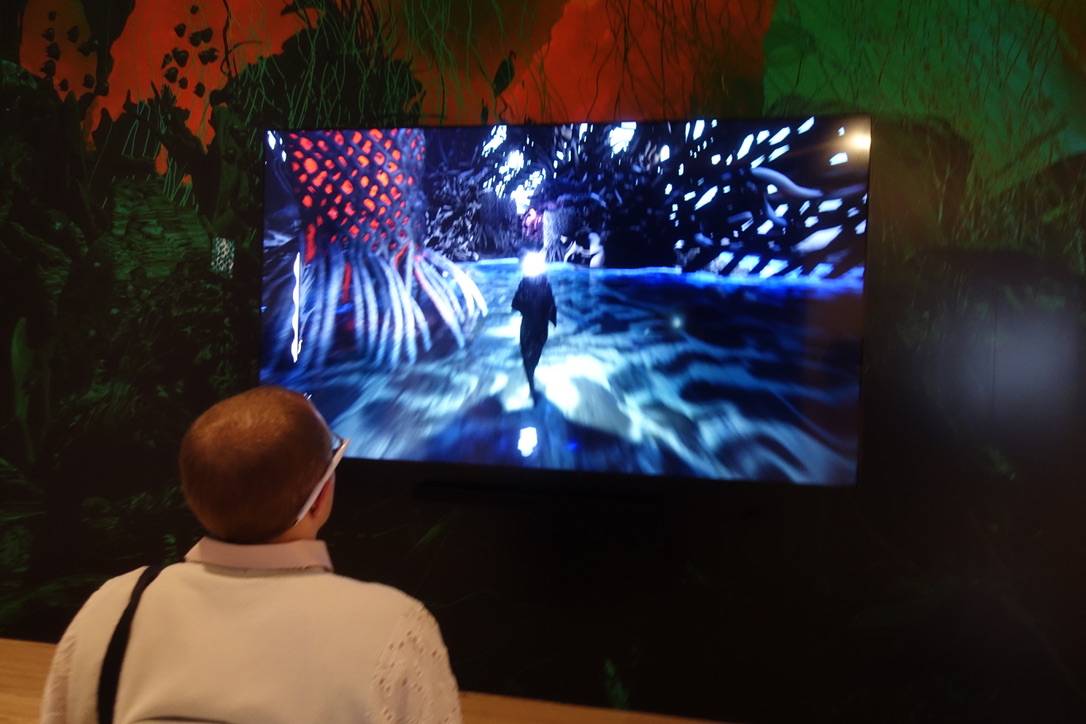
Navigating through the sections divided with partition walls, we encountered an area with multiple screens where all the new generation digital artworks seemed to belong.
While it seemed that the art audience was still hesitant to interact with an artwork that took the form of a computer game, we picked up the controller and virtually walked through beautiful fantasy nature graphics. We wondered what distinguished this work from other pieces that used interactive computer game engines. Was it the specificity in the graphics? Was it the method of play? Did it offer a perspective unavailable in commercial games? What made this a work of contemporary art rather than just a game?
According to the catalog, the curator Hans Ulrich Obrist emphasized Camoflux Recall Grotto as a homage to the artist’s grandmother, Maria Thereza Negreiros, a renowned surrealist painter. It felt like a commentary on the disconnect between the art world of the past and contemporary digital culture.
Watching the conversation, we had hoped to see the discussions of the game as a method of artistic expression or the inevitable collaboration between different disciplines of making. As media artists ourselves, we were looking forward to a deeper conversation about what it means to code an artificial environment to recreate the immersive present and the effects of interacting with the audience by web. Instead, the conversation stayed on the surface.
While Obrist frames the work through the identity and the geographical narrative of the artist’s Colombian grandmother, Castañeda himself emphasizes his interest in the gaming industry and in facilitating more exchange between the art world and the gaming community. It was hard for us to understand why one of the leading curators of our time still considers exhibiting games as a revolutionary act in a 2026 exhibition catalog, while ignoring the inherent segregation of digital culture, and moreover when digital materials have already been leading art scenes for decades.
| Homo Machina, Gabriela Ruiz
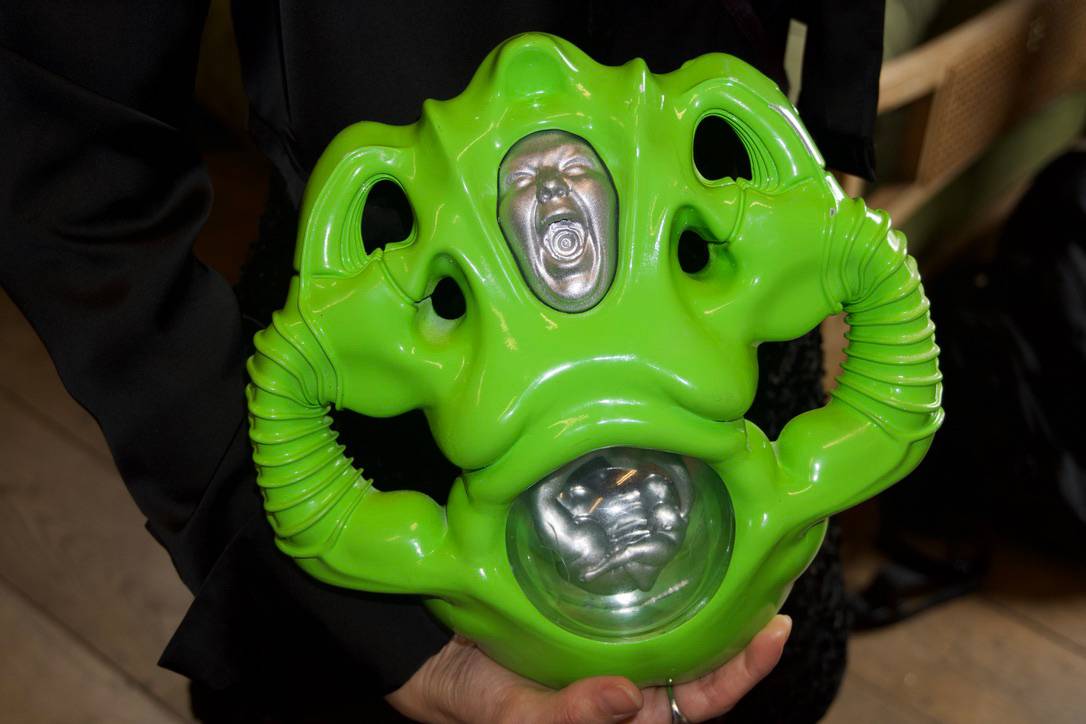
Next to the Camoflux Recall Grotto, we saw a massive neon golem by Gabriela Ruiz. We were both surprised to find the retro-utopian design genuinely refreshing in 2026, living in an era with the same iPhone in everyone’s pocket. We were both intrigued by the ‘90s retro-futuristic aesthetic with a grotesque Frankenstein-like figure replicating the artist’s face. Within the neon green plastic surfaces, we found small screens showing surveillance camera footage and abstract video sequences inspired by Ruiz’s personal experience of digitally archiving memories. On the creature’s belly, we saw the Ouroboros symbol rotating endlessly — a symbol that has become increasingly prevalent in tech art. In this iteration, instead of the circling snake of constant recreation, a human torso devoured its own snake tail.
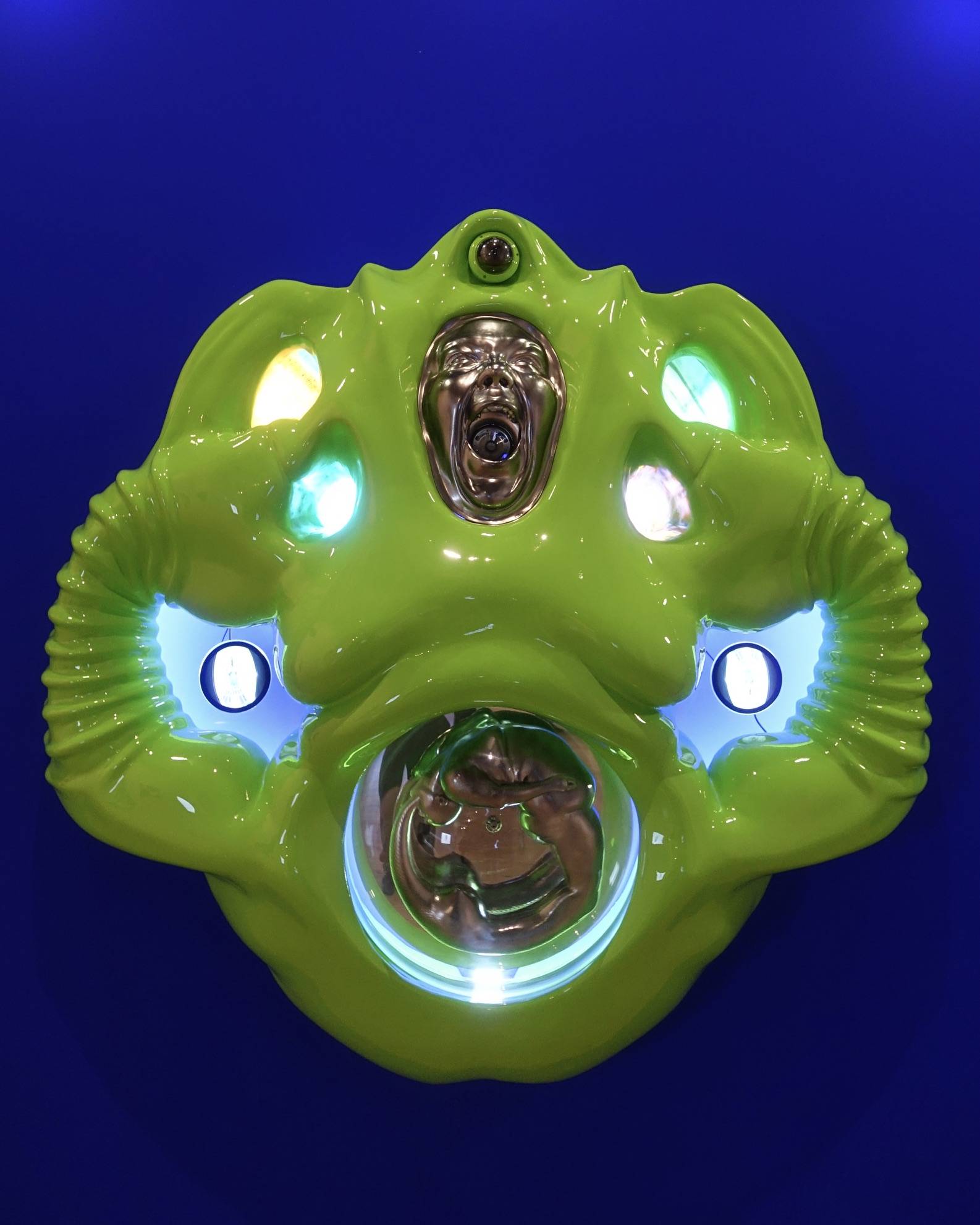
We were unsure whether this human ouroboros was turning into a snake, or the snake was becoming human in this chaotic cycle.
“It’s a shiny but wobbly world we are living in,” Ruiz told us. When we visited her residency studio after the opening, she shared her process and the demo version of this bigger installation. She told us what it meant for her to be exhibited at the biennial as a non-institutional first-generation Latina artist from a working class family, who believed in her own aesthetics and drive. She pointed out that she is not just interested in late-’90s nostalgia of a promising future, but wanted to reinvent a certain digital DIY culture that enabled her to become a self-made artist in 2026.
Institutions in America are still full of international people. People that follow the path of successful previous generations that led countries all over the world, come and stay in the U.S., passing through those narrow gates. The School of the Art Institute of Chicago is also full of international students.
Even though we are in America now, the gravitational pull of American influence started to drift away at some point. Roberto Sifuentes, a professor in SAIC’s performance department, shared the story of the transgressive 1993 Whitney Biennial. That year’s biennial carried a genuinely progressive charge, pushing against dominant hierarchies. Featuring works by Daniel Joseph Martinez, Glenn Ligon, Janine Antoni, and Pat Ward Williams, the art at the 1993 Biennial was a form of direct resistance, pushing back against the conservative pressure of the institutional art world.
“The Whitney Biennial is where American artists define culture,” according to their promotional materials. This year, the 2026 Whitney Biennial focused on stretching the boundary of “American.” And yet the exhibition introduction deployed the softest, most abstract terms possible: “mood and texture rather than definitive answers,” “avoiding clear ideological declarations,” and “ensemble suggesting togetherness.” All of these phrases give the impression of carefully suppressed urgency, given the edge of the cliff we are living on, for an institution navigating government pressure to defund the arts.
| Sanhattan, Ignacio Gatica
We only took a brief look at Imprints by Kelly Akashi in the outdoor gallery before the continuous rain and the strong wind blew us back inside. Walking backwards, we noticed the alignment of pipes for an indoor installation matching the proportions of the windows. Turning into the short hallway, we saw the room on the right.
The room had two LED panels facing each other, showing constantly shifting coordinates, and a video installation in the middle. In Sanhattan, Gatica layers photos of the financial district in Santiago de Chile over the financial district in Manhattan, showing how ideologies and their aesthetics are copy-pasted from America.
By coincidence, we caught Gatica in the room, and were able to have a short chat. He told us about the urban landscape as a visualization of the infrastructure of global capital. He referred tot the Chicago Boys – intellectuals taught in University of Chicago who later laid the foundation for neoliberal privatization in Chile during the dictatorship. The video indicated the export of modern aesthetics as global destruction by the symbol of architecture, made in America.
During our conversation, Gatica also referred to the architecture of the current Whitney Museum, which was designed by Renzo Piano, the same architect behind the Pompidou Centre in Paris, and Modern Wing of Art Institute of Chicago in 2008. After our short dialogue, the installation became part of the building through its shiny, modern pipe melting into the interior, turning the critique into something embedded from within.
| Doomscroll, Joshua Citarella
Perhaps one of the most radical works in the Biennial was Doomscroll by Joshua Citarella. Viewers go upstairs to the sixth floor, turn right, and the work is — nowhere. All that’s visible is the trace of an artwork about to happen, or that had already happened, marked only by a sign on the wall. Actually, the work itself exists outside the institution, distributed as a podcast on the internet.
In our conversation with Citarella, he explained that the piece is a conceptual statement. The media art scene of New York has already shifted outside of major institutions and into digital infrastructures. This context felt like a confirmation of what we had been sensing these days: institutions are often bringing an outdated dialogue, recreating previous discourse.
Citarella also pointed out that there had been a major flip, especially in the New York gallery scene after 2015 and the 2016 election, where technology started to move faster than the institutions. The gallery scene became ultra-conservative in its choice of medium. Most discourses are happening in the digital culture now, and institutions are trying to figure out how to respond to this unique moment of media and politics.
“We are now living in the particular dystopian future where change is very possible,” Citarella said. “We have to kind of do what we can to steer all of these variables in the moment to create the outcome that we would want.”
Citarella intervenes with his podcast, at the intersection of theory, culture, and digital phenomena. At the Whitney Biennial, where the boundaries between institutional and digital discourse are blurred, the conversation lives online and places itself literally inside the museum. (Personally, we would recommend Doomscroll’s first foundational episode featuring media artist Trevor Paglen.
At 1 p.m., the official press opening ended and we stepped outside. Slowly drifting away from the Whitney Biennial, we were intrigued and inspired by all the artworks we had seen. Since coming to America for our first year of graduate school at SAIC, our lives have been heavily challenged by U.S.-influenced global politics. We discussed whether we could continue our studies in a country closing its borders and turning inward. Surrounded by all these urgent discourses, as people who find ourselves inside these institutions now, we started to ask ourselves, what should we do?
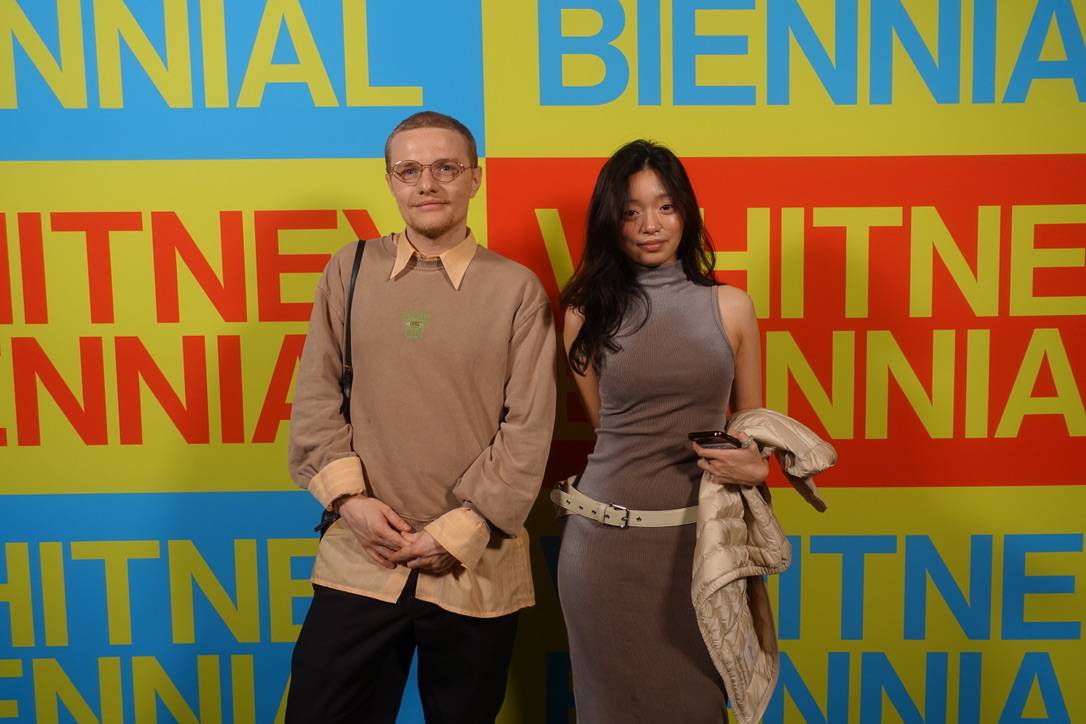
At the VIP opening, one of the most crowded stops was the Whitney Biennial photo wall. We hadn’t seen any other line in front of an artwork all day. After taking our photo, it was difficult to continue the critical thinking about our article, as we saw many influencers from New York walking around the museum. It was funny that one of our lasting thoughts of the biennial was about influencers, who only exist for us through social media, while the exhibition had shifted our perception on how many different artists are looking for answers to question our presence in today’s world.