

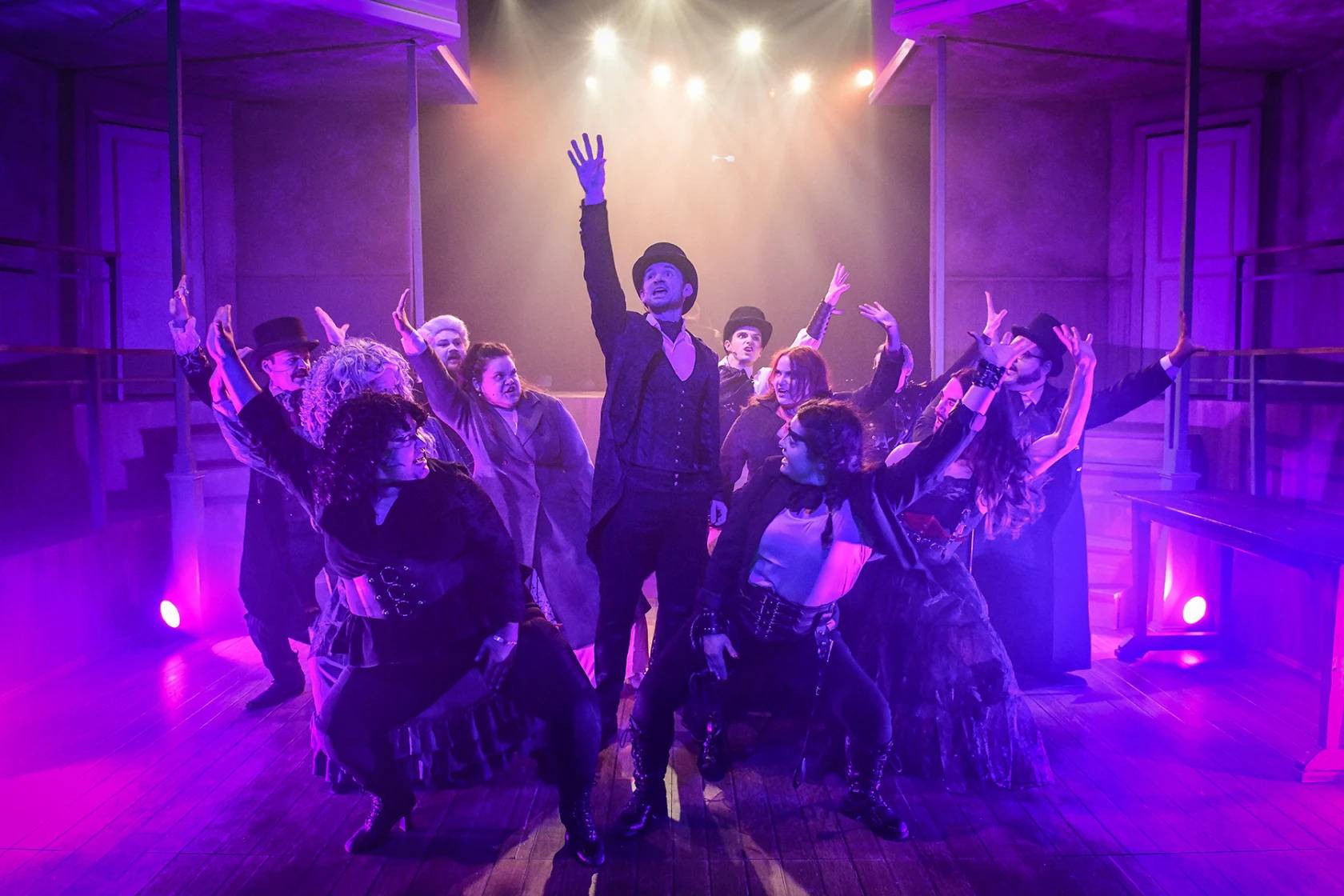
I had the pleasure of watching a production of “Jekyll and Hyde: The Musical” on Oct. 17, at the Chopin Theater, performed by Kokandy Productions. Running through Dec. 21, the production is located a few blocks away from the blue line’s Division station, the Chopin Theater is nestled between brick warehouses – an intimate, lively glimpse of the Chicago theater scene. Impressionist paintings and posters of the theater’s history hang upon a lovely seafoam wall, complete with ornate filigree. I sat down in a chilly theater, watching the ensemble form an amalgamation of arms, voices, and eyes, narrating the classic story of the downfall of a scientist driven mad by his hypocrisy.
Based on the novella “The Strange Case of Dr. Jekyll and Mr. Hyde” by Robert Louis Stevenson, the story follows Henry Jekyll, a doctor who seeks to rid the world of evil by creating a serum that splits the human psyche into two halves – one pure, one corrupt – and erases the corrupt side to create a wholly good human being. After Jekyll decides to act as the test subject for his serum, the manifestation of his violent desires takes form through an alternate self called Edward Hyde. The story was adapted for the stage by Frank Wildhorn and Steve Cuden, with music by Wildhorn and a book by Leslie Bricusse; all four of whom wrote lyrics. After a world premiere in Houston, Texas in 1990, the musical would tour around the world, be translated into over 20 languages, and win Drama Desk Awards for Outstanding Actor in a Musical and Outstanding Scenic Design of a Musical.
Admittedly, despite its fame, my first impression was that the music was generic. The show is wrought with musical clichés: the energetic “I Want” song (“I Need to Know”)—the number where the protagonist proclaims their deepest desire; the kind and gentle lover’s duet (“Take Me As I Am”); and the energetic Act 2 ensemble number (“Murder, Murder”)—the audience’s introduction how a show has changed after the first act. Many of the songs share similar rhyme schemes and time signatures, making them feel repetitive. However, the music’s strength lies in its melodies. The trained musical ear (or Toby Fox fan) will note key leitmotifs (music phrases that symbolize characters, settings, or emotions reused as cues for the audience) that Wildhorn uses to inform us of the characters. Jekyll is characterized by his first number, “Lost in the Darkness,” cast in a soft B minor add-nine-and-twelfth chord, gentle but uncertain; in contrast, Hyde’s guttural, growling proclamations are swept by a fierce orchestral movement in triplets of A minor, F major, C major, and E major. The 15-piece orchestra of this production poured every emotion into each of the musical numbers, no matter how “generic” they seemed to me.
Every number in the show was performed with a frighteningly talented and delightfully queer cast, from Ava Stovall’s ringing tones during “Someone Like You” to Emily McKormick’s hauntingly beautiful operatic cries in “Once Upon a Dream”, and Quinn Simmons’ phenomenal dancing and variety of characters. My favorite performances in the show were David Moreland’s (the actor for Jekyll and Hyde) rendition of “Confrontation,” the musical’s most famous number, and Stovall and McCormick’s duet, “In His Eyes.” In “Confrontation,” Jekyll and Hyde battle for control of the narrative. I was drawn in by an unrestrained, unrivaled performance by Moreland, highlighted by G. “Max” Maxin IV’s lighting design, seamlessly switching between a cautious, sinister red for Jekyll and a violently neon green for Hyde. Stovall and McCormick’s stellar vocals blend in a fraught duet of love, doubt, and desire, as two very different women are drawn and strung together by their love – both hopeful and reluctant – for both Jekyll and Hyde.
Another praiseworthy aspect of this production is Rachel Sypniewski’s impeccable costume design. The story is set in 19th-century London, but many of the costumes – particularly of the antagonistic characters – are fused with burlesque, kink, and modern BDSM culture as an exploration of the thesis of the show: “Each man you meet / in the street / isn’t one man but two!” (Wildhorn and Bricusse 1:45). The violent governor Lord Savage is a lash-wielding dominatrix; Sir Archibald Proops is wrapped in a rope harness and ripped tights; and the Bishop of Basingstoke wears fishnets and a garter belt under his robes. These clothing choices are either greatly exposed or discreetly hidden, representing the truthful, private side of the characters. It is tied together by the ribbon of Jekyll’s corset vest, hidden underneath his coat all along.
In spite of excellent actor performances and design, the show still suffers from directional and technical errors that can be fixed for later productions. During the intermission, before Act 2, a melodramatic rendition of “Psycho Killer” by the Talking Heads was played over speakers as the actors got into position, which had no benefit to the narrative or tone of the show. Cutting this moment would change nothing; in fact, it would spare the audience from a rather half-hearted incorporation of a song that ruins the violent, climactic mood of the second act. The microphone and tech coordination also need rearranging. Ensemble numbers were slightly ear-grating with how loud each microphone was set; simple volume adjustments would make a world of difference, as the actors’ performance is enough to tell me the weight of each scene.
If you desire to see the show but are worried about price, I found discounted tickets for this show on the Hot Tix, where I paid less than $50 for two tickets – still pricy, but more affordable than the average production downtown. Despite my criticisms, I highly recommend a viewing of this haunting show, especially since we live in a city with such a thriving theater world. So support your local theaters, find discounted ticket websites, and experience something worthwhile!