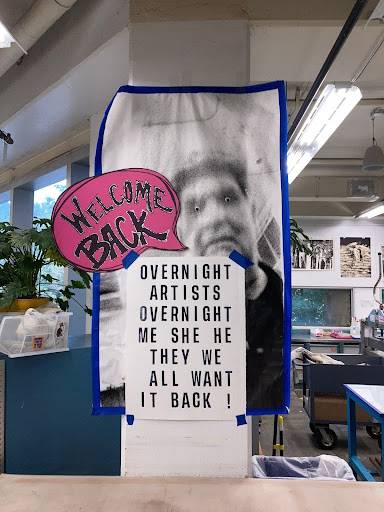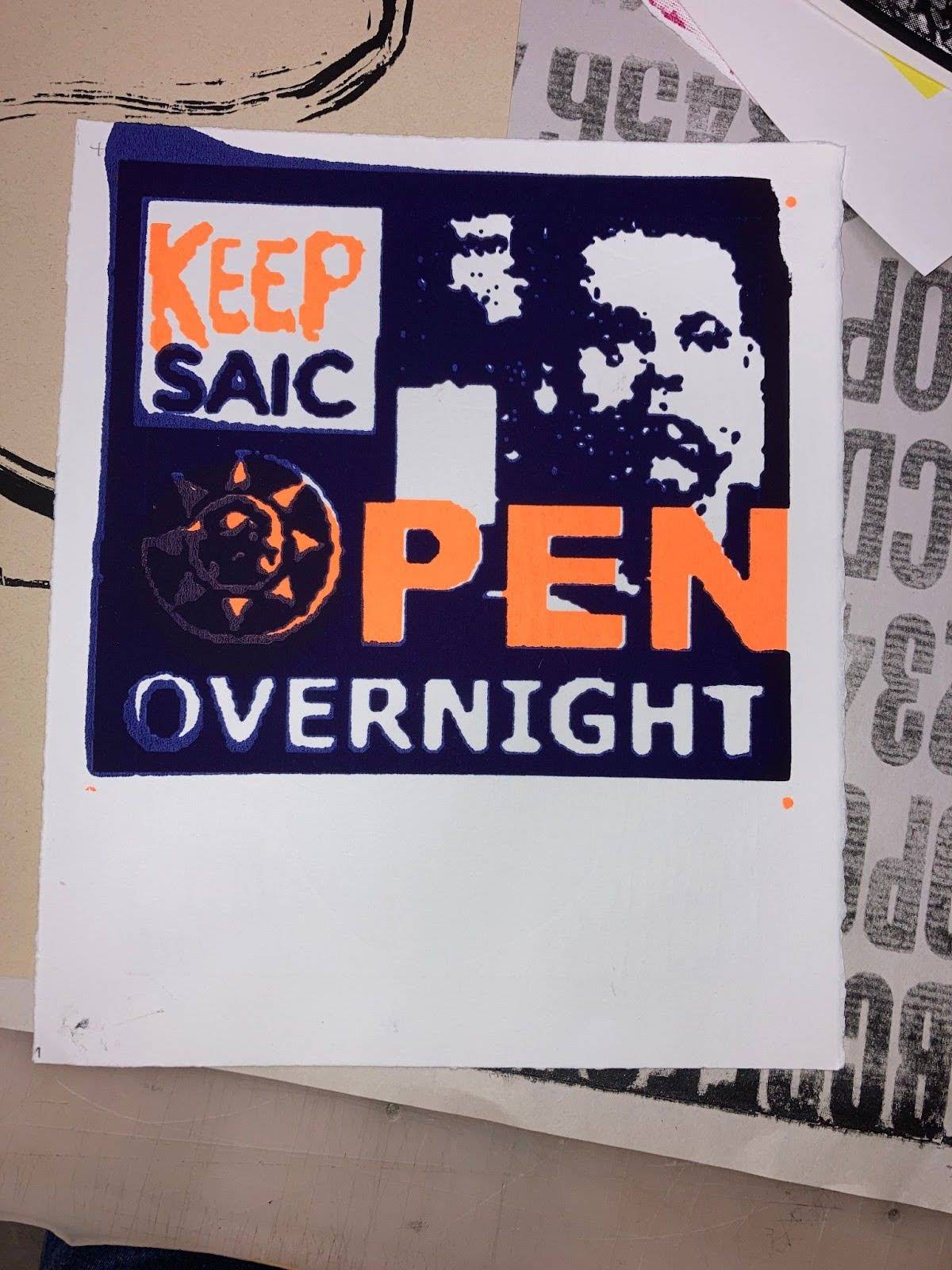



For generations of School of the Art Institute of Chicago students, pulling all-nighters in studio spaces has been a rite of passage. As of Aug. 21, that tradition is officially over. Students and faculty were informed via email that, due to federal budget cuts, the school had made the “difficult decision” to discontinue overnight access to its buildings.
The buildings will remain open from 7:30 a.m. to 10:30 p.m. every day. In the three weeks leading into critique week, buildings will remain open until midnight, except on weekends. There will be no change in access to residence halls. The email explaining the new schedule was signed by Delinda Collier, Dean of Graduate Studies; Dawn Gavin, Dean of Undergraduate Studies; and Camille Martin-Thomsen, Dean of Faculty and Vice President of Academic Affairs.
Bree Witt, the Vice President of Marketing and Communications, said the change came as a budgeting decision.
“Additional pressures caused by the federal government’s actions — which could not have been forecasted — are likely to create a significant shortfall for the School, and it is prudent to take proactive steps now to reduce spending in order to lessen the chances that we will need to take more drastic steps later in the fall or spring,” said Witt in an email to F Newsmagazine.
President Jiseon Lee Isbara and Provost Martin Berger consulted with the offices of Advancement, Academic Affairs, Campus Enrichment, Campus Operations, Educational Technology, Enrollment Management, Finance, and Student Affairs on potential changes the school could make to mitigate impact from federal actions.
Financial pressures on SAIC from federal actions include:
- Increased expenses related to inflation — costs of goods like building materials, equipment and maintenance, contractor costs — as well as personnel costs, such as increasing healthcare costs.
- A decreased international student population due to the US government’s position on immigration. This means tuition is down, which accounts for 79% of SAIC’s revenue.
- The government has new policies limiting student financial aid and institutional eligibility requirements for federal aid. The projected impacts make getting and paying back student loans harder for students.
- An expanded endowment tax (up to 8%) means the endowment is now effectively smaller. The endowment is where much of the money for student scholarships comes from, meaning this pressure has a high chance of directly affecting students.
There are other changes which emphasize not affecting the SAIC student experience. Funds for building and renovation projects will be reduced. Requests to replace vacant faculty and staff positions will include increased vetting. Spending for the fiscal year of 2026 will be pulled back to match the spending from 2025, regardless of increased costs. Non-essential expenses, including employee travel and internal catering, are frozen for the time being.
The annual Special Compensation Program, started in 2024 to increase pay for high-turnover employees, is on pause. (Annual raises and merit raises will continue for all eligible faculty and staff.)
Witt said overnight building access was a benefit used by a small percentage of students — 2.5% according to an email sent to faculty by administration on July 30. Fall 2024 enrollment was 3,395 students, meaning 2.5% of the student body is about 85 students.
The decision was made to prevent further cuts to student resources such as shops, labs, media centers, and fabrication studios, “which are used by the vast majority of the campus population,” said Witt. While the savings from suspending overnight access is not enough to cover SAIC’s financial challenges, it helps the administration to prioritize more student, faculty, and staff needs.
A 15-credit, full-time undergraduate student schedule usually consists of a variation of three studios and two academic classes. At SAIC, a studio class is six hours long. An academic class is 2 hours and 45 minutes. There are 168 hours in a week — in an SAIC student’s typical week, one spends 23.5 hours in class. With the new building schedule, when a student is not in class, they only have 81.5 hours to spend in the studio, 56 fewer hours per week than students used to have. This does not include the time students spend on jobs, their social lives, and necessities like grocery shopping and sleeping.
Demi Sedrakyan (BFA 2026) is a ceramist. She said the reason she’s at SAIC is because of the resources and facilities. In the ceramics department, resources and space were already limited.
Studio classes at SAIC take place in the same space that students use for their work outside of class. If there’s a class in a studio space, students can’t use it. Studio classes can be in session from 9 a.m. to 3 p.m, or from 3:30 p.m to 9 p.m. Students who want to work in the studios have to work around classes that are happening in the same workspaces.
“The removal of overnight means there are, approximately, three hours in a day [to work in the studio],” said Sedrakyan. “That also means I can’t paint overnight in [the 280 Building], and the painting department has the same problem as ceramics, which is, there is not enough studio spaces for everybody there.”
Morgan Robinson-Gay (MFA 2026) is a performance artist. Much of their performance work is time-based.
“Our performance spaces also had 24-hour access, allowing students to test the limits of the human body and spirit in long form work in the school that relied on overnight access. This is gone now, and students like myself have to rethink how to approach durational/endurance work,” said Robinson-Gay.
While some students are rethinking work, other artists are having trouble finding time to make work at all.
“I work on the TC2 digital Jacquard looms, and you can only weave that in studio. It’s a very finite resource. They aren’t really abundant around the world, frankly,” said Jiselle Ramirez (BFA 2026), an interdisciplinary artist who works with ceramics and fibers.
SAIC has three looms for 30 students, who have other classes and jobs. Because of the nature of the machines, students need to do all of their weaving in one sitting.
Ramirez said that in the past, they often booked an appointment with the machine for midnight and wove until 6 a.m. With the new overnight policy, that timetable is no longer possible. Ramirez and Sedrakyan, who are in their last years at SAIC, fear they won’t reach the volume or quality of work they want for their turn in SAIC’s BFA show.
Ramirez also often works in ceramics. However, because of the new policy and the amount of monitoring clay takes, Ramirez said she may drop ceramics entirely from her schedule.
Sedrakyan, in previous years, found herself in the studios past 10:30 p.m. at least three times a week. Ramirez was in the studios overnight at least once a week, increasing to almost every other day during midterms and finals.
But, as Robinson-Gay said, “deadlines occur all semester, and are often tied to opportunities outside of the school as well.”
Robinson-Gay loved coming into the studios in the early hours, before 7:30 a.m. “I’ve had to paint my whole body and do makeup for a 9 a.m. class. I was in my studio at 6,” they said.
Fumiko Komori (BFA 2028), an animation and comics student, has many friends who live off-campus. Her friends say if they’d known they don’t have complete access to SAIC studios, they would have reconsidered living off campus.
As an animation student, Komori has spent many nights in the animation studio working with bulky and expensive tools like light boxes, voice-over recording devices, and rendering equipment. Many animation students work through the night. Komori said they see each other a lot. Because of the reduced amount of time, Komori isn’t sure she can make work at the level she wants.

“A lot of us are very proud of the people that we’ve gone to school with, and we will continue to be, but, if we’re not getting the chance to actually exercise our materials, and in that sense, the study, the level of work and prestige the SAIC is so proud of, we won’t be able to live up to it anymore,” said Ramirez.
Robinson-Gay said she feels like SAIC’s broke a promise.
“Overnight access was something SAIC promised us. It showed an understanding of how the creative process doesn’t sleep, is not to be limited, and that the working student artist may need the open availability, as we are living in expensive times while attending an expensive school,” said Robinson-Gay. The graduate cost per credit hour for the 25-26 academic year is $1988.
Students were not the only people who had something to say. Geralyn Madigan is a parent to a senior student at SAIC. Madigan sent an email to President Jiseon Lee Isbara on Sept. 15. In the email, she said: “Nothing was ever communicated to parents — those paying the tuition in most cases — that hours would be cut. This lack of communication alone is unacceptable.” Madigan asked that extended studio hours be restored immediately.
A petition circulated group chats and Instagram stories in late August, demanding the change in overnight access be reversed. It has 1,382 signatures, as of Sept. 27, asking for the return of overnight access.
Witt said that, because the school hadn’t yet placed security officers in staff positions for the fall, when more security is needed than in the summer, security officers wouldn’t be impacted by the change. “The decision to suspend overnight hours had been made before we needed to increase security coverage for the fall,” she said.
Members of the SAIC security team declined to comment on the overnight access policy change.