

The text of this article was read aloud and recorded for your greater accessibility and viewing pleasure:
Audio voiced, recorded, and edited by Gren Bee.
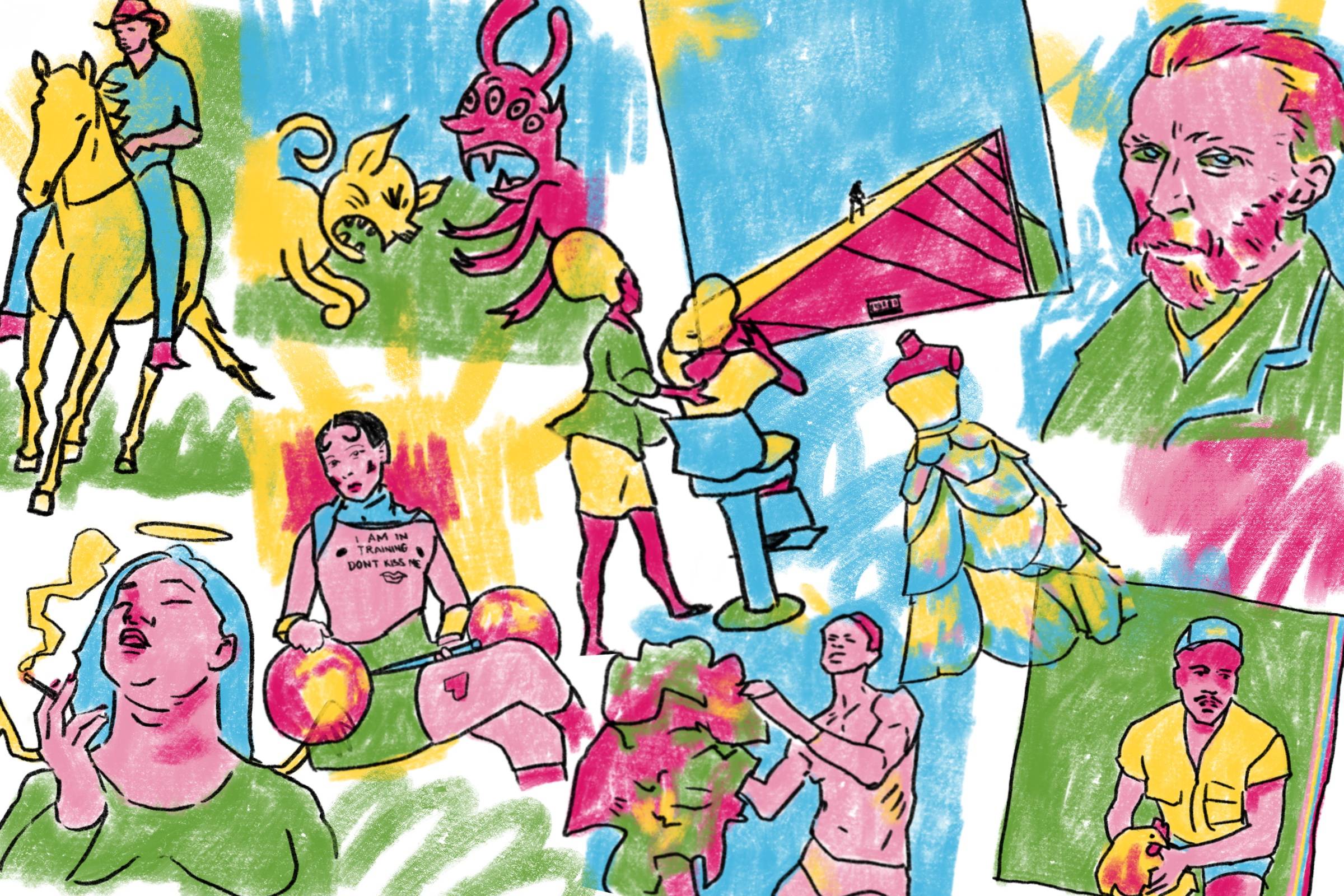
What makes a piece of art important? Who decides what artwork must be remembered? The shape of the art history canon is a long, scholarly debate. As art students, there are works of art, in lots of mediums, that we fall in love with and believe the world at large should know about. We all have different measures of what makes art great, but we all also know a great piece of art when we witness it.
“Castration Movie” by Louise Weard
“Castration Movie” (2024) is an ongoing multipart feature epic directed by Louise Weard that changed what I thought a movie could be. The first part of this series is broken into two chapters: “i. Incel Superman” and “Chapter ii. Traps Swan Princess.” Both chapters come in at about four and a half hours with an intermission included. The film follows two protagonists with horrible politics — a film-bro incel and a transgender sex worker. Both navigate the complications and toxicities of their daily lives on and offline in Vancouver, Canada. The film is a kind of genre-bent “neo-neo-noir,” which is completely lacking in pastiche, opting instead to deliver something wholly original. It is a work that is equal parts weary and self-awarely nostalgic for the strange, deeply sadistic, and twistedly humorous, post-pandemic, fascistic, and hate-filled hellscape that trans people navigate in North America. The film is shot entirely on Weard’s family digital video camera, and features more (often unsimulated) sex scenes than I’ve ever seen in a movie. Definitely worth a watch now, so you can save the hundred grand getting your film masters in the shadow of this movie.
– Gren Bee (MFA FVNMA 2026), multimedia editor
“Self-Portrait” (1887) by Vincent van Gogh
I know it’s a little cliché, but I am so struck by how we almost didn’t get to experience Van Gogh’s work. If it weren’t for the love of his brother and sister-in-law, who put together letters and pieces after his death, and began publicizing his work, we wouldn’t have the access to it that we do now. While Theo van Gogh always supported his brother in his artistic endeavor, once Vincent died – he was only active for about five years – Theo became determined to share his brother’s work with the world.
We, as students, are fortunate to have his 1887 self-portrait available for viewing at the Art Institute of Chicago, alongside other pieces of his. I have spent hours in front of this self-portrait. His passion can be felt in every brushstroke, but it’s the desperation with which he painted that I’m most attracted to. He painted over 20 self-portraits in a two year span; which seems like a frenzied attempt to understand himself in the midst of his artistry and mental illness.
– d.l.adams (MFAW 2026), literature editor
“Junon” by Dior
Designers and admirers alike remake, recreate, and redesign this dress. Not one has come close to the complexity, fragility, or sheer shininess of the 1949 original. The dress is made exclusively of tulle, with sequined motifs that reference peacock feathers. This is likely a reference to the Greek goddess Hera, or Roman mythology’s Juno, the queen of the gods and namesake of the dress. The dress was embroidered by the House of Rebe, founded by René Begue, who is considered one of the greatest embroiderers of his time. The dress is exemplary of the fashion ideals Dior stood for and the haute couture standards of the time. It’s a gateway to discuss how couture has changed in the 75 years since. Junon is considered Dior’s and Christian Dior’s ultimate masterpiece.
– Alex Lee (BFA Fashion 2027), web editor
“I Am In Training Don’t Kiss Me” by Claude Cahun
David Bowie once called Claude Cahun a “cross-dressing Man Ray with surrealist tendencies.” Frankly, I find Cahun infinitely more moving than her contemporary Man Ray. Cahun is a Jewish French artist who, along with her often sidelined but equally artistically formidable life partner Marcel Moore, created heartwrenching, funny, deep, and photographs of self-reflection that transcend time. Together, their work was often culturally and politically charged, especially given the rampant rise of fascism in mid-20th-century Europe. Cahun’s self-portraits play with gender, androgyny, and sexuality. In the self-portrait series she made with Moore, “I Am In Training Don’t Kiss Me” (1927), Cahun has on cabaret makeup with hearts on her face, her hair is slicked back in an Oscar Wilde-esque style; her tight white shirt has the titular text written across her chest. This photo series drips with androgyny, and Cahun’s expressions sit somewhere between invitation and damnation. There is great power in the works of art that stand as testaments to queer joy and identities in the face of historical oppression.
– Sidne K. Gard (MFA comics 2027), managing editor
“Freudian” by Daniel Caesar
“Freudian” is the album that got me into Daniel Caesar’s music and changed my life. I discovered it five or six years ago, and every time I have listened to it, I’ve experienced it differently. The album is full of longing and nostalgia, mixed with heartbreak and healing. Caesar’s voice and music have inspired me deeply to create both visual art and music. Caesar’s lyricism and soul, the album’s overall emotion, and the messages in each song are truly inspiring, and roped me into his artistry, which allowed me to experience his other songs and albums. I even have a lyric from another one of his albums, “Never Enough,” from the song “Do You Really Like Me?” tattooed on my forearm: “We’re still young but for how many moons?”
– Zuzu Hill (BFA studio arts 2028), designer
“One! Hundred! Demons!” by Lynda Barry
“One! Hundred! Demons!” is one of the most wonderfully weird, beautifully made comics you could ever read. It’s incredibly touching, and it operates in a way that makes the memoir accessible and interesting. It’s equal parts endearing and strange, in a delightfully method-to-the-madness sort of way. I found it touching and very hard to put down while I was reading through it. “One! Hundred! Demons!” has anything you could really ever ask for in a book: charmingly collaged pages, childhood trauma, and as many cicadas as you could possibly imagine. It’s just a really really lovely book.
– Kit Montgomery (MFA comics 2027), associate editor
“Song of Myself, 32” by Walt Whitman
It’s such a beautifully worded, simple, melancholic, and intimate reflection on life. “Song of Myself, 32” holds a special place in my heart out of all other poems by Whitman. When I first read this piece, it seemed to slow down time, revealing the hidden beauties within a life of contentment, unbound by vanity and materialism. The longing for simplicity is so beautifully, melancholically, and solemnly expressed through the fleeting interaction between Whitman and a single stallion. Each time I revisit this poem, my mind can’t help but think about Whitman’s later time spent volunteering as a nurse during the Civil War, and his verdict in the last stanza is left lingering in my ears.
– Emily Zhang (BFA VisCom and PTDW 2026), designer
“Lithonia” by Childish Gambino
My best friend told me to listen to this song, and I made fun of her for listening to Childish Gambino. Then I listened to it and I was like … Oh, ur right, it’s kind of awesome. I listen to it all the time now — everyone who knows me well enough knows how obsessed I am with this song. I play it in the car, I play it while drawing, and I play it on the CTA. It reminds me of my best friend. I adore the lyrics, and the orchestral rhythm that picks up throughout the song. It’s the perfect song for angst and everything in-between. I think it’s best enjoyed being played as loud as possible with a buddy to sing it alongside you. It will probably be one of my top songs of the year. Thank you, Maddie!
– Nat Toner (BFA comics 2026), comics editor
“Becoming an Image” by Heather Cassils
“Becoming an Image” is a live performance where Cassils, a trans artist and ex-boxer, attacks a 2,000-pound block of clay in total darkness until they run out of air. A photographer shoots throughout with flash so the surrounding audience sees single images, burned in their retinas, and hears the sound of Cassils’ body operating and their contact with the clay. Cassils’ work speaks to trans resistance and the violence shaping queer lives. Live art needs to be experienced by all, and trans struggles and empowerment need to be seen. I think live performance is one of the most impactful forms of art — the sounds and images imply motion and effort. Their body is both the material and the subject. There is intimacy between the body and the body of clay, and there is a vulnerability to performing with the body, and a connection of energy between performer and audience through just the sharing of space.
– Sivan Gilbert (BFA Performance 2027), news editor
“School of Beauty, School of Culture” by Kerry James Marshall
This is an amazing painting that tells us a lot about Western art history, as well as about its painter, who grew up around the liveliness of the Black beauty parlor. The colors light up the canvas, and it’s riddled with little puzzles. It’s an amazing work of contemporary painting that shows the importance of the beauty school in the Black community; it’s a piece of artwork that is accessible, smart, joyful, and beautiful. And if you’re wondering what that pink-and-yellow shape is toward the bottom middle: it’s a reference to Hans Holbein the Younger’s painting, “The Ambassador” (Google it!), replacing the skull with a warped image of a blonde-haired, white-skinned princess.
– Sophie Goalson, editorial adviser