

Forty-five minutes before the curtain call, I entered the Lyric Opera to soak in the atmosphere of opening night and was greeted by a musical trio: two classical guitar players and a percussionist sitting on a cajón. As patrons entered the hall, ordering champagne and finding their seats, they inevitably circled these enchanting musicians. Long red skirts swayed, scarves wrapped around shoulders, a couple started spinning each other around. It was then that I wished I had worn my first-choice outfit: a long black dress with roses and a fringed scarf that I deemed “a little too Carmen.” It turned out to be the unofficial dress code.
The Joffrey Ballet’s “Carmen” marks the start of the 2025-2026 season, a fitting choice as this ballet’s renditions are notoriously fresh and unconventional. This is also the posthumous US premiere of Liam Scarlett’s choreography of “Carmen,” otherwise executed in 2015 with the Norwegian National Ballet. Adapted from Georges Bizet’s 1875 opera in 1949 by Roland Petit, seduction, betrayal, heartbreak, and the fate of our heroine’s independence, remain the heart of the story, regardless of the setting.
The show opens with a sheer black lace curtain, pulled only slightly above Carmen (Victoria Jaiani). She is entrancing, commanding, and a free spirit. Alone, smoking a cigarette, she reads her fortune. Will she succumb to a pre-determined fate, or is she taking control by choosing which cards to keep?
On an Andalusian street corner, Romani women and men dance in a wonderful question/answer format. Liam Scarlett seamlessly blends flamenco and classical ballet, and the timeless costumes (Jon Bausor) are each unique—colorful skirts with patchwork-style corsets and headscarves for the men. Working in the cigarette factory, Carmen has the strongest urge to twirl her ruffled skirt around each time the guard looks away. Don José (Alberto Velazquez) keeps watch of the women the longest. Carmen seduces him and throws him a red rose.
Don José and Micaëla (Gayeon Jung), his former lover reunite, exuding sweetness: Micaëla’s delicate arabesques and Velazquez’ effortless lifts demonstrate their cheerful romance, but Don José still holds Carmen’s rose in his jacket. I was reminded of Fragonard’s infamous painting, “The Swing.” Velazquez’s solo, aimed at the rose, demonstrates the transformation of his lust, to his love for Carmen. Don José’s attachment to her does not bode well for him; a not-so-secretive kiss leads to his arrest, and he suffers heartbreak in his jail cell.
The Habanera sequence is the heartbeat of the entire ballet — earworm that it is — with Victoria Jaiani executing it pristinely. She commands the stage like no other. The audience members were as entranced as the guards. She relishes seducing everyone but has a slight preference for Don José.
Carmen waves her shoulder scarf as if it were a muleta — shielding her sword of power, ready to confidently take on her next man. Escamillo (Dylan Gutierrez)’s solo mirrors her allure, fluid and quick geometry with playful seduction that is almost too on the nose. She becomes the target of his sexual enticement, the bull to tame. All the women are drawn to him as the guards are to Carmen, but he blows only her a kiss.
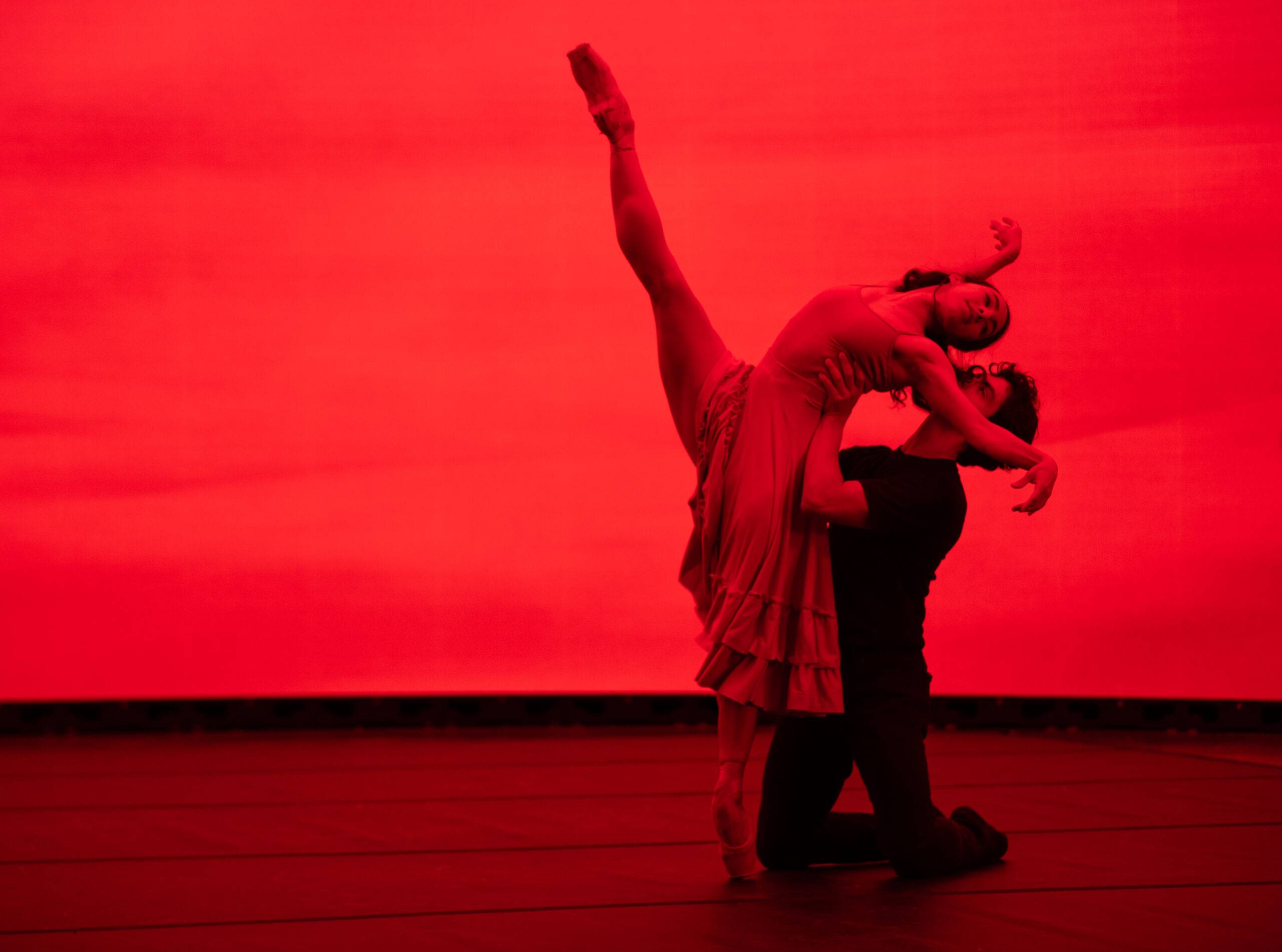
The three following pas-de-deux put forth the differences in the couples’ dynamics: Don José and Carmen’s frequent lifts demonstrate her submission in letting herself be loved. Escamillo and Carmen seduce each-other, taking turns dominating, in a pool of red light. Micaëla confesses her continuing adoration for Don José with an effective ‘attempt’ at a pas de deux: he is distracted and letting go of her, performing ‘half-lifts’, devoid of love.
Our fifth and final scene takes place in a bullring where Escamillo and his men celebrate his victory, near a freshly massacred bull. His men honor him with pastel muletas, synchronized exact movements, and humorous forward sexual energy. Women move hauntingly towards them in long black gowns and funerary veils. Carmen enters, a white version of the others — her veil a matrimonial one. She and Escamillo move sharply together, but her spirit, the bull inside of her, has been tamed, or perhaps, killed. We catch a glimpse of our recognizable heroine, pulled like a magnet away from Escamillo for a split second, to dance and enchant with her friends.
Alone in the bullring, Don José confesses his everlasting attachment to Carmen, and their pas-de-deux reverses his and Micaëla’s. Velazquez is forceful and quick, letting rage be at the forefront. Carmen’s desire is now for his love, not sexual force. Jaiani is reluctantly lifted and dragged, having been weakened like a bull near the end of its fight. She uses her remaining energy to attempt to escape but his force dominates her. The only way he can truly have her again is if she is at his mercy. Don José embraces Carmen after murdering her, and I thought of a passage that I read recently: “If humanity is imperfection, the only perfect woman is a dead one” (Jamison, Leslie, “The Pain of Perfectionism”, The New Yorker, Aug. 2025).
Carmen, who only wished to be free, loses everything in the end: her seductive power, her joy, her community, her agency, and her life.
Liam Scarlett’s choreography is effervescent, geometric, lively, and seductive. Worry not about dressing too ‘Carmen’, because regardless, you will be outdone by Jaiani. “Carmen” will run until September 28, and Friday’s shows are $30 for those under 30 (Code: 30UNDER30).