
We have now entered the holiday gauntlet. You will be required to see your family and friends several times a month, wear uncomfortable dress shoes, and perhaps even spend an hour or two wrapping presents. The many nights of Hanukkah, Kwanzaa, Festivus, Christmas, New Year’s Eve, and countless holiday parties will fill your December through January calendar pages.
Although holidays are about ritual, habit, celebration, and family, they also require a lot of spending. Holidays drive and pace the U.S. retail economy, infusing it with greeting cards, chocolate, alcohol, tinsel, flowers, turkeys, phone calls, airline tickets, hotel reservations, electric lights, pharmaceuticals, and presents of all stripes.
In September 2004, Monacelli Press will release The Business of Holidays, an anthology of connected essays and images written and designed by the Delicious Design group and edited by SAIC professor Maud Lavin. Many contributors to this highly graphic and quirky book are faculty, graduate students, or alumni of The School of the Art Institute. Created by a brainstorm in Lavin’s Design and Writing course, The Business of Holidays will explore how subcultures are mainstreamed, the relationships between value systems and commercial profit, and how holidays are marketed through visual culture. The following are excerpts from the forthcoming publication.
“Merry Hanukkah”
In a 2001 interview with the Los Angeles Times, Kristi Ernsting, a spokeswoman for Hallmark Cards, claims: “Jewish customers have been telling Hallmark that they want choices in gift wrap and cards and other products beyond the traditional blue and white and silver. This year especially we have tried to focus on some of the trendier colors—chartreuse green, yellow, and orange—especially in gift-wrap for children. One is Mickey Mouse—purple, blue, yellow, and orange.” Pure genius. Mickey Mouse, the ultimate in mainstream versatility, is available for birthdays, showers, and for any other occasion celebrated by the young at heart. Not surprisingly, Disney weighs in with dreidels, Looney Tunes, and Winnie-the-Pooh Menorahs (excluding Piglet, of course, due to the Torah’s prohibition against pork), and a musical snow globe announcing “Happy Hanukkah” to Curious George. Santa, only willing to work once a year, may have some competition.
 “Xmas
Excess”
“Xmas
Excess”
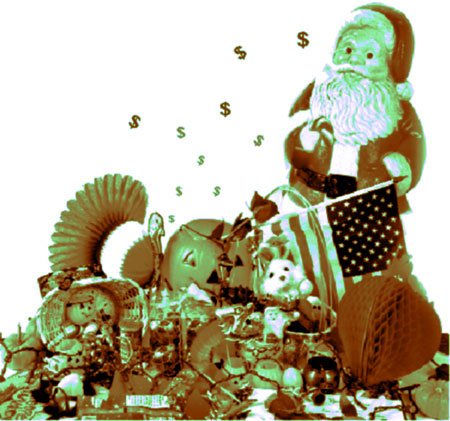
In 2001, the Christmas Decorating industry boasted some $6.4 billion dollars in sales, not a surprising figure considering that ornaments need to be purchased for the trees located in 82 million households. But these figures are just a tip of the Christmas iceberg—sales for the entire season have averaged around $200 billion for the last three years. The celebration of Christmas in America is widespread—an interesting thing considering that it is a religious holiday that celebrates the birth of Jesus Christ. Not all Americans are Christians, of course, and even though 76.5% of the U.S. population is Christian, only 55% of this figure is actually considered practicing. Why does the nation depart from the commonly upheld notion of “separation of church and state” exclusively for this holiday? Is it the festivities? The raucous office parties? The merriment? The presents? More and more, Christmas’s religious significance is being pushed into the background, as its gift-giving, mulled-wine drinking, Christmas tree-decorating characteristics move steadily forward.
“Kwanzaa, Inc.”
Kwanzaa gave African-Americans an alternative to the “European cultural accretions of Santa Claus, reindeer, mistletoe, frantic shopping, and alienated gift giving.” It came out of a critique of Christmas and the capitalism that unfortunately often drives it. However, its popularity amongst black middle-class observers brought about immense entrepreneurial appeal. Selling merchandise and sponsoring expos to commemorate Kwanzaa now reigns as a display of status, racial identity, and profit. Thus, there is much concern about the whirlwind of commercialism that now surrounds this celebration. And here we have a holiday that is characterized by much more than black cultural nationalism. Now, we see a very different Kwanzaa, a holiday that reflects the changing economic, social, and political dynamics of not only a people, but an entire nation that seeks to honor—as well as make a profit from—ethnic diversity. When we see Kwanzaa, we see the authentic vs. the commercial, and sometimes a blurring of the two. Hand-made items and their supporters contend with the mass-distributed merchandise that filters this holiday into mainstream markets.
Image courtesy of Delicious Design Group