
The Opposite of "SPECTACULAR"

Spectacular Vernacular is a confusing exhibition. Not that the theme is confusing necessarily — that part is pretty straightforward. Vernacular allows cultural groups (be they whole regions or alliances of a few individuals), to glean something from a larger, impersonal framework and make it theirs. Vernacular speech allows one to claim words and meanings as one’s own, marking the loaded territory of signification as distinct without altogether sacrificing the accessibility and power of formal language. As a meaning-making tactic in the visual arts, vernacular appropriation of formal visual language is, quite possibly, the broadest theme imaginable, for which nearly any artist I can think of can be argued to be exemplary. Perhaps this broadness of theme is part of the trouble with this exhibition. The work, though some of it is interesting, does not seem to benefit from its contextualization in the larger exhibit at all. The four artists represented here are ostensibly linked by their use of “commonplace” objects, techniques or environments in some distinctive, context-shifting way.
The “sitting duck” of the exhibition, Brian McCutcheon’s “Trailer Queen,” is actually quite beautiful. It is a slick, flashy barbeque grill souped-up with auto-detail flames in a way that recalls a particular sort of American symbology, allying the practices and aesthetics of automobile culture with the notion of marking one’s backyard as personal territory. The reference to a sort of rural vernacular art-making is a touch too easy in this piece, and its presence in a high-art context, as well as its unfortunate title, gives it something of a mean-spirited, jokey quality. The piece seems to put vernacular on display rather than engage with it in any meaningful way. The exhausted Duchampian context-shifting employed here does not come across as anything more powerful than an excuse to indulge in spirited but ungenerous appropriation. Another piece of McCutcheon’s, “Exhaust,” is one of the more successful works in the exhibition — a cardboard and toilet paper model of an automobile frame spewing exhaust, it is both a compelling recasting of materials and a suggestive meditation on the aesthetics of automobile design itself.
Conceptual artist Matthew Weddington’s self-promoting signs mark his personal territory in a way that reflects the unauthorized appropriation and personalization of speech in vernacular language. His work in this show consists of photographs of signs that he has erected in public places that mark them as his own. In what looks like a diner parking lot is a sign that reads “Reserved Parking for Matthew Weddington, Conceptual Artist.” This example is typical of his works in the exhibition. Though I’d imagine that these works could be effective in their actual context, their photographed versions in the gallery retain very little power or whimsy. They read as a stilted, unfunny conceit in the context of the show, and like McCutcheon’s work, employ a rather tired conceptual trope about fame and authorship without bringing anything fresh to the discourse.
Matt Owens’ digital prints are, I feel, the high point of the exhibition– but are overshadowed by the show’s brassier works. These pieces are placed under the umbrella of vernacular work in response to their use of an urban design aesthetic, and their resemblance to promotional materials. Owens’ work does not, however, simply paste these elements into the art context. Rather, the work deals with them in a nuanced, sensitive way that neither suffers from the high art context nor justifies their existence there with banal art historical conventions. Lyn Cazabon’s “Story of M” is successful in a similar way to Owens’ work — her series of 140 photographs that depict the possessions of one person find a way to tell a story with “non-art” materials by actually imbuing those materials with meaning, rather than relying on the friction of contrasting contexts. Cazabon’s piece does not hold up well in the context of this exhibition– it requires a slow, close reading, which the atmosphere of the show is inhospitable to. Owens’ and Casabon’s work refuses to justify its presence with high art posturing, relegating it to the background. They give the exhibition, as an entirety, an unsettling imbalance that confuses the dynamics of all of the works, and does justice to neither the show’s purported themes , nor the artists it features.
The QUILTS of Gee’s Bend
“I melt my heart when I sing a song.”
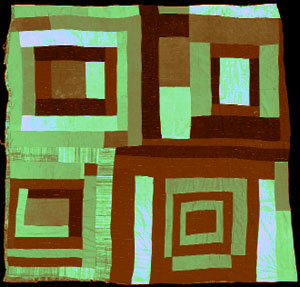
These are the words of one member of Gee’s Bend in Alabama. Gee’s Bend is a small community bound on three sides by the Alabama river and virtually cut off from outside influences for generations. In this small niche of America, women have been handing down the tradition of quilting for more than a century, using whatever materials they had. The words above echo the moment when human spirit and art collide, and the sixty Gee’s Bend quilts currently on display at the Milwaukee Museum of Art provide something of strange interest to viewers, creating a buzz in the art world. The quilts hang vertically on the walls as any piece would, but the result of this curatorial decision is somewhat unexpected.
 Since
the exhibit was first organized by the Museum of Fine Arts
in Houston and traveled to the Whitney Museum of American
Art in New York, dialogue about the quilts center on a dividing
line between art and craft, a conversation that’s been
going on without a break since the era of Aristotle. Curiously,
various articles concerning the exhibition, from those in
Art in America to American Craft, make a comparison between
the patterns and visual strategies of the quilts to various
modern painters. While this may be fun, it is not helpful.
What purpose does the comparison serve?
Since
the exhibit was first organized by the Museum of Fine Arts
in Houston and traveled to the Whitney Museum of American
Art in New York, dialogue about the quilts center on a dividing
line between art and craft, a conversation that’s been
going on without a break since the era of Aristotle. Curiously,
various articles concerning the exhibition, from those in
Art in America to American Craft, make a comparison between
the patterns and visual strategies of the quilts to various
modern painters. While this may be fun, it is not helpful.
What purpose does the comparison serve?
Perhaps a discussion of this nature is inevitable when any object is placed in an art museum. But is it necessary to validate the hanging of these quilts on the walls of a museum by citing similarities to, of all things, modern painting? A viewer receives much more from the quilts by not thinking of art at all.
The fact is that the quilts are stunning. The vibrant colors demand attention not analysis. One quilt is made of work clothes, a testament to the memory of a lost loved one, a way for the artisan to work through the pain of grief. Rather than compare their stripes and variegated collage designs to modern painting, a more helpful comparison is to regard the quilts along with the interviews of the inhabitants of Gee’s Bend. As the museum soundtrack projects the humble singing of Gee’s Bend family hymns into the huge white-walled space, the quilts face the spectators, as unflinching and as undaunted as the women of Gee’s Bend face the strange people behind the camera making the introductory video to the exhibit.
The works belong to these women, and their’s is a fascinating story. For over one hundred years, the community of Gee’s Bend has been wrapped on three sides by a river, isolating this hamlet from the rest of society. The isolation, however, is not as interesting as the community itself and the tradition of quilting, through which its inhabitants found both expression and a way to keep warm. There is truth to the idea that these quilts are estranged from the rich but simple lives for which they were made when placed in a museum. The functionality of the quilts cannot be denied, and the use of these quilts as bed covers, though partially defeated by their vertical hanging on the museum walls, is confirmed by the women of the Gee’s Bend. One such statement reads, “I just do my work, not fancy. Had to do it because I had a family, had to keep them warm.”
The story is infused into the exhibition and the result is compelling. The fundamental existence of the quilts as creative products of living, breathing human beings is retained, though the attempt to associate the world of Gee’s Bend to the art world “proper” is dangerous. Such effort tempts viewers to add meaning which might conceal the genuine humanity of the quilts. The danger is that once the quilts enter the realm of art, there may not be any more room for their spiritual connection to the human beings that made them.
The dignity radiated by these quilts in the gallery is not tangible without the context of love that these women expressed to themselves and their families when they made them. This documentary value raises them above typical works of art.
Back to Reviews